Home Repair Grants for Single Mothers: What Pays in 2026
Home repair grants for single mothers: the USDA grant needs age 62, but free weatherization, LIHEAP furnace help and city repair programs do not.

 Click to zoom
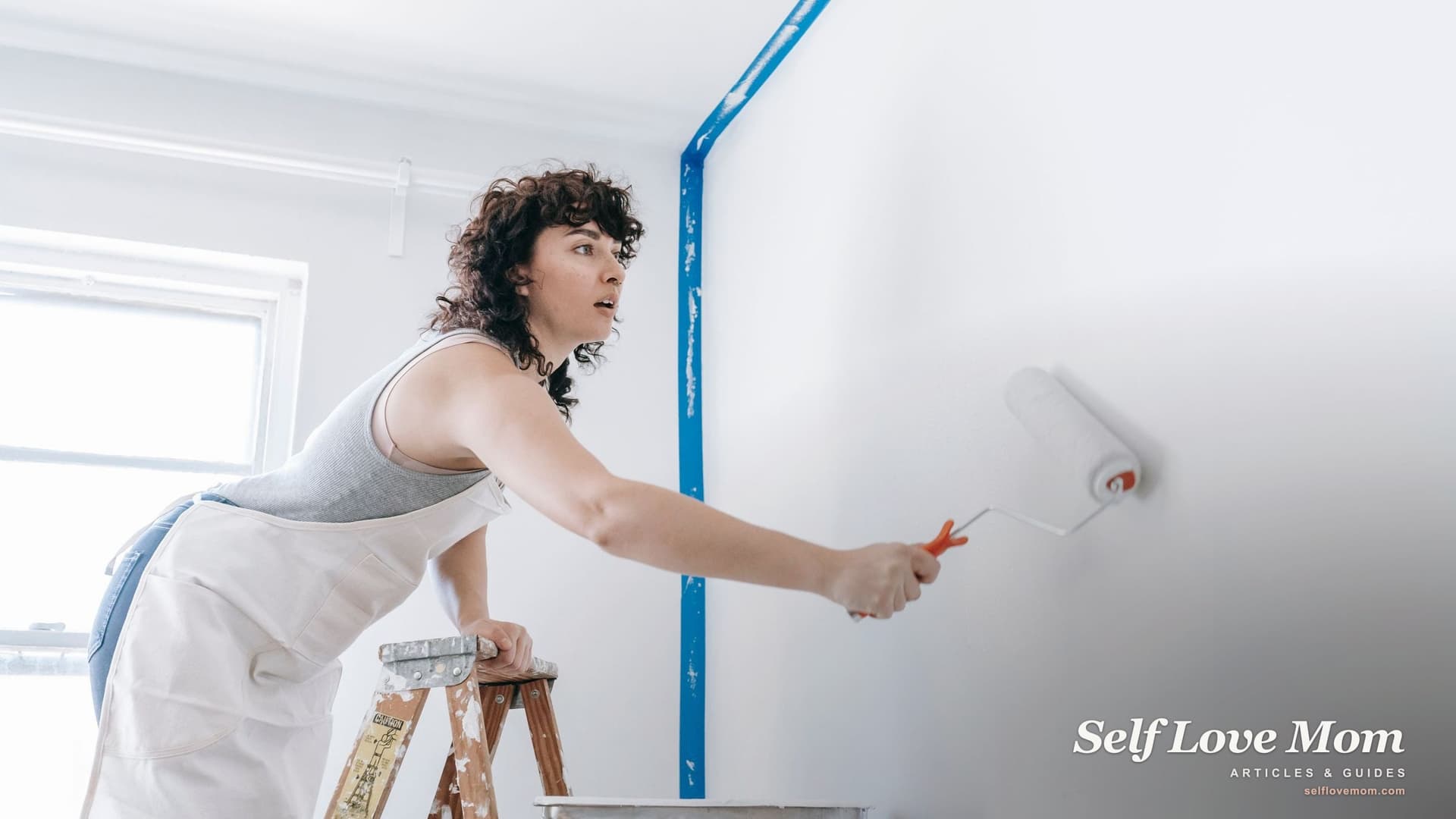
A woman on a stepladder rolls fresh white paint onto a wall at home, the kind of small fix a repair program or a weekend can cover.
Home repair grants for single mothers do exist, but almost none of them are written for single moms, and the best known one has an age rule that shuts most mothers out. The help that really fixes homes is weatherization, LIHEAP furnace repair, city and county repair programs, and nonprofit repair crews.
This guide explains who each program serves, whether it is a grant or a loan, the most it pays in 2026 and where to apply. How this guide was checked. Every amount, age rule and income limit below was read on the agency or nonprofit page linked beside it on October 14, 2026.
| The figure | What it is | Source |
|---|---|---|
| 62 | the minimum age for a USDA Section 504 repair grant | USDA |
| 200% | of poverty, the usual income limit for free weatherization | DOE |
| $8,813 | the average weatherization spending cap per home in 2026 | DOE |
The short version
- The USDA $10,000 repair grant is only for owners 62 or older
- Weatherization is free, open to owners and renters, up to 200% of poverty
- LIHEAP can repair or replace a broken furnace
- City and county programs, paid for with HUD money, are a main source of free repairs
- Anyone who asks for a fee to unlock a grant is running a scam
Which home repair grants for single mothers are real?
No federal program pays a grant to a mom just because she is single. USA.gov says it plainly: the federal government does not offer "free money" to individuals to repair or improve their homes (USA.gov).
What it does fund is programs run by states, cities and nonprofits. Those programs fix the problem for you, usually by sending a contractor, rather than handing you a check. Most single moms qualify through income, not marital status, which is why the same rules show up in the national grants for single moms guide.
That is also why the best home repair grants for single mothers are local: a city repair program, a weatherization agency or a nonprofit crew near you.
For a family of three in 2026, the federal poverty guideline in the 48 contiguous states is $27,320 a year (HHS poverty guidelines). Twice that, $54,640 a year or about $4,553 a month, is the federal income limit for free weatherization.
Why the USDA Section 504 grant is not for most single moms
The USDA Section 504 Home Repair program is the one every list leads with, and the trap is the age rule. To get a grant you must be 62 or older, own and live in the home, and have very low income for your county (USDA Rural Development).
A single mom under 62 can still get the loan. It pays up to $40,000 at a fixed 1% rate over 20 years, for owners with low or very low income who cannot get affordable credit elsewhere. The home must be in an eligible rural area.
For owners who do qualify, the grant tops out at $10,000 for life, or $15,000 for a home damaged in a presidentially declared disaster area (USDA fact sheet). Grant money must remove health and safety hazards, and it must be repaid if you sell within three years.
How does free weatherization fix a home?
The Weatherization Assistance Program is the closest thing to a national home repair grant for a working mom. It is free, and households at or below 200% of poverty or on SSI qualify under federal rules. States may use the LIHEAP limit of 60% of state median income instead (U.S. Department of Energy).
Families with children get priority, and renters can apply too. An energy auditor checks the whole home, including a blower-door test for air leaks, then recommends the most cost-effective fixes and flags health and safety problems.
For 2026, the spending cap averages $8,813 per home across each state's program (DOE Weatherization Program Notice 26-1). That is an average, not a check to you. DOE funds about 32,000 homes a year, and a national evaluation found households save $372 or more a year (DOE). Expect a waiting list.
Can LIHEAP pay to fix a broken furnace?
Yes. LIHEAP is best known for paying heating bills, but HHS says states can use it for energy crises, weatherization and minor energy-related repairs, including repairing or replacing heating equipment (HHS, LIHEAP).
Each state decides how much goes to furnace work and who gets it. If your heat is out in winter, call your local LIHEAP office and ask for crisis help by name. Some cities add their own heat programs. Philadelphia runs a Heater Hotline, 215-568-7190, for free emergency heater repairs, and sends a heater that must be replaced to its Basic Systems Repair Program (PHDC).
The LIHEAP cooling guide explains how the program works in summer, including air conditioner help.
Can your city or county pay for repairs?
Many free home repair programs are run by cities and counties that use HUD's Community Development Block Grant (CDBG) and HOME money. HUD lists housing rehabilitation, code enforcement and homeowner assistance among the uses (HUD, Community Development). The rules change a lot from one city to the next.
Four state and city programs show the range:
- Philadelphia, Basic Systems Repair Program: free repairs for electrical, plumbing, heating and roof emergencies in owner-occupied homes, with no age rule. The income limit is $110,500 a year for three, and you must be current on property taxes and water (PHDC).
- Michigan, Emergency Relief: pays to repair a furnace up to $4,000 per family for life, and other repairs such as a water heater or septic system up to $1,500 for life. Apply on MI Bridges (MDHHS).
- North Carolina, Urgent Repair Program: an interest-free loan forgiven at $5,000 a year, but only for owners who are elderly or have special needs and earn under 50% of area median income (NCHFA).
- Cleveland, Repair-A-Home: a loan, deferred or at 0% to 3%, with half the loan forgivable if you stay five years, for owners at or below 80% of area median income. New intake was paused when we checked (City of Cleveland).
Search your city or county name plus "home repair program," or call 211. Ask three questions: is it a grant or a forgivable loan, is there an age rule, and is intake open now?
Home repair programs compared
| Program | Who qualifies | Grant or loan | Most you can get | How to apply |
|---|---|---|---|---|
| USDA Section 504 | Rural owners with low income; grant only at 62+ | Loan; grant if 62+ | $40,000 loan, $10,000 grant | Local USDA office |
| Weatherization | Owners and renters up to 200% of poverty | Free service | About $8,813 average per home | State weatherization agency |
| LIHEAP crisis | Set by your state | Free service | Set by your state | Local LIHEAP office |
| City CDBG or HOME | Set by each city or county | Grant or loan, often forgivable | Varies by city | City housing office or 211 |
| Rebuilding Together | Women-headed homes (She Builds); low-income older adults (Safe at Home) | Repairs by local volunteers | Varies by affiliate | Local affiliate |
| HUD Title I | Owners who can repay | Loan | $25,000 single-family | HUD-approved lender |
| FEMA | Owners in a declared disaster | Grant | $44,800 housing help | DisasterAssistance.gov or FEMA |
Which nonprofits fix homes for little or nothing?
Rebuilding Together runs She Builds, which provides critical repairs for women-headed households, so it is a strong fit for single moms (Rebuilding Together). Repairs are done by local affiliates, so what they fix and when depends on your area. Find yours on the affiliate map.
Habitat for Humanity's national repair work now focuses on older adults through Aging in Place (Habitat for Humanity). Local affiliates set their own rules, though. Habitat of Greater Los Angeles, for example, makes low-cost repairs for low-income homeowners and was taking applications for several city programs (Habitat LA).
If the repair is done but the rooms are bare, the free furniture guide lists charities that give beds, tables and dressers.
Help for lead paint, a disabled child or disaster damage
Lead paint. If your home was built before 1978, it is more likely to have lead-based paint (EPA). HUD's Office of Lead Hazard Control and Healthy Homes funds local grant programs that find and fix these hazards, with a focus on children (HUD). Ask your city or county health department whether it runs one.
A child with a disability. States run about 257 Medicaid home and community-based services waivers, and some target children, including technology-dependent children (Medicaid.gov). Ask your child's waiver case manager whether the waiver covers ramps, door widening or bathroom changes.
Disaster damage. FEMA's Individuals and Households Program helps repair an owner-occupied primary home after a declared disaster, but it is not a substitute for insurance (FEMA). For disasters declared on or after October 1, 2025, housing help tops out at $44,800 (Federal Register).
What if no grant fits? Low-cost repair loans
A HUD Title I property improvement loan is a private loan that HUD insures, not a grant. The rate is fixed and negotiated with the lender, and any balance over $7,500 must be secured by the home (HUD, Title I). The most for a single-family home is $25,000 (24 CFR 201.10).
HUD warns that some contractors in its loan programs did shoddy work and inflated estimates, so work only with a HUD-approved lender (HUD, Home Improvements). The home loans for single moms guide covers other low-cost options.
What can a renter do when the home needs repairs?
If you rent, most repairs are your landlord's job, not yours. State law sets what a landlord must fix and how fast, and USA.gov links to each state's tenant-rights office. If HUD insures or manages your building, you can report the landlord to HUD's Multifamily Housing Complaint Line (USA.gov, Tenant rights).
- Put every repair request in writing, with the date and photos.
- Call your city's code enforcement or housing inspection office if the landlord does not act.
- Ask about weatherization, which serves renters once the landlord gives permission.
Do not stop paying rent without legal advice. The free legal aid guide shows how to find a free tenant lawyer. The housing assistance guide covers moving to safer housing.
How to spot a home repair grant scam
The FTC says the government will not call, text or email you out of the blue about a grant. It will not offer free government grants to pay for home repairs, either (FTC).
Scammers ask for an up-front fee, your bank account number or payment by gift card, wire transfer or cryptocurrency. Real government grants require an application for a specific purpose. If someone promises guaranteed home repair grants for single mothers for a fee, hang up and report it at ReportFraud.ftc.gov.
How to apply, step by step
- Write down the problem, with photos, and whether it is a health or safety risk.
- Gather proof of income for everyone in the home and proof you own it, such as a deed or tax bill.
- Call 211 and ask for every home repair program in your county.
- Apply for weatherization, and for LIHEAP crisis help if the heat is out.
- Apply to your city's repair program and a local Rebuilding Together or Habitat affiliate.
- If nothing opens in time, ask about the USDA 504 loan or the emergency assistance options.
Apply to several at once. Funding is limited, weatherization keeps a waiting list, and USDA approval times depend on the money left in your area.
Frequently asked questions
Are there home repair grants for single mothers under 62?
Yes, but not through the USDA Section 504 grant, which needs age 62. Moms under 62 can get free weatherization up to 200% of poverty, LIHEAP furnace repair, city repair grants paid for with HUD money, and nonprofit repairs such as Rebuilding Together's She Builds program for women-headed households.
How much is the USDA home repair grant?
The Section 504 grant pays up to $10,000 for life, or $15,000 in a presidentially declared disaster area, to owners 62 or older with very low income. Younger owners can borrow up to $40,000 at a fixed 1% rate over 20 years. The home must be in an eligible rural area.
Who qualifies for free weatherization?
Owners and renters with income at or below 200% of the poverty line, or who receive SSI, qualify under federal rules. For a family of three in 2026 that is $54,640 a year. Families with children get priority, and renters need their landlord's permission before work starts.
Can I get a grant to replace my roof?
Sometimes. City repair programs often cover roofs that leak badly enough to threaten health or safety. Philadelphia's free program, for example, covers roof leaks that have collapsed a ceiling. A USDA 504 loan can pay for a roof, and owners 62 or older may get a grant.
Is the $10,000 home improvement grant real?
The $10,000 figure comes from the USDA Section 504 grant, which is real but only for rural owners 62 or older with very low income. Ads promising $10,000 to anyone who pays a fee are scams. The FTC says the government does not offer grants for home repairs out of the blue.
Sources
- USDA Rural Development, Single Family Housing Repair Loans and Grants (retrieved October 14, 2026)
- USDA Rural Development, Section 504 fact sheet, May 2025 (retrieved October 14, 2026)
- USA.gov, Government home repair assistance programs (retrieved October 14, 2026)
- HHS ASPE, 2026 poverty guidelines (retrieved October 14, 2026)
- U.S. Department of Energy, How to apply for weatherization assistance (retrieved October 14, 2026)
- U.S. Department of Energy, Weatherization Assistance Program (retrieved October 14, 2026)
- U.S. Department of Energy, Weatherization Program Notice 26-1 (retrieved October 14, 2026)
- HHS Administration for Children and Families, LIHEAP (retrieved October 14, 2026)
- HUD, Community Development (retrieved October 14, 2026)
- Philadelphia Housing Development Corporation, Basic Systems Repair Program (retrieved October 14, 2026)
- Michigan DHHS, Emergency Relief home repairs (retrieved October 14, 2026)
- North Carolina Housing Finance Agency, Urgent Repair Program (retrieved October 14, 2026)
- City of Cleveland, Home Repair (retrieved October 14, 2026)
- Rebuilding Together, Programs (retrieved October 14, 2026)
- Rebuilding Together, Find your local affiliate (retrieved October 14, 2026)
- Habitat for Humanity, Aging in Place (retrieved October 14, 2026)
- Habitat for Humanity of Greater Los Angeles, Home Repair Program (retrieved October 14, 2026)
- EPA, Sources of lead (retrieved October 14, 2026)
- HUD, Office of Lead Hazard Control and Healthy Homes (retrieved October 14, 2026)
- Medicaid.gov, Home and Community-Based Services 1915(c) (retrieved October 14, 2026)
- FEMA, Individuals and Households Program (retrieved October 14, 2026)
- Federal Register, FEMA maximum IHP assistance, September 29, 2026 (retrieved October 14, 2026)
- HUD, Title I insured programs (retrieved October 14, 2026)
- eCFR, 24 CFR 201.10, Title I loan amounts (retrieved October 14, 2026)
- HUD, Home Improvements (retrieved October 14, 2026)
- USA.gov, Tenant rights (retrieved October 14, 2026)
- FTC, Government grant scams (retrieved October 14, 2026)
✻ Share this article
✻ About the contributor · Folio N°.203

Written by Subha
Psychologist and writer covering the topics that matter most to single moms, money, mental health, and the small daily rituals that keep a family running. Every article is research-backed and edited four times before publish.
- Articles
- 203
- Desks
- 05
- Edited
- 4×
More from this writer
✻ Edited four times before publish