How to Create a Stress-Free Morning Routine for Preschoolers
A morning routine for preschoolers works best started the night before. Get a research-backed plan, a sample 75-minute timeline, and fixes for meltdowns.

 Click to zoom
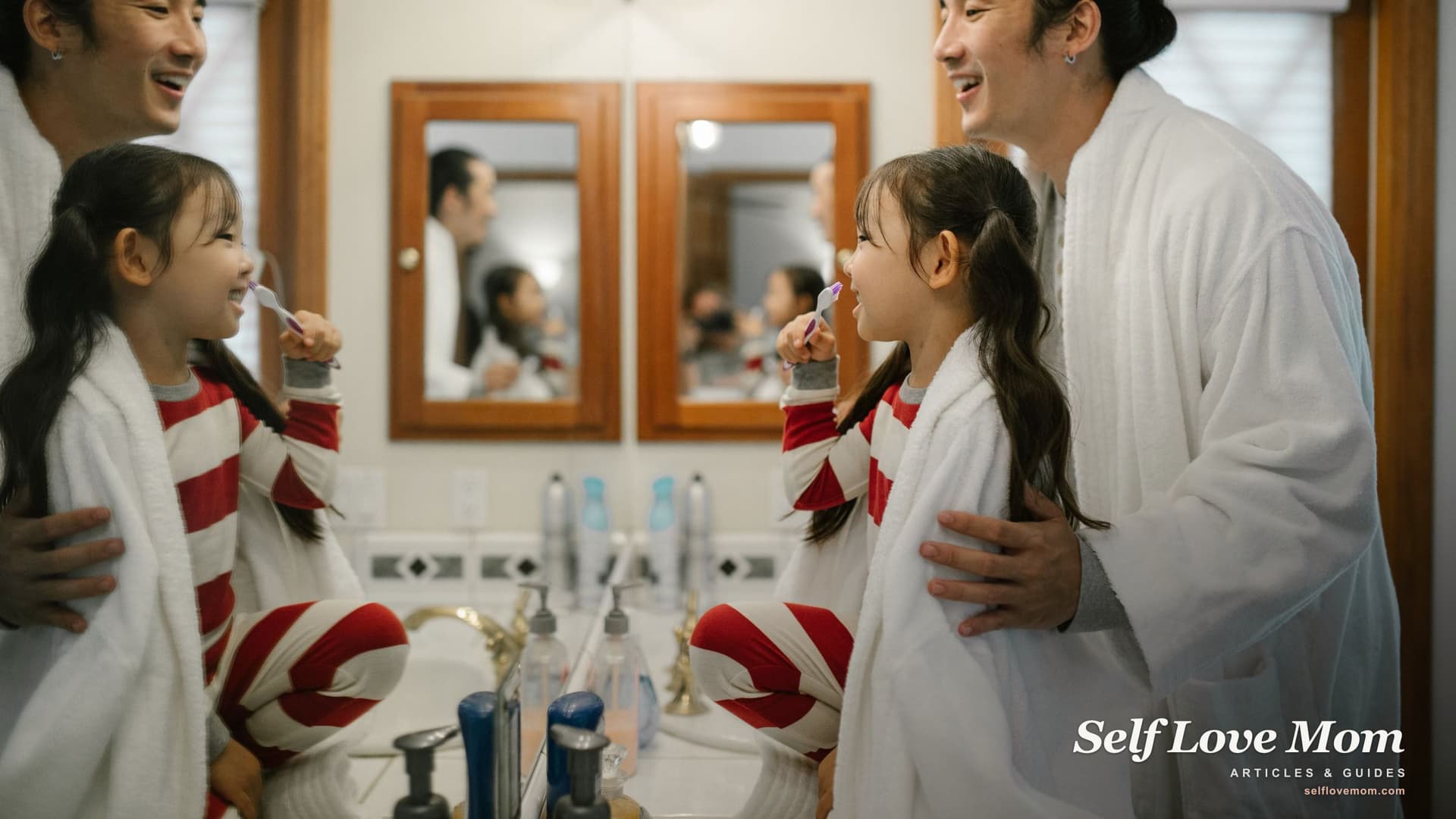
A young child in striped pajamas smiling while brushing their teeth with a parent, part of a calm morning routine for preschoolers.
Preschooler mornings can feel like a small daily emergency. Socks vanish, breakfast gets refused, and the clock never slows down. A calm, predictable morning routine for preschoolers is what turns that scramble into something closer to steady, for your child and for you.
Here is the reassuring part. A 2024 research review found that 16 of 18 studies linked consistent routines to stronger self-regulation in young children (Selman, Journal of Family Theory and Review, 2024). Structure is not only about getting out the door. It is quietly building your child's brain.
This guide lays out what a good preschool morning actually looks like, backed by pediatric research: how much sleep your child needs, a step-by-step sequence, a sample timeline, and calm fixes for the parts that usually fall apart.
| Sleep that sets the tone | Why routines work | Time you actually need |
|---|---|---|
| 10 to 13 hrs recommended daily sleep for ages 3 to 5 (AAP) |
16 of 18 studies link routines to stronger self-regulation (2024 review) |
60 to 90 min unhurried morning window most experts suggest |
The short version
A good morning routine for preschoolers runs on predictability, not speed. Prep the night before, protect 10 to 13 hours of sleep, and keep the same simple sequence every day: wake, bathroom and dress, breakfast, teeth and hair, then shoes. A visual chart lets your child lead the steps, which cuts the nagging and the power struggles.
Why does a morning routine matter for preschoolers?
Because predictability is how young children build self-control. A 2022 study of preschoolers found that consistent daily routines predict fewer behavior problems and stronger school readiness, including early math, language, and social skills (Early Childhood Research Quarterly, 2022). When a child knows what comes next, their nervous system can settle and cooperate.
Zero to Thrive, a University of Michigan early-childhood program, puts it simply: routines give children a sense of safety and control over their world. That security is what frees a preschooler to handle transitions, like leaving the house, without a meltdown every single time.
What time should a preschooler wake up in the morning?
Work backward from sleep, not from the clock. Children ages 3 to 5 need 10 to 13 hours of sleep per 24 hours, including naps (American Academy of Pediatrics). A child who must leave by 8 a.m. and needs about 11 hours should be asleep near 8 p.m. and waking around 6:45 to 7 a.m.
The goal is a wake time early enough that no one is rushed. Enough sleep is tied to better attention, behavior, and emotional regulation, which are exactly the things that keep a morning from unraveling. A tired preschooler is a tantrum waiting to happen.
What does a good morning routine for preschoolers look like?
It follows the same short sequence every day. Pediatric and preschool sources broadly agree on a simple flow: prep the night before, then wake, wash and dress, eat, brush teeth and hair, and gather shoes and bag. A good morning routine for preschoolers keeps that order fixed so the child can predict it.
- The night before. Lay out clothes, pack the bag, and set breakfast items out. Deciding nothing at 7 a.m. removes half the friction.
- Wake gently. Same time daily, with a few minutes to cuddle or stretch before feet hit the floor.
- Bathroom and dress. Potty, wash hands and face, then clothes your child can manage mostly alone.
- Breakfast. Something with protein for steady energy, served at the same spot each day.
- Teeth and hair. Quick grooming where your child can see a mirror and do part of it themselves.
- Shoes and launchpad. Keep shoes, jacket, and bag in one spot by the door so leaving is one step, not a scavenger hunt.
What does a sample morning routine timeline look like?
Here is one realistic version for a family that needs to be out by 8 a.m. Adjust the clock to your own child, but keep the sequence identical day to day. If you want a rhythm for the whole day, not just the morning, our stay-at-home mom schedule maps it out.
| Time | Step | Keep in mind |
|---|---|---|
| 6:45 | Wake and cuddle | Ten minutes to ease in, no rushing |
| 6:55 | Bathroom and get dressed | Clothes laid out the night before |
| 7:10 | Breakfast | Protein-based, same seat each day |
| 7:30 | Brush teeth and hair | Child does part of it |
| 7:40 | Free-play buffer | A reward for staying on track |
| 7:50 | Shoes, jacket, launchpad | Everything waiting by the door |
| 8:00 | Out the door | Calm, not frantic |
How do visual routine charts help preschoolers?
They hand the routine over to the child. Preschoolers cannot read a schedule, but they can follow pictures. A visual morning routine chart turns each step into an image the child checks off, which builds independence and shifts you from nagging to cheering. It is one of the most recommended tools in preschool settings.
Charts also cut the number of instructions a child has to hold in their head, which lowers frustration for everyone. You can make one with photos of your own child doing each step, or start with a ready-made version. Download our free printable morning routine chart for preschoolers and post it at their eye level.
How do you handle common morning routine challenges?
Even the best routine hits friction. The three that derail preschool mornings most are dawdling, flat refusal, and full meltdowns. Each has a calm fix that works better than rushing or raising your voice, which tend to make young children dig in harder.
1. Dawdling and distraction
Let the chart do the reminding instead of your voice. Add a visual timer and turn transitions into a game, like beating a favorite song. Praise the step your child finished, not how fast they did it.
Best for: the child who wanders off mid-sock · Tool: chart plus a sand or visual timer
2. Refusing the routine
Offer limited choices so the child feels some control: this shirt or that one, banana or berries. The sequence stays fixed, but letting them own small decisions heads off the power struggle before it starts.
Best for: the strong-willed "no" stage · Tool: two-option choices inside a fixed order
3. Morning meltdowns
These usually trace back to tiredness or hunger. Protect the 10 to 13 hours of sleep, move breakfast a little earlier, and keep the free-play buffer so there is margin when a rough moment hits. Fill that buffer with a calm indoor activity for toddlers, not a screen.
Best for: the 7 a.m. tears · Tool: earlier bedtime plus a built-in buffer
One last thing these lists rarely mention: the calmest mornings depend on a parent who is not running on empty. If mornings are the hardest part of a packed day, our guides to self-care for stay-at-home moms and stay-at-home mom burnout help you protect the energy a good routine quietly runs on.
Frequently Asked Questions
What is a good morning routine for preschoolers?
A good morning routine for preschoolers uses the same simple sequence daily: prep the night before, then wake, wash and dress, eat breakfast, brush teeth and hair, and gather shoes and bag. Predictability matters more than speed, and a visual chart helps your child lead the steps.
What time should a 4 year old wake up for preschool?
Work backward from the 10 to 13 hours of sleep the AAP recommends for ages 3 to 5. A 4 year old leaving by 8 a.m. usually does best asleep by about 8 p.m. and awake around 6:45 to 7 a.m., which leaves an unhurried 60 to 90 minute morning.
How long should a preschooler's morning routine take?
Most experts suggest a 60 to 90 minute window so nobody feels rushed. A tight 75-minute plan works for many families: 10 minutes to wake, 15 to dress, 20 for breakfast, 10 for grooming, a 10-minute play buffer, and 10 to get out the door.
How do I get my preschooler to follow a morning routine?
Use a visual chart so pictures, not your voice, cue each step, and offer limited choices inside a fixed sequence so your child feels in control. Consistency is key: a 2024 research review linked consistent routines to stronger self-regulation in young children, so keep the order the same daily.
How much sleep does a preschooler need?
Children ages 3 to 5 need 10 to 13 hours of sleep per 24 hours, including naps, according to the American Academy of Pediatrics. Hitting that range is linked to better attention, behavior, and emotional regulation, all of which make the next morning far smoother.
Sources
- American Academy of Pediatrics, "AAP Endorses New Recommendations on Sleep Times," publications.aap.org (retrieved 2026-07-09).
- Selman, S. B. and others, "Routines and Child Development: A Systematic Review," Journal of Family Theory and Review (2024, retrieved 2026-07-09).
- Early Childhood Research Quarterly, "Consistent Routines Matter: Child Routines Mediated the Association Between Interparental Functioning and School Readiness," sciencedirect.com (2022, retrieved 2026-07-09).
- Zero to Thrive (University of Michigan), "Routines for Kids," zerotothrive.org (retrieved 2026-07-09).
✻ Share this article
✻ About the contributor · Folio N°.180

Written by Subha
Psychologist and writer covering the topics that matter most to single moms, money, mental health, and the small daily rituals that keep a family running. Every article is research-backed and edited four times before publish.
- Articles
- 180
- Desks
- 05
- Edited
- 4×
More from this writer
✻ Edited four times before publish