Single Mother Parenting: What Research Says Helps Kids
Single mother parenting is not what holds kids back. Research points to warmth, a calm home, steady routines and a mom whose own health is cared for.

 Click to zoom
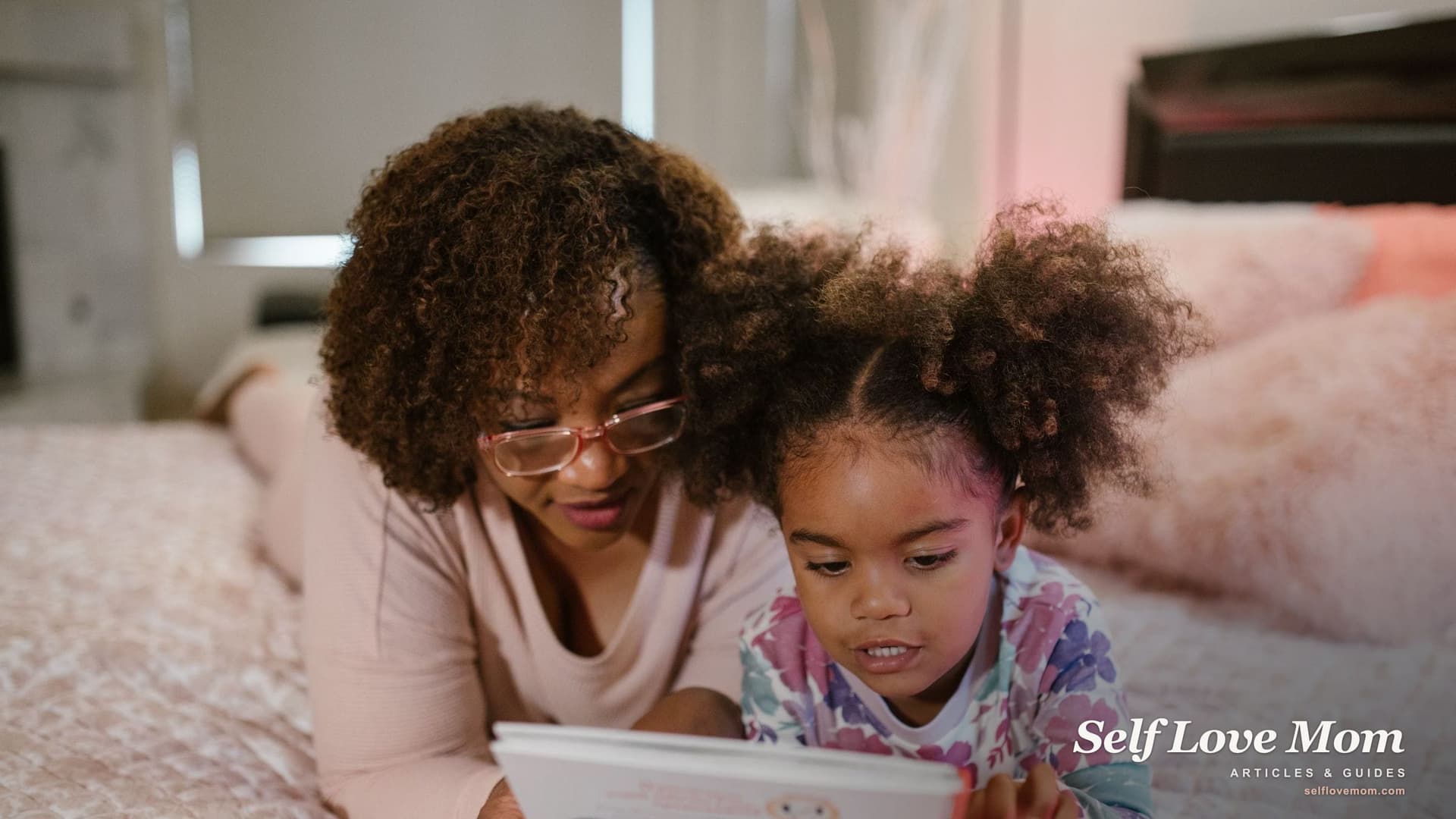
A single mother lies on the bed beside her young daughter, reading a picture book together before bedtime
Single mother parenting gets blamed for a lot, but the research points somewhere more useful. Kids raised by single mothers do face higher risks on average, yet the gaps tend to be small and can disappear once poverty is counted (Annie E. Casey Foundation). What research ties to better outcomes is warmth, a calm home, fewer upheavals and a mother whose own health is looked after.
This guide pulls together the single mother parenting studies behind each of those, and the tested programs that teach the skills. How this guide was checked. Every figure below was read in the study, the Census table or the agency page linked beside it on October 7, 2026.
| The figure | What it is | Source |
|---|---|---|
| 15.3 million | children lived with their mother only in 2025, about 1 in 5 US children | Census CH-1 |
| 29.5% | of single-mother families with kids lived below the poverty line in 2025 | Census CPS |
| 33% vs 12% | of kids recovered from a diagnosis when mom's depression lifted, versus when it did not | JAMA |
The short version
- Most children raised by single mothers grow up to be well-adjusted adults
- Warmth helps kids; guilt, pressure and rejection hurt them
- A class built for single moms still showed fewer arrests for the boys 9 years later
- Treating your own depression can help your kids too
- Need to talk to someone now? Call or text 988, any hour
Does single mother parenting hurt kids?
Not by itself. Children of single parents face higher risks of emotional and behavior problems on average, but most grow up to be well-adjusted adults (Annie E. Casey Foundation). The same foundation says stable relationships, a parent's mental health and money matter more than family structure itself.
Money is one of the biggest pressures on single parenting. In 2025, 29.5% of single-mother families with children lived below the poverty line, against 14.2% of single-father families and 4.7% of married-couple families (Census Bureau).
Income does not explain everything about single parenting, though. A study of 198,864 children found that money and education explain only part of the gap between family types (Krueger and others, 2015). The study did not measure the rest, but research below points to stress, conflict and stability. The single mother statistics guide has the full national numbers.
One more clue comes from widowed families. Children who lose a parent to death do not show the same poor outcomes as children raised by single parents after a divorce or a nonmarital birth (Brookings). That suggests the problem is not simply having one parent at home.
What single mom parenting habits matter most for kids?
In single mother parenting, warmth helps, and pressure through guilt is linked to real harm. A study of 385 teens and their mothers around Philadelphia compared 157 single mothers with 228 mothers living with a partner (Daryanani and others, 2016).
Single mothers in the study were more likely to use what researchers call psychological control: showing disappointment often and using guilt and pressure to steer a child's behavior. That predicted more depression and acting out in their teens. The link to depression was stronger for girls than for boys.
Rejecting, less warm parenting predicted more acting out too. But the authors are clear that single mothers are not worse parents by nature. Their parenting is strained by the demands and stress they carry, and low income was linked to both single motherhood and more negative parenting.
In practice, that points to small swaps in single mom parenting. Name the behavior and the consequence instead of saying "after everything I do for you." Give each child one warm moment a day that is not about chores or grades. The mindset guide for single moms covers the guilt you may be carrying.
Does a parenting class for single moms actually work?
One single parenting program has unusually strong evidence. Parenting Through Change was tested in a randomized trial with 238 divorcing mothers of boys in grades 1 to 3 in Oregon (Forgatch and DeGarmo, 1999). The 153 mothers in the program group met for 14 group sessions on parent management training (Patterson and others, 2004).
The program cut harsh, coercive parenting and kept positive parenting from slipping. Children gained through that better parenting rather than directly (Forgatch and DeGarmo, 1999). Over 30 months, program families held steady while comparison families got worse, and for boys' compliance, more positive parenting mattered more than less harsh discipline (Martinez and Forgatch, 2001).
The long-term results stand out. Nine years later, the boys whose mothers took part had less delinquency reported by teachers and fewer police arrests (Forgatch and others, 2009). Mothers who improved their parenting in the first year were also less depressed that year (Patterson and others, 2004).
By year nine, the mothers themselves had a better standard of living, measured by income, work, education and financial stress (Patterson and others, 2010). The limits are real: the trial included only boys, in one state, with mothers going through a divorce in the 1990s. It says nothing direct about daughters or about mothers who never married.
Why is your own mental health part of single parenting?
Because children's symptoms tend to follow their mother's. The STAR*D-Child study followed 151 mothers being treated for depression and their children aged 7 to 17 (Weissman and others, JAMA 2006).
When a mother's depression went into remission, diagnoses among the children fell 11%. When it did not, they rose about 8%. Among children who already had a diagnosis, 33% recovered when their mother got better, compared with 12% when she did not.
The mothers were treated with medication and were not assigned to recover, so this shows a strong link rather than proof. The NIMH notes that with proper treatment, most women with perinatal depression feel better (NIMH). The guide to free therapy for single mothers lists low-cost options.
If you need someone now, call or text 988 at any hour (988 Lifeline). New and expecting moms can also call the National Maternal Mental Health Hotline at 1-833-852-6262, free and open 24/7 in English and Spanish (HRSA).
How much do a calm home and fewer changes matter?
A lot. Conflict between parents harms children's emotional, behavioral, social and school outcomes whether the parents live together or apart (Harold and Sellers, 2018). The AAP adds that children are more resilient when conflict drops, and many bounce back within 2 to 3 years of a separation (AAP, HealthyChildren.org).
Stability counts too. A Brookings op-ed argues that a stable single-parent home, without new partners and half siblings coming and going, has begun to look like a better place for a child than constant change (Brookings).
A large study found that more family changes may partly cause behavior problems in white children, while their test score gaps mostly traced to the mother's earlier traits, and found no clear effect for Black children (Fomby and Cherlin, 2007). The practical lesson for single parenting is the same either way: go slowly with new partners and keep the kids' daily life steady.
If your ex keeps the fighting going, a parallel parenting plan cuts down the contact points where conflict starts.
Do kids need their dad involved?
Quality matters more than quantity. A review of 63 studies found that how often children saw a nonresident father was not linked to how they did (Amato and Gilbreth, 1999). What mattered was feeling close to him and his use of authoritative parenting, which went with better school results and fewer behavior and emotional problems.
A 2013 update of 52 studies also found that the amount of contact was not linked to child well-being (Adamsons and Johnson, 2013). So in single mom parenting, the goal is not a set number of visits. If the father is safe, a close and supportive relationship helps. If he is not involved, single mom parenting still has the levers this research points to: warmth and steady routines at home.
Which daily routines are worth the effort?
Bedtime and shared meals have strong evidence. Mothers of 10,085 young children in 13 countries and regions reported that a consistent bedtime routine went with earlier bedtimes, falling asleep faster, fewer night wakings and more sleep (Mindell and others, 2015).
A UK study of 10,230 seven-year-olds found behavior improved when children moved from irregular to regular bedtimes (Kelly and others, Pediatrics 2013). Shared meals help as well. A review of 17 studies covering 182,836 children linked eating together 3 or more times a week with healthier weight and eating habits (Hammons and Fiese, 2011).
The AAP's advice on single parenting lines up: schedule meals, chores and bedtimes at regular times so children know what to expect, and read a bedtime story or eat together with phones off (AAP, HealthyChildren.org). The single mom daily routine turns this into a morning, midday and evening plan.
You may have seen the 7-7-7 rule: seven screen-free minutes with each child in the morning, after school and before bed. The Australian Psychological Society says it is not a formally validated idea (APS). The CDC's advice is simpler: start with at least five minutes of child-led play (CDC).
Where can single moms get free parenting help?
Parenting as a single mom is easier with backup, so start with programs that have been tested. Ask your pediatrician or county family services which of these run near you, and what they cost where you live.
| Program | Who it is for | What to know |
|---|---|---|
| Parent-Child Interaction Therapy (PCIT) | Children about 2 to 7 with tantrums, aggression or defiance | Rated 1, the top level, by the California Evidence-Based Clearinghouse |
| Triple P | Parents of children and teens | A 5-level system of parent education and support |
| Nurse-Family Partnership | First-time moms who enroll by 28 weeks of pregnancy and meet income limits | Nurse visits from pregnancy to the child's second birthday |
| Postpartum Support International | Moms with mood problems in pregnancy or after birth | HelpLine 1-800-944-4773; leave a message and a volunteer calls or texts back |
| NAMI HelpLine | Any parent who needs mental health support | 800-950-6264, free and confidential, weekdays 10am to 10pm ET |
The Nurse-Family Partnership asks you to enroll early, by week 28, and has an income limit (Changent). The AAP's single parenting advice also says not to handle everything yourself. A single mom support group gives you that adult backup.
Single mother parenting: a weekly checklist
- One warm, phone-free moment with each child every day
- Name the behavior and the consequence, and skip the guilt
- The same bedtime routine on most nights
- At least three shared meals a week; breakfast counts
- Keep adult conflict and money worries away from the kids
- Go slowly with new partners
- Check in on your own mood, and call or text 988 if it is urgent
- Ask your pediatrician about PCIT or Triple P near you
Frequently asked questions
Is single parenting bad for a child?
Not in itself. Children of single parents face higher risks on average, but most grow up to be well-adjusted adults, and the gaps can disappear once poverty is counted. In single parenting, money, stable relationships and a parent's mental health matter more than family structure itself.
What is the 7-7-7 rule for parenting?
It is a social media idea: seven screen-free minutes with each child in the morning, after school or work, and before bed. The Australian Psychological Society says it has not been formally validated. The research-backed version is simpler: regular warm, one-on-one time, starting with five minutes of child-led play.
What do single moms struggle with the most?
Money is the best-measured gap. In 2025, 29.5% of single-mother families with children lived in poverty, compared with 4.7% of married-couple families. Researchers also point to stress and heavy demands, which can strain parenting. Help with income and with a mother's own mental health can also help her children.
How do I raise a son as a single mother?
The strongest evidence comes from Parenting Through Change, a program for divorcing mothers of young boys. It improved mothers' parenting, which cut boys' defiance and, nine years later, their police arrests. If his father is safe and involved, closeness matters more than how often they meet.
Can a single mom raise a successful child?
Yes. Most children raised in single-parent homes grow up to be well-adjusted adults. Children who lose a parent to death do not show the poorer outcomes seen after divorce, which suggests one parent at home is not, by itself, the problem. Warmth, stability, low conflict and enough money all help.
Single parenting does not have to be perfect to work. For the practical side of running the house alone, see these 7 daily systems for surviving as a single mom.
Sources
- Daryanani and others, Single Mother Parenting and Adolescent Psychopathology, Journal of Abnormal Child Psychology (2016) (retrieved October 7, 2026)
- Forgatch and DeGarmo, Parenting Through Change: an effective prevention program for single mothers, Journal of Consulting and Clinical Psychology (1999) (retrieved October 7, 2026)
- Martinez and Forgatch, Preventing problems with boys' noncompliance, Journal of Consulting and Clinical Psychology (2001) (retrieved October 7, 2026)
- Patterson, DeGarmo and Forgatch, Systematic changes in families following prevention trials, Journal of Abnormal Child Psychology (2004) (retrieved October 7, 2026)
- Forgatch, Patterson, DeGarmo and Beldavs, Testing the Oregon delinquency model with 9-year follow-up, Development and Psychopathology (2009) (retrieved October 7, 2026)
- Patterson, Forgatch and DeGarmo, Cascading effects following intervention, Development and Psychopathology (2010) (retrieved October 7, 2026)
- Weissman and others, Remissions in maternal depression and child psychopathology: a STAR*D-Child report, JAMA (2006) (retrieved October 7, 2026)
- National Institute of Mental Health, Perinatal Depression (retrieved October 7, 2026)
- Annie E. Casey Foundation, Child Well-Being in Single-Parent Families (retrieved October 7, 2026)
- Brookings, Are Children Raised With Absent Fathers Worse Off? (2014) (retrieved October 7, 2026)
- Krueger and others, Family structure and multiple domains of child well-being, Population Health Metrics (2015) (retrieved October 7, 2026)
- Fomby and Cherlin, Family Instability and Child Well-Being, American Sociological Review (2007) (retrieved October 7, 2026)
- Harold and Sellers, Interparental conflict and youth psychopathology, Journal of Child Psychology and Psychiatry (2018) (retrieved October 7, 2026)
- American Academy of Pediatrics, How to Support Children after Parents Separate or Divorce (retrieved October 7, 2026)
- Amato and Gilbreth, Nonresident Fathers and Children's Well-Being: A Meta-Analysis, Journal of Marriage and Family (1999) (retrieved October 7, 2026)
- Adamsons and Johnson, An updated and expanded meta-analysis of nonresident fathering and child well-being, Journal of Family Psychology (2013) (retrieved October 7, 2026)
- U.S. Census Bureau, Historical Poverty Table 4, Poverty Status of Families by Type of Family (CPS ASEC 2026) (retrieved October 7, 2026)
- U.S. Census Bureau, Table CH-1, Living Arrangements of Children (December 2025) (retrieved October 7, 2026)
- American Academy of Pediatrics, Single Parenting: Tips for When You're Raising Kids on Your Own (retrieved October 7, 2026)
- Mindell and others, Bedtime Routines for Young Children, SLEEP (2015) (retrieved October 7, 2026)
- Kelly, Kelly and Sacker, Changes in bedtime schedules and behavioral difficulties in 7 year old children, Pediatrics (2013) (retrieved October 7, 2026)
- Hammons and Fiese, Is frequency of shared family meals related to the nutritional health of children and adolescents? Pediatrics (2011) (retrieved October 7, 2026)
- Australian Psychological Society, the 7-7-7 rule of parenting (retrieved October 7, 2026)
- Centers for Disease Control and Prevention, Special Playtime (retrieved October 7, 2026)
- PCIT International, What is PCIT? (retrieved October 7, 2026)
- California Evidence-Based Clearinghouse for Child Welfare, Parent-Child Interaction Therapy (retrieved October 7, 2026)
- California Evidence-Based Clearinghouse for Child Welfare, Triple P System (retrieved October 7, 2026)
- Changent, Nurse-Family Partnership (retrieved October 7, 2026)
- Changent, Nurse-Family Partnership for moms (retrieved October 7, 2026)
- 988 Suicide and Crisis Lifeline (retrieved October 7, 2026)
- HRSA, National Maternal Mental Health Hotline (retrieved October 7, 2026)
- Postpartum Support International, Get Help (retrieved October 7, 2026)
- NAMI HelpLine (retrieved October 7, 2026)
✻ Share this article
✻ About the contributor · Folio N°.191

Written by Subha
Psychologist and writer covering the topics that matter most to single moms, money, mental health, and the small daily rituals that keep a family running. Every article is research-backed and edited four times before publish.
- Articles
- 191
- Desks
- 05
- Edited
- 4×
More from this writer
✻ Edited four times before publish