Step Parenting as a Single Mom: Why Most Advice Misses You
A mother plus a stepparent is the most common blended family at 33%. What step parenting really looks like when you are the single mom bringing him in.

 Click to zoom
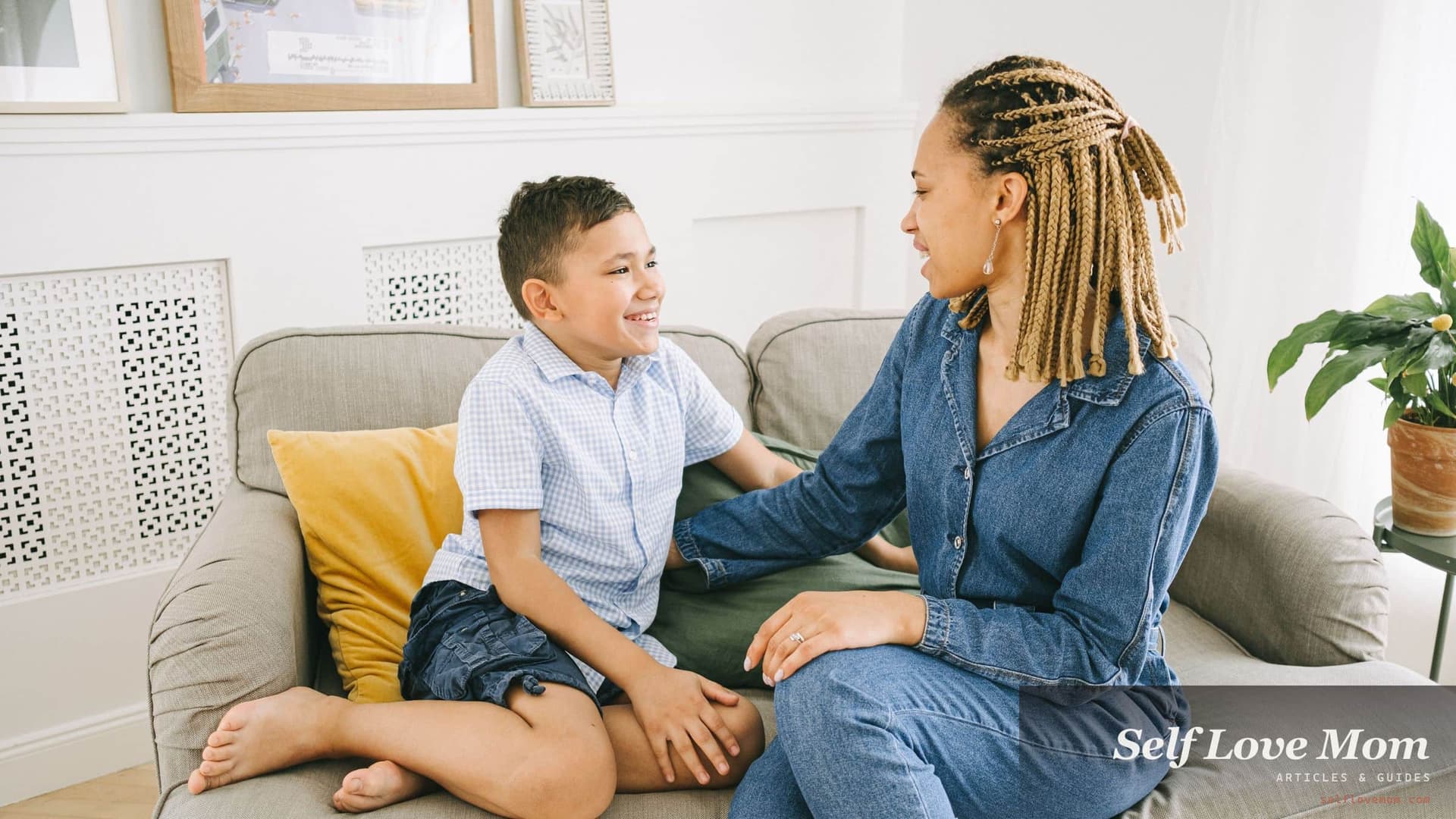
A mother and her young son sit facing each other on the couch, talking before a new partner moves in
The man you are seeing has children of his own, and suddenly every article about step parenting assumes the same picture. Two adults marry, each brings children, everyone moves into one house. That picture describes a minority of American households, which is why so much of the advice does not fit your life.
In April 2026 Pew Research published an analysis of Census Bureau data on what these families actually look like. The most common shape in that data is a mother and a stepparent, not two households merging. Worth reading before anyone gives you a tip about bonding.
| What the Census data shows | The figure | Where it comes from |
|---|---|---|
| US children under 18 in a blended family | 17% | Pew Research analysis of Census SIPP, 2026 |
| Of those children, share living with a stepparent | 46% | Same analysis. The other half live with no stepparent |
| Parent and stepparent pairs who are not married | 34% | Same analysis. Cohabiting counts as a stepparent here |
| Median household net worth, blended vs not | $86,300 vs $194,400 | Same analysis. The gap is the part nobody plans for |
The short version
Step parenting is one arrangement inside a much broader category. Only 17% of US children live in a blended family, and just 33% of those live with their mother and a stepparent. That is the single mom version, and it is the most common one in the data. A third of these couples are not married. Decide your role, your money and your discipline line before anyone moves anywhere.
What counts as a blended family?
A blended family is any household that includes a stepparent, stepsiblings or half siblings, which is broader than most people assume. Pew uses that definition in its 2026 analysis, and it is the reason the headline number surprises people who picture only remarriage.
Step parenting sits inside that category rather than defining it. You can be in a blended family with no stepparent anywhere in the house, which is exactly what happens when a parent has children with more than one partner.
The definition also does not require a wedding. A stepparent, in this data, can be the spouse or the unmarried live in partner of the child's parent. That single detail changes who should be reading step parenting advice, and it is a much larger group than the guides suggest.
How common is this, really?
Some 17% of US children under 18 live in a blended family, according to the 2026 Pew analysis of 2023 Census SIPP data. That is roughly 1 in 6, and it is down from 23% in 2013 rather than rising the way the culture assumes.
The decline has a specific cause. The share of children living with a half sibling fell from 17% to 12%, which tracks falling birth rates among people in their teens and early twenties. Stepparent and stepsibling arrangements barely moved.
Teenagers are the most likely age group to be in one, at 22%, compared with 13% of children aged 5 and under. So step parenting most often begins with a child who already has a fully formed opinion about it, not a toddler who will not remember otherwise.
| Group | Share in a blended family |
|---|---|
| Teens aged 13 to 17 | 22% |
| Children aged 6 to 12 | 18% |
| Children aged 5 and under | 13% |
| Parent has a high school diploma or less | 28% |
| Parent has a bachelor's degree or more | 9% |
Where a single mom actually sits in this data
At the center of it, not the edge. Only 46% of children in blended families live with a parent and a stepparent, and that 46% splits sharply by which parent. Some 33% live with their mother and a stepparent, against 13% with their father. The mother plus stepparent household is the common shape, not the Brady Bunch merger.
So if you are a single mom bringing a partner into your children's lives, you are the largest single group in this data. You are also the group the advice tends to skip, because it is written for two parents combining two households rather than one mother adding one adult.
The other 50% live with no stepparent at all and at least one half sibling. That is a completely different household to run, and almost no step parenting content addresses it either.
Why does money cause so much of the friction?
Because the gap is real and large. Median household net worth for children in blended families is $86,300, against $194,400 for children who are not in one. That is less than half, and it is present before anyone argues about whose child needs new shoes.
Home ownership follows the same line. Some 55% of blended families own their home against 66% of other families, and among owners the median equity is $132,000 against $195,000. Housing is where most American wealth sits, so this compounds quietly.
Child support adds a second layer, and for a single mom it is often the layer that stings. Among blended families with a child living apart from one parent, 46% have a formal or informal agreement, and those receiving cash get a median of $400 a month. Pew puts that at 12% of monthly household income on average.
Which means your household may be receiving support for your children while his goes out for his. Two flows in opposite directions, neither of them yours to control. That is a specific conversation, not a general one about splitting bills.
None of this means the household will struggle. It means money conversations are structurally harder here and deserve to happen early rather than during a crisis. Our guide to budgeting on a single income is a reasonable starting frame.
What role should step parenting actually take?
Not the disciplinarian, at least not for a long time. Psychologist Patricia Papernow, author of 3 books on stepfamilies, calls the opposite approach disastrous. Children are not ready for a stepparent's discipline until that stepparent has built a caring, trusting relationship, she says.
So the stepparent begins as another caring adult. Closer to a trusted aunt or a mentor than a second parent. Time outs, consequences and curfews stay with the biological parent while the relationship is still new.
The reason is mechanical rather than sentimental. Discipline only works where a relationship of trust already exists. Applied before that, it reads to the child as a stranger with authority, and it damages the connection you need for everything that follows.
This is where step parenting goes wrong fastest in practice. The new adult tries to prove they are serious about the family by enforcing rules, and every enforcement withdraws from an account that has nothing in it yet.
Age changes the calculation. With teens the most likely group to be living this, you are usually not building a parental role at all. You are building a working relationship with a near adult who did not choose you, and that is a different and more modest goal.
The assumptions that cost the most time
There are 5 that come up repeatedly, and each one is a version of expecting a biological family on a shorter timeline. Reading them as a list is uncomfortable and useful.
| The assumption | What tends to be true instead |
|---|---|
| Love will arrive if everyone tries | Respect and routine come first. Affection is not scheduled |
| A stepparent should be treated as a parent | The child already has two. A third adult is an addition |
| Blending is an event, ending at the move | It is a long process, and the move is near the start |
| Conflict means the family is failing | Conflict is expected. Its absence often means avoidance |
| The other household is the problem | Handled well it is a resource. Handled badly it is a war |
The last row carries the most weight, and Papernow puts it bluntly. What produces the poorest wellbeing for children is not stepfamilies, and it is not single parent families. It is adult conflict. That reframes the other household entirely. It is not a rival to be beaten, it is the single variable most worth keeping calm.
The last one deserves care. If your co-parent is genuinely hostile rather than merely difficult, ordinary blending advice will not hold, and our guide to co-parenting with a narcissist covers that case separately.
How long does step parenting take to feel normal?
Longer than the first year, and the honest answer is measured in years rather than months. Papernow's phrase for it is that a stepfamily is a slow cooker, not fast food. This is well studied ground, not folklore: a 2026 paper she co-authored in Family Transitions reports that 42% of Americans have a close stepfamily relationship.
The 22% teen figure explains the pace. An adolescent has less time left at home and less reason to rebuild a family identity. Expecting the same timeline you would get with a 4 year old sets you up to read normal progress as failure.
Two things speed it up, and both come from the same interview. Papernow stresses regular, reliable one to one time between the biological parent and the child. Stepfamily coach Kisha Batsuli suggests starting with low stakes activity, ice cream or a hike, where nobody has to perform closeness.
One thing to avoid. Asking the child to name the relationship before they feel it. Papernow describes a loyalty bind, where a child feels that caring about a stepparent is a betrayal of their own parent. A title requested early lands straight in that bind.
What to agree before anyone moves in
Have these 9 conversations while they are still theoretical, because each one becomes a fight the first time it happens live and nobody has agreed a position. If your custody arrangement is still being worked out, our guide to 50/50 custody schedules covers the timing side.
- Who disciplines, for what, and at what age. Write down where the stepparent's line sits today.
- How money works. Separate, joint, or a hybrid, and who covers which child's costs.
- What the children call the stepparent, decided by the children rather than the adults.
- How you speak about the other household, especially when it has just done something maddening.
- What happens to existing routines. Which ones survive the move untouched, and say so out loud.
- How much one to one time each child keeps with their own parent, protected in the calendar.
- Who handles school, medical and legal contact, given a stepparent often has no standing there.
- How his time with your children fits your custody schedule, and whether their father needs to hear about him from you first.
- What you will do when it is going badly at month six, agreed now while everyone is calm.
If a new relationship is still early and children have not met anyone yet, the sequencing question comes first. Our guide to dating with children in the picture deals with that stage. If you are still at the app stage, the single mom dating profile tips cover how to mention children in a bio.
Frequently asked questions
What is a blended family?
Any household including a stepparent, stepsiblings or half siblings. Pew uses that definition in its 2026 Census analysis, which is why 17% of US children qualify while far fewer live with an actual stepparent.
Is a single mom with a new partner a blended family?
Yes, once he lives with you, and marriage is not required. In this data a stepparent can be a spouse or an unmarried live in partner. A mother plus a stepparent is the most common arrangement of all, at 33% of children in blended families.
Do you have to be married to be a stepparent?
Not in this data. A stepparent can be the spouse or the unmarried live in partner of a child's parent. Among children living with a parent and stepparent, 34% have a pair who are not married to each other.
Should a stepparent discipline the children?
Not early on. Psychologist Patricia Papernow says the research is clear that children are not ready for a stepparent's discipline until that stepparent has formed a caring, trusting relationship. Time outs, consequences and curfews should come from the biological parent.
Are blended families financially worse off?
On average, measurably. Median household net worth is $86,300 for children in blended families against $194,400 for those who are not, and 55% own a home against 66%. Education differences explain much of the gap.
How long does it take to feel like a family?
Years rather than months, and longer with teenagers, who are the age group most likely to be in a blended family at 22%. One to one time and low pressure shared activity move it faster than group events.
Is step parenting getting more common?
No. The share of US children in blended families fell from 23% in 2013 to 17% in 2023, driven mainly by fewer children living with half siblings. Stepparent arrangements themselves stayed roughly flat.
Where to go next
If the co-parenting relationship is the harder half of this, start with our guide to co-parenting that works.
Sources
- Hays J. Five facts about US children living in blended families. Pew Research Center, April 2026, retrieved 2026-08-17, pewresearch.org
- US Census Bureau. Survey of Income and Program Participation, the dataset behind the analysis, retrieved 2026-08-17, census.gov
- Definition of a blended family as households including stepparent, stepsibling or half sibling relationships, retrieved 2026-08-17, pmc.ncbi.nlm.nih.gov
- Cardoza K, Schneider CM. The Key to Stepparenting: Be Patient, It Takes Time. NPR Life Kit, interview with Dr Patricia Papernow, 2021, retrieved 2026-08-18, npr.org
- Jensen TM, Papernow P. Bridging the Know-Do Gap in the Stepfamily Field. Family Transitions, 2026, retrieved 2026-08-18, tandfonline.com
✻ Share this article
✻ About the contributor · Folio N°.185

Written by Subha
Psychologist and writer covering the topics that matter most to single moms, money, mental health, and the small daily rituals that keep a family running. Every article is research-backed and edited four times before publish.
- Articles
- 185
- Desks
- 05
- Edited
- 4×
More from this writer
✻ Edited four times before publish