
If you are facing challenges affording groceries, the Supplemental Nutrition Assistance Program (SNAP), formerly known as food stamps, may be able to help. Food stamps in Indiana are provided through the Hoosier Works Card, which is accepted at most grocery stores, farmers’ markets, and certain online vendors.
If you’re a working dad or mom or a senior or just hit with an unexpected financial curveball, applying for SNAP in 2026 can be a little relief. This blog will guide you through the eligibility criteria, the required documents, and the application process.
Let’s get into the details of how to apply for food stamps in Indiana and receive the assistance you deserve.
What Are Food Stamps (SNAP)?
1. Program Overview
In Indiana, “food stamps” are known as the Supplemental Nutrition Assistance Program (SNAP). The program is state-administered and federally funded through the Indiana Family and Social Services Administration (FSSA), Division of Family Resources (DFR)
2. How Benefits Are Delivered
Eligible households get benefits each month loaded onto an EBT card, a debit-style card that can be used at most grocery stores, supercenters, and many farmers’ markets in Indiana.
Need help urgently? If your household is currently struggling with a lack of income or resources, you can apply for emergency food stamps indiana to be able to receive assistance within 7 days of filing an application; even as your full application is under review.
What Food Stamps in Indiana Cover?
1. SNAP Eligible Items
Here are the items that are eligible for purchase with food stamps in Indiana:
- Fruits and Vegetables
- Meat, Poultry, and Fish
- Dairy Products
- Bread and Cereals
- Non-Alcoholic Beverages
- Seeds and Plants that produce food for consumption
- Pantry Staples
- Family Needs
- Healthy Snacks
2. SNAP Ineligible Items
Here’s what you cannot purchase with food stamps in Indiana:
- Alcoholic Beverages
- Tobacco Products
- Hot Foods or Prepared Meals (except for elderly, disabled, or homeless individuals)
- Vitamins, Medicines, or Supplements
- Non-Food Items (such as household products, pet food, or cleaning supplies)
- Sugary Drinks or Candy (New for 2026)
Who Qualifies for Food Stamps in Indiana?
To be eligible for food stamps in Indiana, you must meet income, household size, resources, and other requirements. Here are some of the important food stamp Indiana guidelines for eligibility:
1. Income Limits
The gross monthly income for your household must be no greater than 130% of the federal poverty level. Net income (after allowable deductions) must be less than 100%. Limits for Indiana food stamp income are adjusted yearly and depend on how many people live in that particular household.
Here are the food stamp Indiana income limit for 2026:
| Household Size | Gross Monthly Income (130% FPL) | Net Monthly Income (100% FPL) |
| 1 | $1,696 | $1,305 |
| 2 | $2,292 | $1,763 |
| 3 | $2,888 | $2,221 |
| 4 | $3,483 | $2,680 |
| 5 | $4,079 | $3,138 |
| 6 | $4,675 | $3,596 |
| 7 | $5,271 | $4,055 |
| 8 | $5,867 | $4,513 |
| Each Additional Person | +$596 | +$459 |
2. Residency & Citizenship
You must reside in Indiana and be a U.S. citizen or a non-citizen who meets the eligibility criteria (such as a lawful permanent resident). Undocumented individuals are not eligible, but children who are US citizens in mixed-status homes may still be able to apply.
3. Work Requirements
Able-bodied adults aged 18–54 without dependents may be required to work or participate in a training program for at least 80 hours per month to receive benefits for more than three months. Those who are disabled, pregnant, or a guardian to a child less than 6 years old are exempt.
4. Asset / Resource Limits
In addition to the income limit, Indiana has resource limits on bank accounts, property, and vehicles. These limits are as follows:
- For households with elderly or disabled members: The resource limit is $3,750.
- For other households: The resource limit is $2,500.
Note: Certain resources, such as your primary home, retirement accounts, and household belongings, are not counted toward the resource limit.
If you’re already receiving Temporary Assistance for Needy Families (TANF) benefits, you may automatically qualify for food stamps in Indiana, although a separate application process is often necessary.
How to Check Your Eligibility for Food Stamps in Indiana?
If you’re unsure whether you meet the Indiana food stamp eligibility criteria, there are online tools and resources available to help you determine your qualification.
- Indiana SNAP Calculator: This online tool allows you to calculate your potential SNAP benefit based on your household size, income, and other factors. Check your eligibility on the Benefits Portal.
- Indiana EBT Portal: After submitting your food stamp application, indiana, you’ll receive an eligibility determination. You can also check your food stamp Indiana balance at any time by calling the Indiana EBT phone number at 1-877-768-5098 or through the food stamp Indiana login portal at ConnectEBT.
Documents You Will Need
To complete your food stamp Indiana application, you’ll have to submit a number of documents that authenticate your eligibility. Among these documents are:
1. Identity & Residency
- Driver’s license, passport, or other state-issued ID
- Proof of Indiana residency (utility bill, lease agreement, mail)
2. Income & Employment
- Recent pay stubs (last 30 days) or employer letter
- Records of self-employment or profit/loss statements
- Letters for unemployment, Social Security, or disability benefits
3. Household & Financial
- SSN (social security numbers) for everyone in your household
- Recent statements from your bank
- Rent/mortgage receipts and utility bills
- Medical bills (for senior or disabled family members)
How Do You Apply for Food Stamps in Indiana?
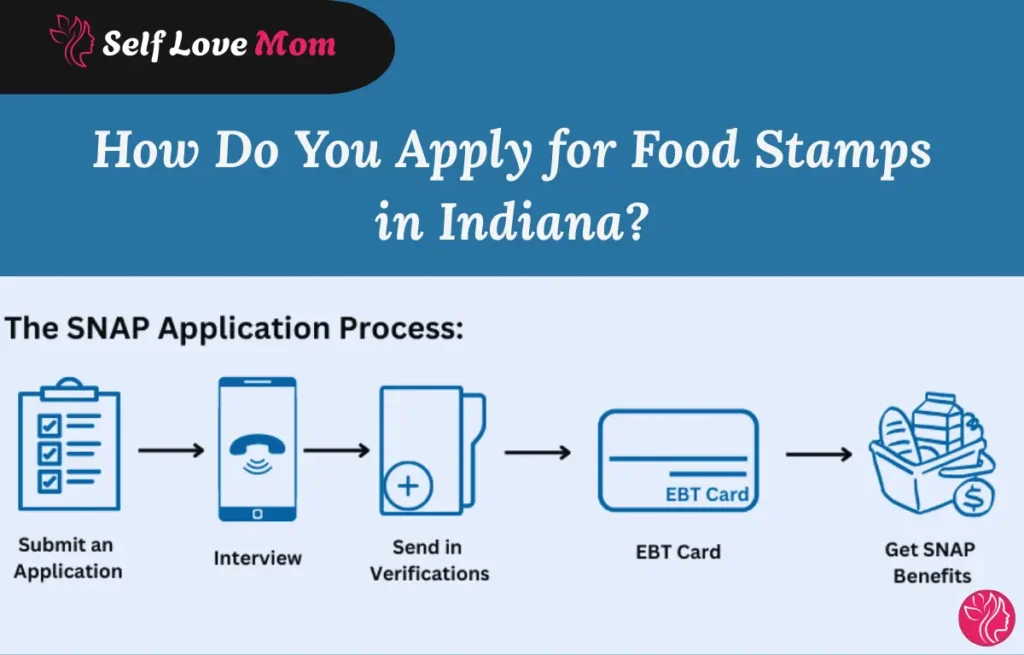
The process of food stamp application in Indiana is simple, but it needs some attention. Here are the steps to apply for food stamp indiana:
1. Check Your Eligibility
Before applying for food stamps in Indiana, make sure you’re eligible. At in.gov/fssa/dfr, you can use the Indiana SNAP calculator to see if your household qualifies and how much you could get based on your income and household composition.
2. Gather Your Documents
Use the above document checklist to ensure you have everything prepared before starting. Being organised with your documents from the beginning will make the process move faster and less likely to hold things up.
3. Submit Your Application
You have three ways to apply for food stamps in Indiana:
- Apply Online (Recommended): Go to the Indiana FSSA Benefits Portal at fssabenefits.in.gov. Register, fill out the food stamp application form online Indiana, and upload your documents available 24/7. Through the food stamp Indiana portal, you can also check the status of your case and benefits.
- Apply by Phone: Call the food stamp Indiana number at 1-800-403-0864 (Monday–Friday, 8 AM–4:30 PM ET). A food stamp Indiana customer service representative will help you with the application or send you a food stamp application to print out and fill in at home.
- Apply In Person: Go to a Division of Family Resources (DFR) office near you with the required documentation. Find your local DFR office by county.
- By Mail or Fax: You can download a paper application from the DFR website, fill it out, and mail or fax it to your local office.
4. Complete Your Eligibility Interview
Once you submit your foodstamp application Indiana, you’ll be scheduled for an eligibility interview, typically by phone or in person. Answer every question honestly and have your documents with you. This is a necessary step, and skipping it is one of the biggest reasons applications get held up.
5. Receive Your Decision & EBT Card
Your application must be processed by Indiana within 30 days. Once approved, your Hoosier Works Card will be mailed to the address on file, and your benefits will be loaded, and you can use them. Emergency applications may be approved within 7 days for eligible families.
Indiana SNAP Dates: When Will You Get Your Benefits?
Food stamps in Indiana are deposited onto Hoosier Works EBT cards between the 5th and 23rd of every month. Your specific deposit date is determined by the first letter of your last name.
Indiana Food Stamp Schedule
| If the first letter of your last name is… | Your benefits are deposited on the… |
|---|---|
| A or B | 5th of the month |
| C or D | 7th of the month |
| E, F, or G | 9th of the month |
| H or I | 11th of the month |
| J, K, or L | 13th of the month |
| M or N | 15th of the month |
| O, P, Q, or R | 17th of the month |
| S | 19th of the month |
| T, U, or V | 21st of the month |
| W, X, Y, or Z | 23rd of the month |
Examples:
- Example 1: If your last name is Smith, your benefits will arrive on the 19th of every month.
- Example 2: If your last name is Miller, your benefits will arrive on the 15th of every month.
Managing Your SNAP Benefits
1. Using Your EBT Card
Your EBT card is credited with your benefits on a specific date each month. The card is accepted at most major grocery stores in Indiana, like Kroger, Walmart, Aldi, Meijer, and Target, and at many farmers’ markets locally as well.
2. Renewing Your Benefits (Recertification)
Food stamps in Indiana (SNAP) benefits are not permanent. You are required to recertify your eligibility every 6 to 12 months, depending on your household classification. A notice will be mailed to you by the FSSA prior to the expiration of your current period. Missing the due date leads to a break in benefits.
3. Reporting Changes to Your Case
You are legally required to report significant household changes within 10 days of the change occurring. This includes changes in income, employment status, household size, or your home address. Not reporting it can result in overpayment or disqualification.
4. Lost or Stolen EBT Card
If your EBT card is lost, stolen, or damaged, call EBT Customer Service at 1-877-768-5098 immediately to freeze your account and request a free replacement card. Also, never share your PIN with anyone.
Indiana also offers SNAP Employment & Training (SNAP E&T) programs, free job skills training, resume help, and work placement services available to SNAP recipients. Ask your DFR caseworker for details.
Key Contacts & Resources
If you need assistance with your food stamp application, here are some important phone numbers and resources:
- Food stamp Indiana phone number: 1-800-403-0864
- Indiana EBT Customer Service: 1-877-768-5098
- Food stamp Indiana portal (apply, login, renew): fssabenefits.in.gov
- Food stamp office in Indiana (find by county): in.gov/fssa/dfr
Don’t Wait to Apply for Food Stamps in Indiana

If you think you might qualify for food stamps in Indiana, apply today. The food stamp application form online Indiana takes as little as 20 minutes to complete. SNAP benefits exist for exactly these moments, helping working families, seniors, and individuals through hard times, and the Hoosier Works Card makes accessing those benefits simple and dignified.
Whether you’re in New Albany, Anderson, Evansville, or anywhere else across the Hoosier State, food stamps in Indiana are within reach. Use the Indiana SNAP calculator to estimate your benefits, gather your documents, and apply for food stamps Indiana today because every family deserves food on the table.
References
- Indiana FSSA: SNAP Food Assistance Overview – https://www.in.gov/fssa/dfr/snap-food-assistance/about-snap/
- Indiana SNAP Income Limits – https://www.in.gov/fssa/dfr/snap-food-assistance/income
- https://www.joinproviders.com/state/indiana/food-stamps-eligibility-income-limits/
- Indiana EBT Deposit Schedule for 2026 – https://www.bennyapp.com/ebt/deposit-schedule/indiana
- USDA SNAP Eligibility – https://www.fns.usda.gov/snap/recipient/eligibility