Grants for Single Mothers in Alaska (2026): Full List
Up to $923/mo ATAP cash, $1,032 SNAP, $7,395 Pell. The full 2026 list of grants for single mothers in Alaska, verified from state and federal sources.

 Click to zoom
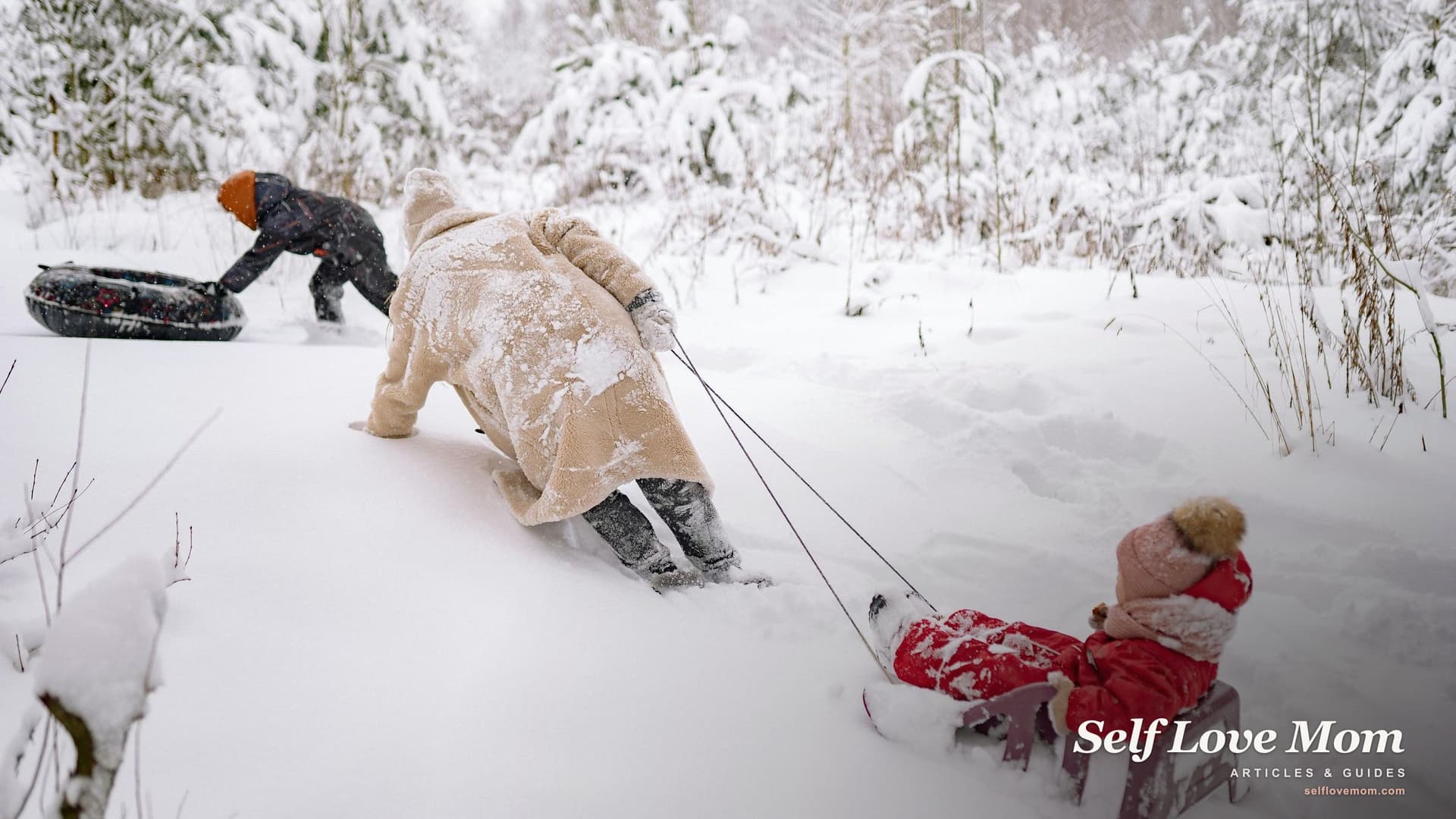
A mother and her two children sledding together in deep snow on a bright winter afternoon, dressed in warm winter coats and laughing.
For a single mom in Alaska, October is the month when the money moves. The 2026 Permanent Fund Dividend is $1,200 per person, so a mother with two children who all qualified can expect $3,600 for the household. Heating Assistance began paying vendors on the first working day of the month, and a new federal year reset SNAP maximums for the state's urban and rural zones.
This guide to grants for single mothers in Alaska follows one household: a mom raising two kids on one income. It walks through each program the state, its tribes and its housing agency run. Every figure was checked against its source on October 21, 2026. For federal programs that work the same everywhere, see the national guide to grants for single moms.
The household-of-three numbers at a glance
ATAP cash up to $923 a month. SNAP up to $1,032 in Anchorage and $1,602 in Rural II villages. Heating help with income up to $6,401 a month. Denali KidCare for the kids up to $5,778. Child care copays at 7% or less of pay. Pell up to $7,395.
A Year of Alaska Deadlines on One Page
Most grants for single mothers in Alaska run on fixed windows. Miss the PFD filing period or the heating deadline and the next chance is a year away. The dates below come from the agencies listed in Sources.
| When | What happens | What a mom of two should do |
|---|---|---|
| January 1 to March 31 | PFD application period, per the PFD Division FAQ | File for yourself and each child; late filings are denied by law |
| April 30 | Last day for regular heating assistance | Apply before spring if you skipped the fall |
| June 30 | Last day for heating Crisis Assistance | Use it for a fuel run-out or shutoff within 48 hours |
| July 1 | New WIC income chart starts | Recheck eligibility if your pay changed |
| September 1 | New heating application posted | Apply early; payments are not issued before October 1 |
| October 1 | Heating payments begin; new SNAP figures take effect | Watch for a SNAP notice with your new amount |
| October 22, November 19, December 17, 2026 | PFD distribution dates for applications marked Eligible-Not Paid | Check status in myPFD and keep your address current |
| Whenever you file the FAFSA | Alaska Education Grant priority is partly set by FAFSA date | File as soon as you decide to enroll |
The $1,200 Dividend and Your Kids' Applications
The Permanent Fund Dividend Division set the 2026 amount at $1,200, which includes a $200 energy relief payment. There is no income test. To qualify for 2026, an applicant had to be an Alaska resident for all of calendar year 2025 and meet the division's presence and absence rules.
Each child needs their own application, and a child must have an eligible adult sponsor on file. A baby born on or before December 31 of the qualifying year can be included, even if the birth certificate has not arrived yet. If a parent never filed for a child in a past year, the child can apply for missed dividends only after turning 18 and before turning 20.
The dividend is not invisible to other programs. The Division of Public Assistance notes that special rules apply to PFDs when SNAP counts your income, so report the payment and ask your caseworker how it is budgeted. Under Alaska's child support rule, the other parent's dividend counts as part of their income when support is set.
Three SNAP Zones, and the Rural Ones Pay More
Alaska is the only state with three SNAP benefit zones. Federal rules at 7 CFR 272.7 map each community to one of them. Anchorage, the Mat-Su Borough (except Denali and Skwentna), Fairbanks North Star, Juneau, Kodiak city and Ketchikan are Urban. Bethel, Nome, the North Slope and most of the Yukon-Koyukuk area are Rural II.
Eligibility uses Alaska's own poverty lines, which run about 25% above the 48-state figures. According to the FY2027 SNAP standards, a household of three passes the gross test below $3,700 a month and the net test below $2,846. Alaska's standard deduction is $371, and the excess shelter deduction can reach $1,229.
The asset limit is $3,000 for most households, which matters because some websites claim Alaska dropped it. The Division of Public Assistance SNAP page still lists it. Work rules now reach adults 18 to 64, but a parent caring for a child under 14 is exempt, and Alaska Native and American Indian people now have their own exemption.
ATAP Cash: How $821 Plus $102 Becomes $923
Among grants for single mothers in Alaska, the Alaska Temporary Assistance Program is the monthly cash grant, funded by federal TANF. The 2026 to 2028 TANF State Plan sets the maximum at $821 for one child living with one needy parent, plus $102 for each additional child. That makes $923 for a single mother with two children, paid to a Quest card or by direct deposit.
Part of the grant is meant for rent. A family with low or no shelter costs, such as a mom staying with relatives for free, can see the payment cut by up to 30%, to roughly $646. Countable resources must stay under $2,000. Your home, household goods and most vehicles do not count.
Going back to work does not end the grant at once. For a mom who received ATAP in one of the prior four months, the first $150 of monthly earnings plus 33% of the rest is not counted during the first year of earnings. The protected share then steps down: 25% in year two, 20% in year three, 15% in year four and 10% in year five.
Adults face a 60-month lifetime limit, and the plan allows hardship extensions after that. You must take part in work activities and cooperate with child support enforcement. Under the Family Violence Option, the state can waive time limits and the child support rule when complying would put a survivor at risk. Apply through the Alaska Connect Portal listed on the ATAP page, or call 800-478-7778.
ATAP can also cover the costs of getting to a job. Listed support services include car repairs, a driver's license, interview clothing, tools and work equipment.
Tribal Family Assistance in Seven Regions
In much of Alaska, a Native family's cash program is run by a regional tribal organization, not the state. The TANF State Plan names seven Native Family Assistance Programs:
- Tanana Chiefs Conference, interior Alaska
- Bristol Bay Native Association, Bristol Bay region
- Cook Inlet Tribal (CITCI), Anchorage and the Mat-Su Valley
- Association of Village Council Presidents, western Alaska
- Central Council of Tlingit and Haida Indian Tribes, Southeast
- Kodiak Area Native Association, Kodiak area
- Maniilaq, Northwest Arctic
Alaska Native families outside those service areas use ATAP on the same terms as everyone else. Months on a tribal TANF program count toward the same 60-month limit, so a mother moving between regions should keep her award letters.
General Relief When Every Other Door Is Closed
General Relief Assistance is the state's last-resort fund. It pays toward a specific emergency, such as an eviction notice, a utility shutoff notice, or a need for food or clothing. According to the GRA page, a household of three must have net income below $500 a month and no more than $500 in resources.
You also have to show you cannot get help from another program and have no cash or credit to cover the need. For most single moms with children, ATAP or Heating Assistance comes first, and GRA fills the gap that remains.
Heating Help Has Two Income Lines, Not One
The state's Heating Assistance Program runs two funds through one application, which makes it one of the few grants for single mothers in Alaska that reaches middle incomes. Federal LIHEAP serves households up to 150% of poverty. The state-funded Alaska Affordable Heating Program covers households from 150% up to 225%. For the 2026 to 2027 season, a household of three qualifies with monthly income up to $6,401.
You must have at least $200 a year in out-of-pocket heating costs. Each household gets one benefit per season from one of three options:
- Regular heating assistance, a one-time credit paid to your fuel or electric vendor, with applications taken October 1 through April 30.
- Crisis Assistance when you are out of fuel, within 48 hours of running out, facing a disconnection, or holding an eviction for unpaid rent that includes heat.
- A utility deposit for subsidized rentals where heat is included but the renter pays for electricity.
The amount depends on income, household size, fuel type, home type, bedrooms, community, and whether your rent is subsidized. The Heating Assistance FAQ also lets you send half of the grant to your electric company if you ask when you apply.
Health Coverage: The Kids' Line Sits Far Above Yours
Alaska's Medicaid income standards, effective April 1, 2026, are built on the Alaska poverty guideline. For a household of three, adult Medicaid through the expansion group covers income up to $3,785 a month, and a 5% disregard of $143 can be applied on top.
Children through age 18 qualify for Denali KidCare up to $5,778 a month if they have no other insurance, or $5,038 if they do. That gap is common for a single mother who takes a higher-paying job: she can lose her own Medicaid while her children stay covered. Children's coverage renews every 12 months. Compare other options in the guide to health insurance for single moms.
Pregnant or Postpartum: WIC and Coverage Before the Baby Arrives
Denali KidCare also covers pregnant women, up to 225% of the Alaska poverty line. For a household of three, that is $6,404 a month, well above the adult Medicaid line.
WIC uses a separate Alaska chart. Under the USDA income guidelines for July 1, 2026 to June 30, 2027, a household of three in Alaska qualifies with income up to $5,265 a month, or $63,178 a year. The 48-state limit for the same family is $4,212. For what WIC covers, see WIC for single mothers.
Child Care Through PASS: Copays Cap at 7 Percent
Alaska's child care subsidy is called Parents Achieving Self-Sufficiency, or PASS. PASS I serves ATAP families through their case manager. PASS II covers up to 12 months after an ATAP case closes with earnings. PASS III serves other working or studying parents. The Child Care Assistance page lists the regional offices, including Alaska Family Services in Anchorage at 907-644-5000.
The Family Income and Contribution Schedule revised January 1, 2026 sets the limit for a family of three at 85% of state median income, or $7,655 a month. The family contribution rises with income: $45 a month at $2,252, $225 at $4,503, $473 at $6,755, and $536 at the $7,655 limit, all 7% or less of gross pay.
Moms earning just above the line may get relief. In a July 30, 2026 notice, the Department of Health proposed a new PASS V category for families between 86% and 105% of state median income. Comments closed September 14, 2026. More options are in the guide to child care assistance for single mothers.
AHFC Housing: Open Lists and the Five-Year Step Clock
Alaska Housing Finance Corporation owns rental units for households at or below 80% of area median income and runs voucher programs in 12 communities. Its waiting list status page showed Housing Choice Voucher lists open in Fairbanks, Juneau and the Mat-Su on October 21, 2026. Anchorage's open lists were limited to public housing two and three bedroom units and senior housing.
Bethel, Cordova, Homer, Ketchikan, Kodiak, Nome, Petersburg, Seward, Sitka, Soldotna, Valdez and Wrangell showed all lists open. Apply to each community separately, at the AHFC office there.
Assistance for a family with an adult who can work is not open-ended. Under AHFC's Step program, the family pays 28.5% of gross income toward housing in year one. After that, rent is no longer tied to income and AHFC's share shrinks each year until the family pays full rent after year five. A Step Extension can add two more years if the rent burden stays high.
Step families can also join Jumpstart, which offers job training, tuition help and a savings match. For broader options, read the guide to housing assistance for single mothers.
College Money: Pell, AEG and the Eight-Year APS Window
The Federal Pell Grant pays up to $7,395 for the 2026 to 2027 award year. Alaska adds two state awards on top, and both need the FAFSA. The Alaska Education Grant pays $500 to $4,000 a year based on financial need, at 11 Alaska schools including the three University of Alaska campuses and their branches.
AEG goes first to prior-year recipients, then by FAFSA date and enrollment level. You need 365 days of Alaska residency before filing. The Alaska Performance Scholarship pays $7,000, $5,250 or $3,500 a year, tied to a high school GPA of 3.5, 3.0 or 2.5 plus a required course list. A mom who earned APS can use it within eight years of graduating.
For more on stacking federal aid, see Pell Grants for single mothers. Together these three make up the main college grants for single mothers in Alaska who want a degree or a trade.
Child Support: CSED and Alaska's 20 Percent Formula
When you have primary custody, Alaska Civil Rule 90.3 sets support at a share of the other parent's adjusted annual income: 20% for one child, 27% for two and 33% for three. The minimum order is $50 a month. Income above $138,000 a year is normally not counted, and the commentary lists permanent fund dividends as income.
Means-tested benefits such as ATAP and SNAP are not treated as income under the rule. Collection runs through the Child Support Enforcement Division, which replaced myAlaska logins with its own client portal. Customer service is 907-269-6900. The division's February 2026 release says the new system went live October 6, 2025.
A Free Lawyer, and One Number for Everything Else
Alaska Legal Services Corporation handles family law, housing, public benefits and Alaska Native law at no cost. Its eligibility chart uses 125% of the Alaska poverty guideline, which is $3,557 a month for a household of three, and some cases above that can be accepted. Apply online or at 1-888-478-2572. The guide to legal aid for single mothers explains how intake works.
If you are not sure which of these grants for single mothers in Alaska fits your situation, Alaska 211 is a free, confidential referral line run by United Way of Anchorage. Search online or call 800-478-2221, and interpretation is available.
What Single Moms in Alaska Ask Before Applying
I moved from Anchorage to a village. Does my SNAP change?
It can. The maximum benefit depends on which federal zone your new community falls in, and many villages are Rural I or Rural II. For three people the ceiling climbs from $1,032 in Anchorage to as much as $1,602. Report the move to the Division of Public Assistance promptly so the new zone is applied to your case.
Can I file a PFD for a baby born in late December?
Yes, if the baby was born on or before December 31 of the qualifying year and you are an eligible sponsor. File the child's application between January 1 and March 31, even if the birth certificate has not come yet, and send it once it arrives. Each child can have only one sponsor on file.
My income is a little over the child care limit. Is anything changing?
Possibly. The state proposed a PASS V category for families earning 86% to 105% of state median income, which tops out around $9,456 a month for three people. Public comments closed September 14, 2026. The department can adopt the rule, change it or take no action, so ask your regional child care office about its status.
I finished an Alaska high school six years ago. Can I still use APS?
If you met the APS course and GPA or test requirements, yes. Students can receive up to eight full-time disbursements within eight years of high school graduation. You need a FAFSA listing an eligible Alaska school, and you must keep a 2.5 cumulative GPA and complete enough credits each year to keep the award.
Are ATAP and tribal TANF the same program?
No. ATAP is run by the state, while Native Family Assistance Programs are run by regional tribal organizations under their own federal plans, with state grants added. Rules and services differ by region. Months of assistance from either program count toward the same 60-month lifetime limit, so keep records if you move.
Sources
- Frequently asked questions: application period and child filings / Alaska Department of Revenue, Permanent Fund Dividend Division, checked October 21, 2026
- 2026 PFD amount and payment schedule / Alaska Department of Revenue, Permanent Fund Dividend Division, checked October 21, 2026
- 7 CFR 272.7, Urban, Rural I and Rural II Alaska areas / Legal Information Institute, checked October 21, 2026
- SNAP FY2027 income standards, allotments and deductions / USDA Food and Nutrition Administration, checked October 21, 2026
- Supplemental Nutrition Assistance Program (SNAP) / Alaska Department of Health, Division of Public Assistance, checked October 21, 2026
- Alaska TANF State Plan 2026 to 2028 / Alaska Department of Health, checked October 21, 2026
- Alaska Temporary Assistance Program (ATAP) / Alaska Department of Health, checked October 21, 2026
- General Relief Assistance / Alaska Department of Health, checked October 21, 2026
- Heating Assistance Program, 2026 to 2027 season guidelines / Alaska Department of Health, checked October 21, 2026
- Heating Assistance FAQ / Alaska Department of Health, checked October 21, 2026
- Medicaid Income Eligibility Standards, effective April 1, 2026 / Alaska Division of Public Assistance, checked October 21, 2026
- Denali KidCare / Alaska Department of Health, checked October 21, 2026
- WIC Income Eligibility Guidelines, July 1, 2026 to June 30, 2027 / U.S. Department of Agriculture, checked October 21, 2026
- Child Care Assistance Program (PASS) / Alaska Department of Health, checked October 21, 2026
- Family Income and Contribution Schedule, revised January 1, 2026 / Alaska Child Care Program Office, checked October 21, 2026
- Notice of proposed changes on the Child Care Assistance Program, July 30, 2026 / Alaska Department of Health, checked October 21, 2026
- Application packets and waiting list status / Alaska Housing Finance Corporation, checked October 21, 2026
- Step program / Alaska Housing Finance Corporation, checked October 21, 2026
- Federal Pell Grants, 2026 to 2027 award year / Federal Student Aid, checked October 21, 2026
- Alaska Education Grant / Alaska Commission on Postsecondary Education, checked October 21, 2026
- Alaska Performance Scholarship / Alaska Commission on Postsecondary Education, checked October 21, 2026
- Alaska Rules of Civil Procedure, Rule 90.3 and commentary / Alaska Court System, checked October 21, 2026
- Child Support Enforcement Division / Alaska Department of Revenue, checked October 21, 2026
- CSED announces new case management system, February 23, 2026 / Alaska Child Support Enforcement Division, checked October 21, 2026
- Eligibility / Alaska Legal Services Corporation, checked October 21, 2026
- Alaska 2-1-1 / United Way of Anchorage, checked October 21, 2026
✻ Share this article
✻ About the contributor · Folio N°.221

Written by Subha
Writer and researcher covering the topics that matter most to single moms, money, mental health, and the small daily rituals that keep a family running. Every article is research-backed and checked against official sources.
- Articles
- 221
- Desks
- 05
- Edited
- 4×
More from this writer
✻ Checked against official sources