Decision Fatigue as a Single Mom: The Science and the Fixes
Decision fatigue hits hard when no other adult shares the choices. What the contested research shows, and fixes that fit a single mom's week.

 Click to zoom
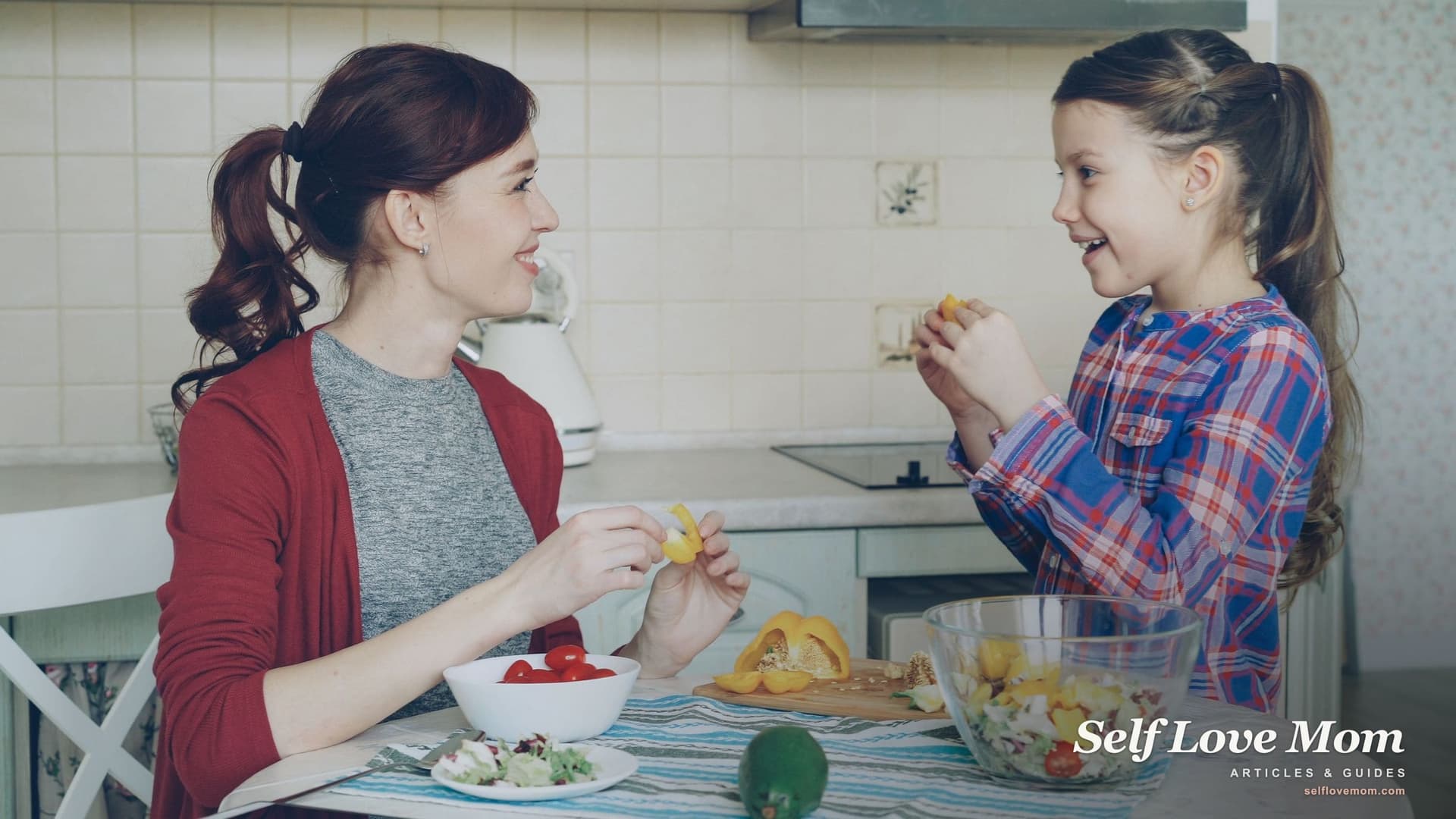
A single mom and her daughter make a salad together at the kitchen table, one small moment in a day full of choices that feed decision fatigue.
It is 9:40 on a school night. A permission slip needs a yes or a no, tomorrow's lunch needs a plan, and a cough from the bedroom raises the question of whether to call the pediatrician in the morning. In a two-parent home, some of those land on someone else. When you are a single mom, every one of them lands on you.
That worn-down, cannot-pick-one-more-thing feeling has a name: decision fatigue. This guide covers what researchers mean by it, where the evidence holds and where it has cracked, and how a single mother can cut the number of choices she makes from scratch each day. Every study cited here was read, in full or in abstract, on October 21, 2026.
The short version
- Decision fatigue describes weaker choices and self-control after a long run of decisions
- The lab theory behind it, "ego depletion," came out close to zero in two large replication projects, in 2016 and 2021
- Real-world patterns, such as doctors prescribing more antibiotics late in a clinic session, still suggest something worth planning around
- The fix that holds up either way: make recurring choices once, then let the default run
Decision fatigue, in plain words
A concept analysis in the Journal of Health Psychology defines decision fatigue as "the impaired ability to make decisions and control behavior as a consequence of repeated acts of decision-making" (Pignatiello and colleagues, Decision Fatigue: A Conceptual Analysis). The authors reviewed 17 relevant articles and sorted the warning signs into three groups: behavioral, cognitive and physiological.
The behavioral signs are the ones you notice first. The same analysis lists impulsivity, passivity and avoidance: putting a choice off, letting someone else pick, or grabbing whatever option ends the choosing. It also names sleep deprivation as one of the conditions that sets the stage.
For a single mom, those signs of decision fatigue tend to look like this:
- "Whatever you want" becomes the answer to the dinner question, and nobody likes the result
- Small online orders pile up after the kids are asleep
- A school form sits unsigned for three days because it needs one decision
- A simple either-or question from your child gets a sharp answer
- Screens win by default because picking an activity feels like a project
Why decision fatigue hits harder when you parent alone
One lab finding speaks directly to solo parenting. In a 2008 series of studies, Kathleen Vohs and colleagues reported that making choices was more draining than just thinking about the options, and more draining than carrying out choices someone else had made (Vohs and colleagues, 2008).
In a two-adult home, one partner can hand the other a decision already made. A single mom rarely gets that handoff. A caution belongs here, though: the 2008 studies used the same lab method that later failed large replication tests, covered below, so treat the idea as useful rather than proven.
The workload is real either way. In 2025, 75.6% of mothers heading their own families were employed, according to the Bureau of Labor Statistics. For most single mothers, a workday full of choices stacks on top of every household decision, with no second adult to split the evening.
Sleep adds to the load. A National Center for Health Statistics data brief found that women raising children alone were the group most likely to sleep under seven hours and to wake up feeling unrested (NCHS Data Brief 230). Poor sleep and decision fatigue feed each other, and the chart shows how wide the gap was.
What the research shows, and where it cracked
Many articles present decision fatigue as settled science. It is not. The idea grew out of "ego depletion," the theory that self-control draws on a limited inner resource. In the 1998 study that launched it, people who made themselves eat radishes instead of chocolates then quit sooner on unsolvable puzzles (Baumeister and colleagues, 1998).
The famous real-world example followed in 2011. Researchers studied Israeli parole boards and reported that favorable rulings fell from about 65% to nearly zero across each session, then returned to about 65% after a food break (Danziger and colleagues, PNAS). The data set held 1,112 rulings.
Critics found other explanations. Court staff and attorneys told two researchers that case order was not random: prisoners without lawyers usually came last in a session and won parole 15% of the time, against 35% for those with counsel (Weinshall-Margel and Shapard, PNAS letter).
A 2016 simulation added a second explanation: the pattern could appear simply because favorable rulings take longer to hear, so a judge who plans even slightly ahead would end sessions on shorter, unfavorable cases (Glöckner, Judgment and Decision Making).
Then came the replication tests. A preregistered project across 23 labs and 2,141 people found an effect of d = 0.04, too small to tell apart from zero (Hagger and colleagues, 2016). A second project, across 36 labs and 3,531 people with Vohs as lead author, found d = 0.06, which was not statistically significant (Vohs and colleagues, 2021). None of this makes decision fatigue imaginary; it means the original explanation for it is shaky.
Some field data still point the same way. In one health system's 23 primary care practices, the odds of a clinician prescribing antibiotics for a respiratory infection were 1.26 times higher in the fourth hour of a session than in the first (Linder and colleagues, JAMA Internal Medicine). The authors say general tiredness or other factors could explain it.
Belief may play a part too. A 2010 Stanford study found that people who did not see willpower as a limited supply showed no drop in self-control after a draining task (Job, Dweck and Walton, 2010). The 2021 multisite project, though, found that willpower beliefs did not change its result. The takeaway for a single mom is modest: the evening slump is real enough to plan around, but it is not proof that your willpower is used up.
| Study or claim | What it reported | How it has held up |
|---|---|---|
| Baumeister and colleagues, 1998 | Resisting chocolate cut persistence on a later puzzle task | Large preregistered tests of ego depletion in 2016 and 2021 found little or no effect |
| Vohs and colleagues, 2008 | Making choices drained self-control more than following someone else's choices | Built on the lab method that later failed those replications |
| Danziger and colleagues, 2011 | Parole approvals fell across each session and rebounded after food breaks | Case order and case length offer other explanations |
| Hagger and colleagues, 2016 | 23 labs, 2,141 people: effect near zero | Preregistered, and a major blow to the theory |
| Vohs and colleagues, 2021 | 36 labs, 3,531 people: no significant effect | Exploratory data hinted at a larger effect in people who already felt fatigued |
| Linder and colleagues, 2014 | Antibiotic prescribing rose as clinic sessions wore on | Real-world data; the authors flag possible confounding |
| "35,000 decisions a day" | Repeated in health articles, including an AMA explainer | A 2018 review cites it to a 2016 newspaper column, not a study |
That last row deserves a word. A psychiatrist repeats the 35,000 figure in an American Medical Association explainer, and the 2018 concept analysis cites it to a 2016 Wall Street Journal column rather than to research. None of these sources points to a study that counted daily decisions, so it has no place in a plan for your week.
Decide once: defaults that run without you
Because the mechanism is disputed, the fix for decision fatigue that works under any theory is to lower the number of fresh decisions. Each default below turns a daily choice into a one-time choice, which matters most for a single mom who is the only adult making them.
- A two-week dinner rotationWrite ten weeknight dinners on one list and repeat them. "What's for dinner?" already has an answer on the fridge. Shop from the same base grocery list each week and change only the produce.
- A capsule school wardrobeKeep five or six tops and bottoms per child that all match, and let the kids choose only from that drawer. Laid out the night before, the morning outfit stops being a debate.
- A fixed morning orderSame sequence every school day: dress, breakfast, teeth, bags by the door. A posted list does the reminding, and a single mom daily routine built around blocks keeps the rest of the day from needing new plans.
- Bills timed to paydaySet fixed bills to draw a day or two after your paycheck lands, so you are not deciding when to pay each one. Keep a small cushion in checking and look at the account once a week. A single mom budget gives each dollar a job in advance.
- One weekly decision hourBatch sign-ups, forms, appointments and the grocery order into one sitting on a calm morning. Questions that come up during the week go on a list for that hour instead of getting answered at 10 p.m.
- Standing answers to repeat requestsDecide once on screen limits, school-night sleepovers and snacks before dinner. Write the rules down and point to them, so a request does not reopen the whole question every night.
- The two-option ruleGive young kids two choices you can live with: the red cup or the blue cup, a bath now or after one show. They still get a say, and you skip open-ended negotiations.
- A sick-day plan on paperKeep your pediatrician's after-hours number, a backup sitter and your employer's leave rules in one note. When a child wakes up sick at 6 a.m., you follow the plan instead of building one half-awake.
Handing decisions to your kids, by age
In a single-mom home, the children are the only other people under the roof. Giving them real, age-sized choices takes items off your list, eases your decision fatigue and builds their judgment. The split below is a starting point, not a rule; adjust it to each child.
| Age | Choices they can own | What you still decide |
|---|---|---|
| 3 to 5 | Which of two outfits, the bedtime book, which fruit at snack time | Bedtime, food offered, anything about safety |
| 6 to 9 | Packing lunch from a set list, a weekend activity from two or three options, spending a small allowance | The schedule, screen rules, money limits |
| 10 to 13 | One family dinner a week from the rotation, the order of their homework, gifts for friends within a budget | Devices, curfew, medical calls |
| 14 and up | Their own school and work calendar, part of the grocery list, a weeknight dinner they cook | Driving, large purchases, safety rules |
Older children of a single mother often pick up extra jobs. Keep what you hand over to tasks and small choices. Adult worries, like rent or a hard call about their other parent, stay with you or with another trusted adult.
Rules for the bigger calls
Some choices cannot run on autopilot: a new lease, a job offer, a school change. A single mom facing them without a partner can use a few rules to keep decision fatigue from steering the outcome.
- Give hard calls your fresh hours. If the clinic data hold even partly, a big decision deserves a morning slot, not the stretch after bedtime.
- Use a 24-hour rule on purchases. Anything above an amount you set waits a day. Late-evening impulse buys are one of the classic signs in the research.
- Borrow a second adult. A friend, a sibling or someone from single mom support groups can stand in for the missing co-parent on one question: "Here are my two options. Which would you pick?"
- Set a "good enough" bar. For low-stakes choices, the first option that meets your needs wins. Comparing a ninth backpack costs time you do not have.
- Say no without a long defense. Every extra commitment adds decisions. If guilt follows each no, mom guilt has its own practical fixes.
When it is more than decision fatigue
Decision fatigue usually eases with sleep, a lighter week or a few defaults. Trouble making decisions is one of the symptoms of depression the National Institute of Mental Health lists, and a diagnosis requires symptoms most of the day, nearly every day, for at least two weeks. For people with depression, NIMH advises putting off major life decisions until they feel better. Steady self-care for single moms habits, sleep first, make the ordinary kind of decision fatigue lighter.
Exhaustion that runs for months, with dread about jobs you once handled, can point to burnout instead. A guide on how long burnout lasts lays out recovery timelines. When self-help is not enough, therapy for overwhelmed moms explains when to get help and which kinds of therapy fit.
If you feel hopeless or think about harming yourself, call or text 988. The 988 Suicide and Crisis Lifeline is free and confidential, and you do not have to be suicidal to reach out; money worries and loneliness are among the reasons it lists. If you or your child is in immediate danger, call 911.
Frequently asked questions
Is decision fatigue a medical diagnosis?
No. It is a research concept for weaker choices and self-control after many decisions in a row, not a condition a doctor diagnoses. If trouble deciding comes with low mood, lost interest or changes in sleep and appetite for two weeks or more, talk to a doctor, because those can be signs of depression.
Why does decision fatigue feel heavier for a single mom?
Because there is no handoff. In a two-adult home, one partner can take the school forms while the other plans dinner. A single mom covers both, often after a full workday and on short sleep, so the evening choices arrive when her reserves are lowest. Fewer fresh decisions, not more effort, is the realistic fix.
Did the research behind decision fatigue fail to replicate?
The lab version did. Two large preregistered projects, published in 2016 and 2021, found the classic ego depletion effect close to zero. Field studies of judges and doctors show choices shifting over long sessions, but other explanations exist. The practical advice of fewer and earlier decisions holds up whatever the mechanism turns out to be.
What is a quick reset on a bad evening?
Stop deciding for the rest of the night. Serve a dinner from your rotation, set out tomorrow's clothes from the capsule drawer, and write any open question on the list for your weekly decision hour. Then protect your bedtime, since short sleep is one of the conditions linked to poor decisions the next day.
Do kids make decision fatigue worse?
Mostly through volume. Young children ask for choices all day: which cup, which show, one more story. Offering two set options, posting a routine chart and giving older kids real jobs cuts the count. Their questions are not the problem; open-ended questions answered fresh each time are what wear down a single mom with no one to share them.
Sources
- Pignatiello GA, Martin RJ, Hickman RL. Decision Fatigue: A Conceptual Analysis, Journal of Health Psychology (PMC full text). pmc.ncbi.nlm.nih.gov (retrieved October 21, 2026)
- Vohs KD and colleagues. Making choices impairs subsequent self-control, Journal of Personality and Social Psychology, 2008 (PubMed abstract). pubmed.ncbi.nlm.nih.gov (retrieved October 21, 2026)
- U.S. Bureau of Labor Statistics. Employment Characteristics of Families, 2025 (released April 23, 2026). bls.gov (retrieved October 21, 2026)
- National Center for Health Statistics. Data Brief No. 230, Sleep Duration, Quality of Sleep, and Use of Sleep Medication, by Sex and Family Type, 2013 to 2014. cdc.gov (retrieved October 21, 2026)
- Baumeister RF and colleagues. Ego depletion: is the active self a limited resource? Journal of Personality and Social Psychology, 1998 (PubMed abstract). pubmed.ncbi.nlm.nih.gov (retrieved October 21, 2026)
- Danziger S, Levav J, Avnaim-Pesso L. Extraneous factors in judicial decisions, PNAS, 2011 (PubMed abstract). pubmed.ncbi.nlm.nih.gov (retrieved October 21, 2026)
- Weinshall-Margel K, Shapard J. Overlooked factors in the analysis of parole decisions, PNAS, 2011 (PMC full text). pmc.ncbi.nlm.nih.gov (retrieved October 21, 2026)
- Glöckner A. The irrational hungry judge effect revisited, Judgment and Decision Making, 2016 (PDF). journal.sjdm.org (retrieved October 21, 2026)
- Hagger MS and colleagues. A Multilab Preregistered Replication of the Ego-Depletion Effect, Perspectives on Psychological Science, 2016 (PubMed abstract). pubmed.ncbi.nlm.nih.gov (retrieved October 21, 2026)
- Vohs KD and colleagues. A Multisite Preregistered Paradigmatic Test of the Ego-Depletion Effect, Psychological Science, 2021 (PubMed abstract). pubmed.ncbi.nlm.nih.gov (retrieved October 21, 2026)
- Linder JA and colleagues. Time of day and the decision to prescribe antibiotics, JAMA Internal Medicine, 2014 (PMC full text). pmc.ncbi.nlm.nih.gov (retrieved October 21, 2026)
- Job V, Dweck CS, Walton GM. Ego depletion: is it all in your head? Psychological Science, 2010 (PubMed abstract). pubmed.ncbi.nlm.nih.gov (retrieved October 21, 2026)
- American Medical Association. What doctors want patients to know about decision fatigue (March 21, 2025). ama-assn.org (retrieved October 21, 2026)
- National Institute of Mental Health. Depression (publication). nimh.nih.gov (retrieved October 21, 2026)
- 988 Suicide and Crisis Lifeline. Get help. 988lifeline.org (retrieved October 21, 2026)
✻ Share this article
✻ About the contributor · Folio N°.219

Written by Subha
Writer and researcher covering the topics that matter most to single moms, money, mental health, and the small daily rituals that keep a family running. Every article is research-backed and checked against official sources.
- Articles
- 219
- Desks
- 05
- Edited
- 4×
More from this writer
✻ Checked against official sources