29 Hobbies for Relaxation: Simple Self-Care Ideas for Busy Moms
The average adult gets 5.2 hours of leisure a day and spends 2.6 watching TV. Here are 29 hobbies for relaxation that fit real life, sorted by effort.

 Click to zoom
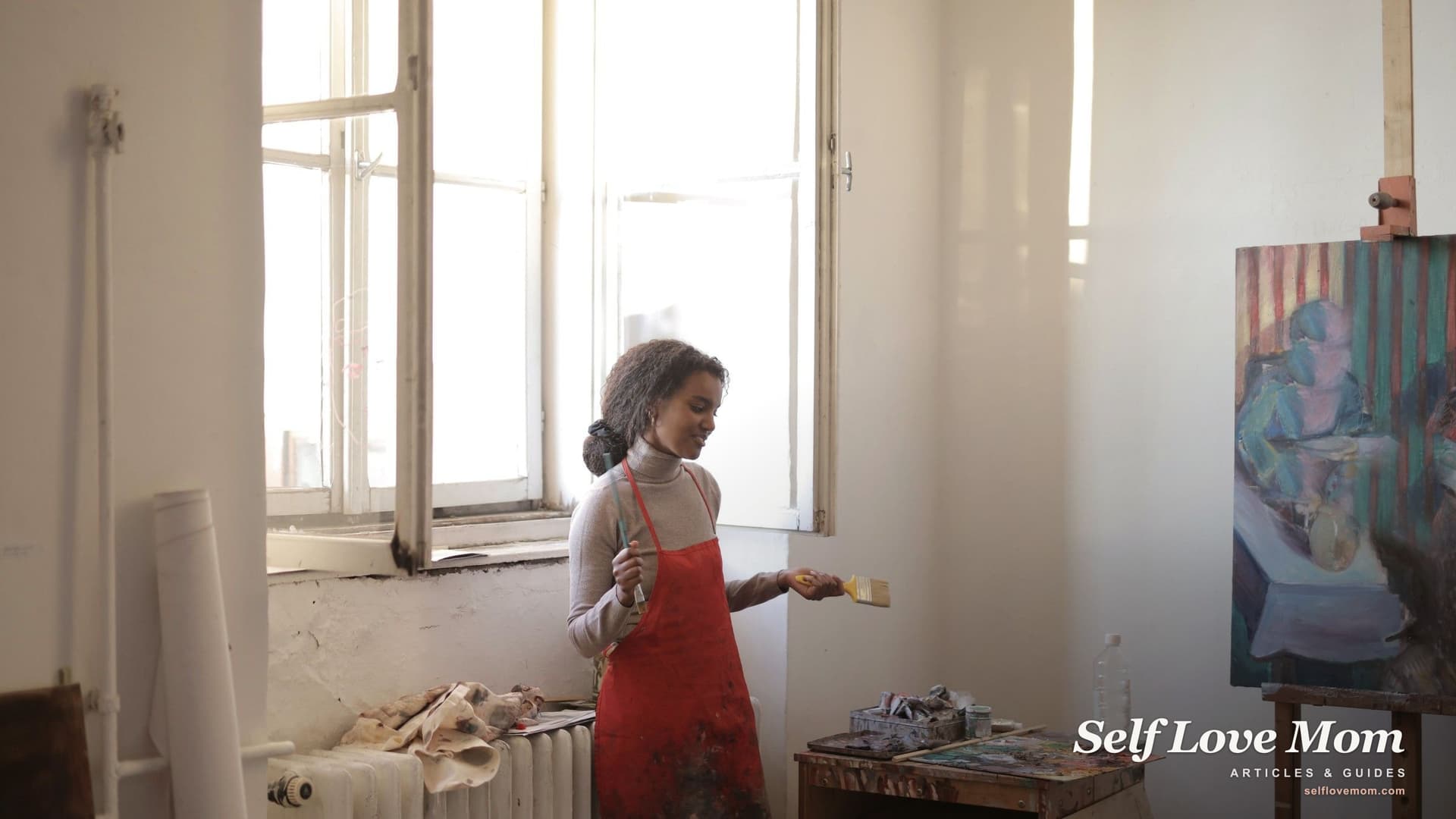
A woman painting at an easel by a bright window, one of the most absorbing hobbies for relaxation.
You are probably not as short of downtime as it feels. The average adult gets 5.2 hours of leisure a day and spends 2.6 of them watching TV. For a mom of young children the total is smaller, nearer 3.2 hours, but the shape holds: TV takes the biggest single share of whatever you get.
That reframes the problem. The question is rarely where to find the time. It is what to put in the time you already have, on a night when you are too tired to decide.
| Average leisure time per day | Of that, time spent watching TV | Weekly nature contact linked to better health |
|---|---|---|
| 5.2 hrs | 2.6 hrs | 120 min |
The short version
Hobbies are not a luxury bolt-on. In a real-time study, people reported less stress and showed a measurably lower heart rate while doing leisure than when not. The 29 hobbies for relaxation below are sorted by effort, opening with creative ones and ending with the ones that ask almost nothing of you on a bad night.
Do hobbies actually reduce stress?
Yes, and it shows up in the body rather than only in how people describe their day. In a 2015 study in Annals of Behavioral Medicine, researchers pinged 115 people six times a day for three days and measured them in the moment. Participants reported more positive mood, more interest, and less stress while engaged in leisure, and their heart rate was lower.
The design matters more than the sample size. Because it caught people during the activity rather than asking them to remember it later, it avoids the obvious trap that people who feel better simply recall their hobbies more fondly.
The catch is what counts. Watching TV is leisure and it does have value, but it is passive, and it already occupies half your downtime. A hobby is a different use of the same hour: something with your hands or your attention in it.
Creative hobbies for relaxation
Making something occupies the part of your mind that otherwise runs the list. Start here if your problem is that you cannot stop thinking.
All five start for under twenty dollars, and none of them punish you for being out of practice. That matters more than it sounds. The most common reason a creative hobby dies in week two is that it started as a project with a deadline attached.
- 1. Painting. A small canvas or a cheap sketchbook. The absorption is the point, not the result.
- 2. Drawing or sketching. Draw what is in front of you. It pulls attention outward, which is why it settles the mind.
- 3. Adult coloring. Structured and repetitive on purpose. Good for ten-minute gaps.
- 4. Journaling. Your day, your worries, or three good things. A plain notebook is enough.
- 5. Creative writing or poetry. Nobody has to read it. That is what makes it honest.
Craft hobbies for relaxation
Repetitive handwork is the closest thing to meditation for people who cannot sit still. You also end up with something, which helps on the days when rest alone feels indulgent.
Craft hobbies for relaxation share one useful property: they pause cleanly. You can stop mid-stitch, deal with a child, and pick the thread back up an hour later without having lost anything.

- 6. Knitting or crocheting. The rhythm does the work. Cheap to start, easy to put down mid-row.
- 7. Embroidery. Portable, quiet, and it survives being interrupted.
- 8. Candle making. A kit and an evening. Makes gifts, which takes care of December.
- 9. Soap making. Same logic, more chemistry, and the kids can watch.
- 10. DIY home decor. Small projects with what is already in the house.
- 11. Jewelry making. Fiddly in a good way. Beads cost very little.
Mindful and calm hobbies for relaxation
These aim directly at the nervous system. Two of them also get you the 120 minutes a week of nature contact that research links to better health and wellbeing, whether you take it in one go or in pieces.
- 12. Meditation. Free apps, or silence. Ten minutes counts.
- 13. Yoga or stretching. Free videos at home. No class fee, no sitter.
- 14. Nature walks or gardening. The one with the best evidence behind it. Kids can come.
- 15. Puzzles. Absorbing, and you can leave one out on the table for a week.
- 16. Bird watching. Costs nothing, works from a window, and gets you outdoors.
Simple and easy hobbies for stress relief
Low barrier, low setup. These are the ones you will still do when you are tired, which is most of the point.
Do not mistake simple for lesser. A hobby you actually do twice a week beats an ambitious one you do twice a year, and hobbies for stress relief only work at the frequency you can sustain.

- 17. Reading. The library is free, and so is the app that borrows from it.
- 18. Music or podcasts. The only hobby that works while you fold laundry.
- 19. Films or documentaries. Passive, yes, but chosen on purpose rather than scrolled into.
- 20. Making playlists. Small, creative, and oddly satisfying.
- 21. Tea rituals. The point is the five minutes it takes to drink it hot.
Indoor hobbies for relaxation at home
For when leaving is not happening. These are the hobbies for relaxation that need no sitter, and all four work with children awake in the same room. If most of your day happens at home, our list of hobbies for stay at home moms starts even smaller.

- 22. Houseplants. Ten minutes of tending something that is not a person.
- 23. Board games or solo cards. Works alone or with the kids.
- 24. Origami. Paper and a video. Genuinely absorbing for the cost of nothing.
- 25. Learning a language. Free apps, five minutes a day, and it compounds.
Almost-no-effort hobbies for a bad day
Some nights you have nothing left. These still count, and choosing one beats defaulting to the screen. The bar here is deliberately on the floor: the aim is a hobby that asks nothing of you on your worst evening, so that the habit survives the week rather than collapsing with it.
- 26. Cutting and collaging. Old magazines, scissors, no skill required.
- 27. Easy games or puzzles. Undemanding on purpose.
- 28. Nature sounds or ASMR. Works in the dark, works in bed.
- 29. Doodling patterns. Repetitive lines. It is closer to meditation than to art.
What if you have not had a hobby in years?
This is the most common version of the problem, and lists rarely address it. If someone asked what you enjoy and you came up blank, that is not a personality defect. It is what happens when every hour has been spoken for by someone else for a long time.
Do not try to remember what you loved. Preferences go quiet when they are never consulted, and interrogating yourself about it mostly produces guilt. Pick something from this list on the weakest possible grounds: it looked mildly interesting, or it was cheap. Our fun hobbies for women list works on the same principle from the playful end.
Then give it three sessions before judging it. The first one is nearly always awkward, because you are out of practice at being the person being pleased. Enjoyment tends to arrive after competence, not before it, which is exactly backwards from how hobbies are usually sold.
If three sessions in it is still a chore, drop it without ceremony and take the next one. You are not failing at hobbies. You are running cheap experiments to find out who you are now, which is different from who you were before the kids.
How do you actually make time for a hobby?
By swapping rather than adding. Hobbies for relaxation do not need an hour you have to invent, because you already have one going somewhere by default. The same swap logic runs through our self care activities list.
- Take it out of the TV hour. Not all of it. The first twenty minutes, before the autoplay decides for you.
- Leave it out where you can see it. The knitting on the arm of the chair. Setup cost is what kills hobbies, not time.
- Pick one that survives interruption. If a hobby dies when a child walks in, it is not the right one for this decade.
- Let it be bad. A hobby you are graded on is a job. The whole value is that nobody is checking.
If none of this is landing and the tiredness is deeper than a busy week, that is worth naming. Our guide to stress management for moms covers what to do when rest stops working.
Frequently Asked Questions
What is the most relaxing hobby?
There is no single answer, but the ones with the best evidence involve nature or repetitive handwork. Spending at least 120 minutes a week in nature is associated with better health and wellbeing, and it made no difference whether that came in one visit or several short ones. Gardening and walking both qualify.
Are hobbies for relaxation worth it if I only have ten minutes?
Yes. The real-time leisure research measured people during the activity and found lower stress and heart rate while it was happening, not only after a long session. Ten minutes most days beats a two-hour block you keep postponing.
Does watching TV count as a hobby?
It counts as leisure, and it is not nothing. But it already takes 2.6 hours of the average 5.2-hour leisure day, so it is rarely the thing you are missing. The hobbies on this list are a different use of an hour you are already spending.
What are good hobbies for moms with no money?
Walking, bird watching, library books, doodling, meditation, and podcasts all cost nothing. Two of the strongest options on this list, nature time and reading, are free by default, and the evidence behind them is better than for most things sold as relaxation.
How do I stick with a hobby when I keep getting interrupted?
Choose one built to be dropped mid-task. Knitting, coloring, embroidery, and puzzles all survive a child walking in, because you can stop at any point and lose nothing. Hobbies that need a clean hour tend not to last through early parenting.
Sources
- Zawadzki, M.J., Smyth, J.M., and Costigan, H.J., "Real-Time Associations Between Engaging in Leisure and Daily Health and Well-Being," Annals of Behavioral Medicine 49(4):605-615 (2015), doi:10.1007/s12160-015-9694-3 (retrieved 2026-07-20). Ecological momentary assessment of a community sample of 115 people, six times daily over three consecutive days; participants had more positive and less negative mood, more interest, less stress, and lower heart rate while engaging in leisure than when not.
- White, M.P., Alcock, I., Grellier, J., Wheeler, B.W., Hartig, T., Warber, S.L., Bone, A., Depledge, M.H., and Fleming, L.E., "Spending at least 120 minutes a week in nature is associated with good health and wellbeing," Scientific Reports 9:7730 (2019), PMID 31197192 (retrieved 2026-07-20). The association held whether the 120 minutes came from one long visit or several shorter ones.
- U.S. Bureau of Labor Statistics, "American Time Use Survey Summary, 2025 Results," USDL-26-1022 (released 2026-06-25, retrieved 2026-07-20). Leisure averages 5.2 hours per day, of which watching TV accounts for 2.6 hours; games or computer use for leisure 37 minutes; socializing 35 minutes. Employed adults living with a child under 6 averaged 3.2 hours of leisure per day.
✻ Share this article
✻ About the contributor · Folio N°.180

Written by Subha
Psychologist and writer covering the topics that matter most to single moms, money, mental health, and the small daily rituals that keep a family running. Every article is research-backed and edited four times before publish.
- Articles
- 180
- Desks
- 05
- Edited
- 4×
More from this writer
✻ Edited four times before publish