50+ Inexpensive Self Care Activities for Women to Try in 2026
Employed moms of a child under 6 average just 3.2 hours of leisure a day. Here are 56 inexpensive self care activities that fit the time you actually have.

 Click to zoom
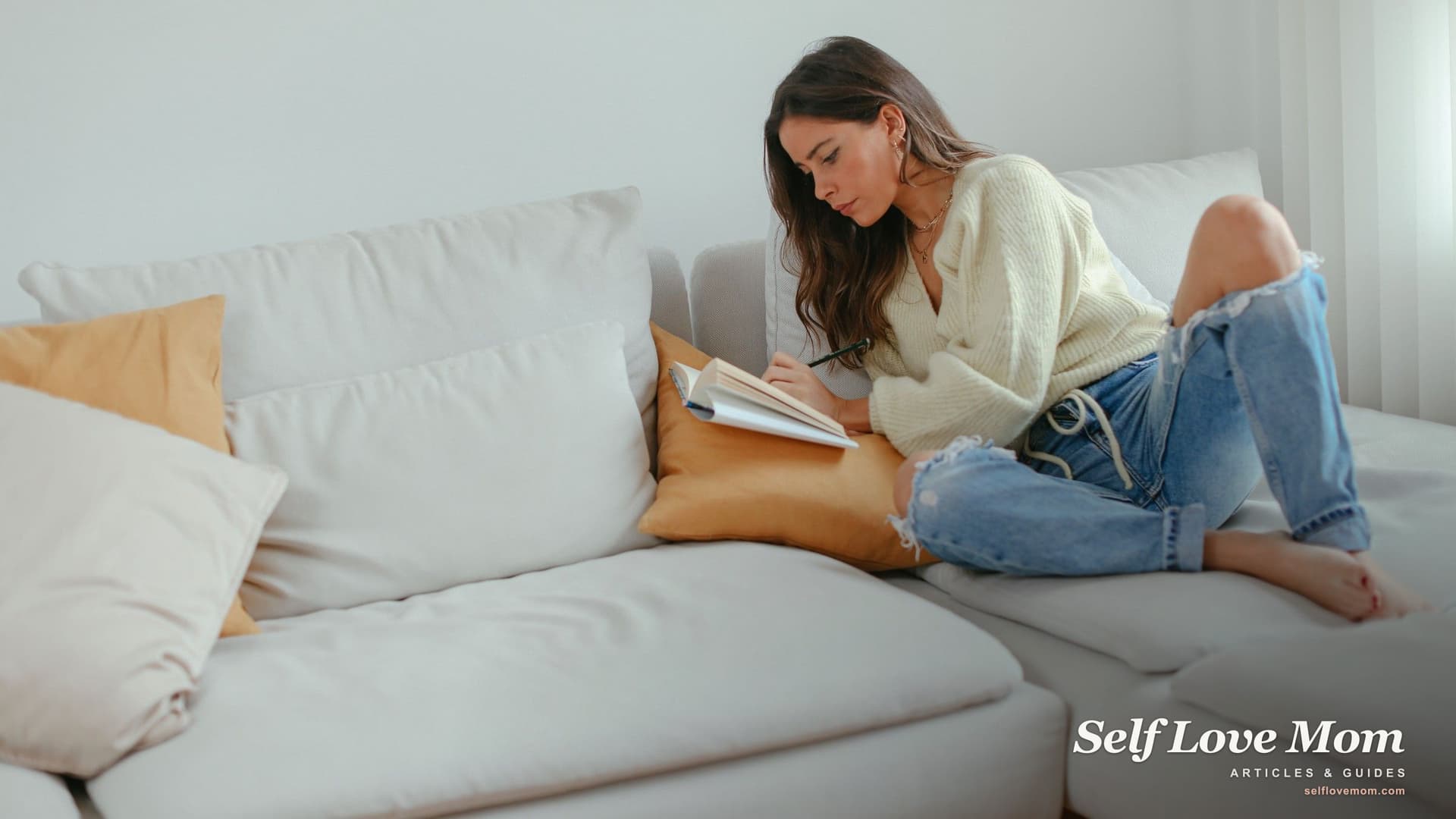
A woman writing in her journal on the couch, one of the simplest self care activities that fits inside a real day.
Most lists of self care activities are written for someone with an empty afternoon. You do not have one. If you are the only adult in the house, the gap between that advice and your actual day is the whole problem.
So this guide starts with the time you really have, which is measured and smaller than most people assume, and then fills it. Everything below is inexpensive, most of it is free, and none of it needs the house to be quiet.
| Daily leisure, employed parent of a child under 6 | Daily leisure, employed adult with no children | Share of leisure time spent watching TV |
|---|---|---|
| 3.2 hrs | 4.5 hrs | 50% |
The short version
Employed parents of a child under six average 3.2 hours of leisure a day, against 4.5 for adults with no children, and roughly half of that is television. The 56 ideas below are built for that gap. Most cost nothing, most take under twenty minutes, and none of them require an empty house.
Why is self-care so hard for moms specifically?
Because the time genuinely is not there, and that is measured rather than felt. In the 2025 American Time Use Survey, employed adults living with a child under six averaged 3.2 hours of leisure per day. Employed adults with no children under 18 averaged 4.5. That difference of about 78 minutes is the space your self-care has to fit inside.
The gap has a shape, too. Across all adults, men averaged 5.6 hours of leisure a day against 4.8 for women. Among adults living with a child under six, women spent 2.8 hours a day on primary childcare while men spent 1.7.
There is a second number that explains why leisure can still feel like work. Adults living with a child under 13 logged 5.1 hours a day of secondary childcare, meaning a child was in their care while they did something else. Your time off is supervised. If you are the only adult in the house, there is nobody to hand that to.
This is why the usual advice fails. It is not that you lack discipline. It is that the plan assumed a spare afternoon and a second parent, and you have neither.
What is self-care not?
Before the list, it helps to clear out four ideas that make self-care feel out of reach. Each one quietly raises the bar until nothing qualifies.
- Not self-indulgence. Treating yourself is fine, but the point is balance, not escape into overspending you will regret on Monday.
- Not avoiding responsibility. A break is a reset, not a hiding place. The aim is to come back to the day with something left.
- Not a one-time rescue. Self-care is not the thing you finally do at breaking point. It works as a rhythm, not an emergency measure.
- Not expensive. Nearly everything on this list is free or close to it. A spa day is a nice option, not the standard.
The version that survives real life is small, repeatable, and unglamorous. That is not a downgrade. It is the only version that fits an actual week.
How do you choose a self care activity that fits?
Match the activity to what is actually depleted. Reaching for the wrong one is why self care activities so often feel like another chore rather than a break.
- Name what is empty. Physical rest, mental quiet, and social contact are different needs. A nap will not fix loneliness.
- Fit it to the gap you have. Ten real minutes beats a two-hour plan you will cancel.
- Pick what you would do anyway. If you dread it, it is a chore wearing a nicer name.
- Choose repeatable over perfect. Five ordinary Tuesdays beat one flawless Saturday that never comes.
50+ inexpensive self care activities for women
Fifty-six self care activities, grouped by what they restore. Start with the category matching whatever is most depleted today rather than working through in order.
1. Mental health self care activities
These work on the mental noise that does not stop when the kids go to bed.
- Guided meditation. Free apps like Insight Timer, or any YouTube video, in whatever quiet corner exists.
- Breathing exercises. Slow the exhale and the heart rate follows. Works anywhere, including a locked bathroom.
- Journaling. Thoughts, worries, plans. A plain sheet of paper counts.
- A power nap. Fifteen to thirty minutes is enough to take the edge off without the groggy afterward.
- Mindful walking. Walk and actually notice what you see and hear instead of running the mental list.
- Digital detox. A few hours off every device. Given that TV alone accounts for half of all leisure time, this one buys back the most.
2. Physical self-care for your body
Your body holds the stress first. These are the fastest self care activities because they work on it directly.

- DIY facial mask. Honey, avocado, or oatmeal from the kitchen.
- Stretching routine. Five minutes on whatever is tightest, usually neck and shoulders.
- At-home spa hour. Candles, music, a long shower with the door actually shut.
- DIY nail spa. A manicure at home for the price of one polish.
- Epsom salt bath. Warm water and salt at the end of a long day.
- Yoga. Free videos at home, no class fee, no childcare needed.
- Sleep mask. A few dollars, and it makes broken sleep slightly less broken.
3. Creative outlets
Making something is one of the few activities that is genuinely absorbing rather than merely restful. Our list of hobbies for relaxation goes deeper on this category.
- Painting or drawing. Paper and markers. Being bad at it is not disqualifying.
- DIY crafting. Whatever is already in the house.
- Coloring books. Adult coloring is repetitive on purpose, which is the point.
- Write poetry. Nobody has to read it.
- Play an instrument. If you once played, ten minutes will remind you why.
- Photography. A phone and a walk.
- Upcycle something. A worn T-shirt becomes a tote bag, cardboard becomes art.
4. Health and wellness
Small physical maintenance that compounds quietly over weeks.
- Herbal tea. Chamomile or lavender, and the five minutes it takes to drink it hot.
- Hydrate. Unglamorous, and it does more for afternoon energy than most things that cost money.
- Walk or jog. Around the block counts.
- Practice gratitude. Three things, written down, most days.
- Cook one real meal. Not for anyone else. For you.
- Aromatherapy. A few drops of lavender or eucalyptus in a diffuser or the bath.
- Cold water on your face. It slows the heart rate within seconds, which is why it works when nothing else will.
5. Fun and recreation
Self care activities do not have to be earnest to work.
- Movie night at home. Blankets, snacks, the film you keep postponing. Build it into a full self care night if the evening is yours.
- Virtual book club. Join one, or start one with two friends.
- Dance it out. One loud song in the kitchen. The kids will join in.
- Board games. With family or friends, and they count as social too.
- Puzzles. Absorbing, cheap, and you can leave one out for days.
- Picnic in the park. The same lunch, outdoors.
6. Home and reset
Contested territory, because housework is not self-care. The exception is when the mess itself is the thing draining you.
- Declutter one small area. A single drawer. Not the house.
- Rearrange the furniture. A free change of scenery.
- Reset the kitchen. Waking up to a clear counter changes the morning.
- Laundry with a podcast. The chore is happening anyway. Make it yours.
- Plant care. Ten minutes of tending something that is not a person.
7. Social connection
Isolation is the part of single motherhood that gets least airtime. Only 30 percent of people socialized on an average day in 2025, down from 38 percent a decade earlier.
- Phone a friend. An actual call, not a text thread.
- Write a card. Slower than a message, and it lands differently.
- Virtual coffee date. No sitter, no travel, still counts.
- Volunteer locally. Purpose and company in the same hour.
8. Getting out of the house
A change of scenery resets more than its cost suggests. Aim for the 120 minutes of weekly nature contact linked to better health.

- Day trip somewhere new. One tank of gas, one town you have never seen.
- Museum or gallery. Many have free or discounted days.
- Nature hike. A local park or reserve. Kids can come.
- Stargazing. A blanket and a clear night. Free.
- Mini road trip. Sometimes a reset is just different scenery.
9. Travel-like ideas at home
When leaving is not realistic, these self care activities borrow the feeling without the cost.

- DIY staycation. A home retreat: movie night, or a picnic in the yard.
- Cook a cuisine you have never made. A food tour of your own kitchen.
- Watch documentaries. Somewhere far away, from the couch.
- Take a virtual tour. Museums and landmarks worldwide offer them free.
- Build a bucket list. Naming where you want to go is its own small pleasure.
10. Self care for women over 50
Priorities shift toward keeping strength, balance, and purpose rather than chasing intensity.
- Join a fitness class. Many communities run low-impact classes for the over-50s.
- Tai chi or qigong. Gentle, and specifically good for balance.
- Volunteer for a cause. Purpose is a health input, not a luxury.
- Look after your skin. Moisturizer and sunscreen, consistently.
What if you only have ten minutes?
Then use them in this order. This is the floor, not the ideal, and it is genuinely better than waiting for a better week that is not coming.
- Two minutes: slow the exhale. Breathe out longer than you breathe in. Do it before you walk back through the door.
- One minute: cold water. On your face and wrists. It resets the body faster than talking yourself down.
- Five minutes: get outside. Daylight and air, even in the doorway. This is the one that compounds, because it fixes the night.
- Two minutes: write the top three. The three things actually pressing on you. Seeing them shrinks them.
If ten minutes feels impossible most days rather than some days, that is worth noticing. It usually means the problem has moved past a busy week, and our guide to stress management for moms covers what to do about it.
Frequently Asked Questions
What are good self care activities when you have no money?
Most of the strongest ones are free. Walking, sleep, sunlight, breathing, journaling, and calling a friend cost nothing and have better evidence behind them than anything sold as self-care. Spending at least 120 minutes a week in nature is associated with better health and wellbeing, and a public park is free.
How much time do I actually need for self-care?
Less than the advice implies. The nature research found that 120 minutes a week worked whether it came as one long visit or several short ones, which means ten minutes most days is a legitimate strategy rather than a compromise.
Why does self-care feel like just another chore?
Usually because the activity does not match what is depleted, or because it needs setup you do not have. If you are tired, a social event is work. If you are lonely, a bath will not touch it. Name what is empty first, then pick. The eight types of self care are a quick map for doing that.
Is doing housework self-care?
Generally no. On days they do household activities, women average 2.8 hours on them against 2.1 for men, so adding more of it is rarely restorative. The narrow exception is when a specific mess is the thing draining you, and clearing one small area buys back real mental space.
What self care activities work with kids in the house?
The ones that do not need you to leave or be silent. Breathing, stretching, music, coloring, and a walk with the stroller all survive company. This matters more than it sounds: adults living with a child under 13 average 5.1 hours a day supervising while doing something else.
Sources
- U.S. Bureau of Labor Statistics, "American Time Use Survey Summary, 2025 Results," USDL-26-1022 (released 2026-06-25, retrieved 2026-07-20). Leisure: employed adults with a child under 6 averaged 3.2 hours per day vs 4.5 with no children under 18; men 5.6, women 4.8; ages 35 to 44 lowest at 3.9; TV 2.6 of 5.2 hours; secondary childcare 5.1 hours; household activities 2.8 hours for women vs 2.1 on days they did them; socializing 30% in 2025 vs 38% in 2015.
- White, M.P., Alcock, I., Grellier, J., Wheeler, B.W., Hartig, T., Warber, S.L., Bone, A., Depledge, M.H., and Fleming, L.E., "Spending at least 120 minutes a week in nature is associated with good health and wellbeing," Scientific Reports 9:7730 (2019), PMID 31197192 (retrieved 2026-07-20). The association held whether the 120 minutes came from one long visit or several shorter ones.
✻ Share this article
✻ About the contributor · Folio N°.180

Written by Subha
Psychologist and writer covering the topics that matter most to single moms, money, mental health, and the small daily rituals that keep a family running. Every article is research-backed and edited four times before publish.
- Articles
- 180
- Desks
- 05
- Edited
- 4×
More from this writer
✻ Edited four times before publish