How to Become a Bookkeeper With No Experience: A Mom Plan
How to become a bookkeeper with no experience: free QuickBooks and Xero training, real certification costs, honest BLS pay, and a plan built for single moms.

 Click to zoom
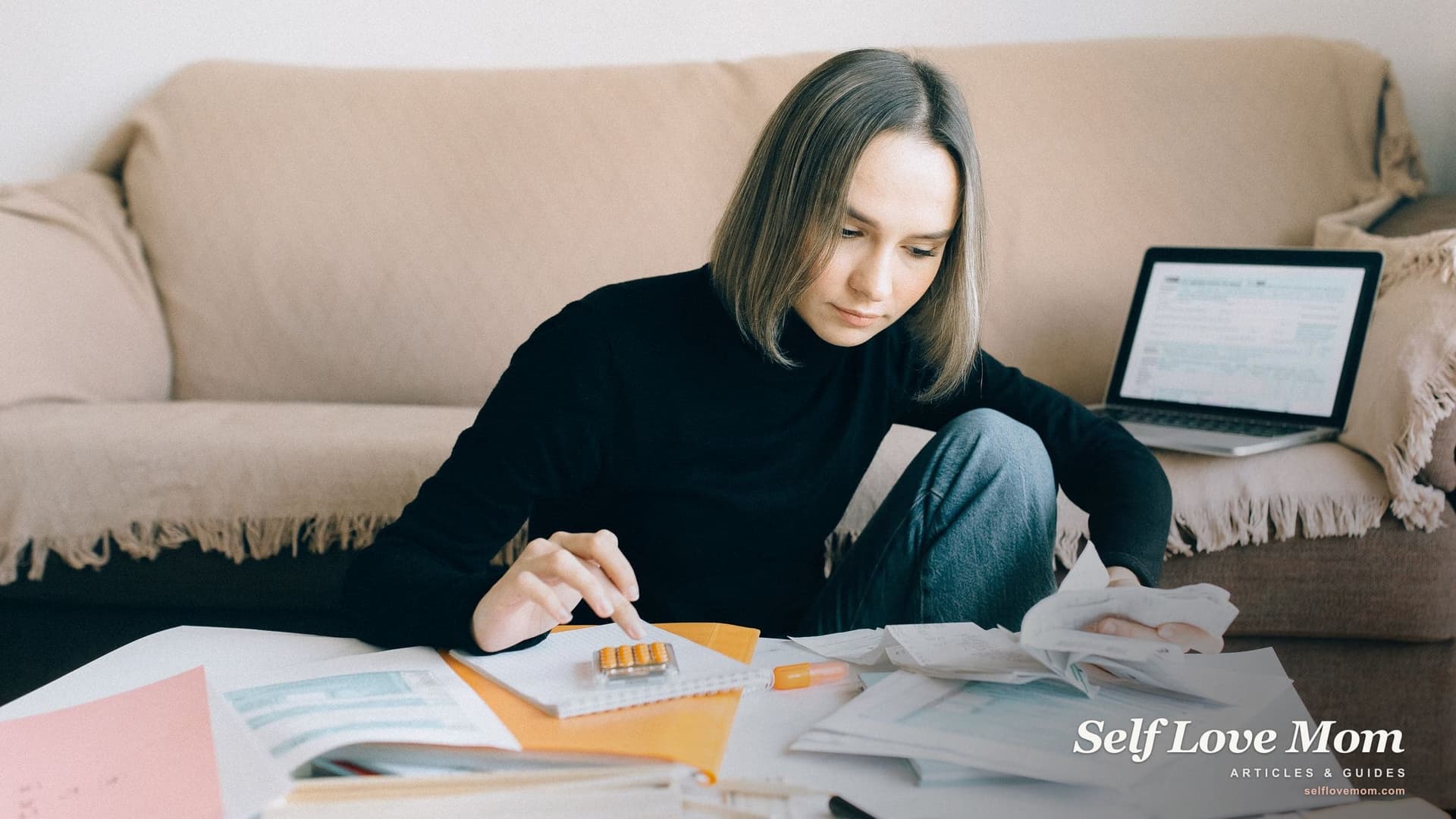
A mom sits on the living room floor totaling receipts on a calculator, her laptop open on the couch behind her, a home setup many single mothers use while learning how to become a bookkeeper.
If you are wondering how to become a bookkeeper with no experience, the short answer is that the job has no license, no required degree and no single required certificate. The Bureau of Labor Statistics lists "some college, no degree" as the typical entry point, and adds that some employers hire workers with a high school diploma and train them on the job (BLS Occupational Outlook Handbook).
For a single mom who wants work that can live on a laptop at the kitchen table, that matters. The skill can be learned in free online modules after bedtime, and the median bookkeeping clerk earned $24.36 an hour in May 2025. The less welcome truth comes later in this article: BLS projects the number of these jobs to shrink, so the plan needs to aim at the work that is still growing inside the field.
| Starting point for a mom with zero background | What the record says |
|---|---|
| Degree needed | None required; "some college, no degree" is typical |
| Prior work experience needed | None, per BLS |
| Median pay, May 2025 | $50,670 a year, or $24.36 an hour |
| Jobs in 2025 | About 1.5 million |
| Outlook, 2025 to 2035 | Down 6%, yet about 144,100 openings a year |
| Free credentials to start | QuickBooks Online (ProAdvisor) and Xero certification |
| Paid credentials later | NACPB $399 course plus $100 exam; AIPB course $1,495 with exam fees |
What the work looks like on a normal Tuesday
Before working out how to become a bookkeeper, know what the job is. Strip away the course ads and it is steady, careful data work. BLS lists the core duties: posting transactions into accounting software, recording cash and checks, assigning each cost and each payment to the right account, producing balance sheets and income statements, and reconciling any differences between the books and the bank.
BLS adds that some clerks also take on payroll, billing and tracking overdue bills. A "full-charge" bookkeeper keeps an entire company's general ledger, while an accounting clerk at a larger firm might handle only accounts payable. The math is mostly addition and subtraction. The real skill is accuracy, plus the integrity to handle someone else's money and keep it confidential.
Two details shape the schedule. Most clerks work full time, according to BLS, and they may work extra hours at the end of the fiscal year, during tax time and around audits. A single mother building a career around school hours should plan for a busy stretch every winter and spring, and line up backup care before January rather than in the middle of it.
Before you spend a dollar, check three things
- You enjoy finding why two numbers do not match
- You can work in a quiet corner for an hour without interruption
- You have, or can borrow, a computer that runs a web browser well
On the computer question, cloud software such as QuickBooks Online and Xero runs in a browser, so a modest laptop works. If the household has none, the guide to free laptops for low-income families lists programs worth trying first.
Is bookkeeping shrinking? The numbers, without spin
Yes. BLS projects employment of bookkeeping, accounting and auditing clerks to fall 6% from 2025 to 2035, a loss of about 85,600 jobs. The stated reason is software: programs now automate many routine entries, so the same amount of work needs fewer people. Any guide on how to become a bookkeeper that calls this a booming field is ignoring the federal data.
The same report holds the reason to keep going. Even while shrinking, the field is expected to have about 144,100 openings a year, all from people who retire or change careers. BLS also expects the clerks who stay to take on "a more analytical and advisory role," reviewing a client's books for problems rather than typing receipts by hand.
For a single mom, that points to a plan: learn the software that does the typing, then sell the judgment. Cleanup work, monthly reviews and explaining a profit and loss statement to a small business owner are tasks software does not finish on its own.
Pay depends heavily on the employer. Bookkeeping clerks in construction had a median of $54,890 in May 2025, while those in retail trade had $45,830. The overall median of $50,670 sits just under the $50,980 median for all US workers. BLS notes that with experience and more education, some clerks may become accountants or auditors. That job usually needs a bachelor's degree, and CPAs are licensed by their state's Board of Accountancy (BLS, accountants and auditors).
Free training first: QuickBooks and Xero
The lowest-cost way to learn how to become a bookkeeper is through the software makers. Intuit, which makes QuickBooks, and Xero both give away training for their own accounting software. Intuit's ProAdvisor program is free to join, and one ProAdvisor quoted on the program page says, "I love that I can access free training whenever I want" (Intuit ProAdvisor program). Inside, the ProAdvisor Academy offers QuickBooks Online Certification Level 1 and an Intuit Bookkeeping Certification.
Both QuickBooks credentials come with an annual catch. Intuit asks certified ProAdvisors to pass a shorter recertification exam each year to keep expert status and ProAdvisor rewards (QuickBooks certification page). Put it on the calendar, since a lapsed certification is a bad surprise right before a job interview.
Xero is just as plain about price: "Xero certification is free." The program runs in three levels, starting with an associate certification, and each can be earned through a self-paced online course, a live webinar or by going straight to the assessment, with a short annual check-in to stay active (Xero, get certified). Learning both platforms lets a single mom say yes to clients on either one.
A third software credential is sold through testing companies rather than given away. The Intuit QuickBooks Online Certified User exam from Certiport runs 50 minutes with about 40 questions, expects at least 150 hours of instruction, and can be taken online with a remote proctor (Certiport, QuickBooks Certified User). Certiport does not post one fixed price on that page, so ask a local college or testing center.
Bookkeeping certification online: what each one costs and asks
BLS says professional certification is "not usually required," though it can help show competency. For a newcomer without a work history, a credential is a way to prove the skill on paper. The table below lists what each issuer's own site said on October 29, 2026.
| Credential | Issuer | Price on the issuer's site | Experience required |
|---|---|---|---|
| QuickBooks Online Certification Level 1 | Intuit ProAdvisor Academy | Free program sign-up | None; yearly recertification exam |
| Xero associate certification | Xero | Free | None; yearly check-in |
| QuickBooks Online Certified User | Certiport (Pearson VUE) | Not listed on the overview page | None; at least 150 hours of instruction expected |
| Bookkeeping Certification | NACPB | $100 exam and certificate after a required $399 course; $50 retake | None; 75% score needed |
| Certified Public Bookkeeper (CPB) | NACPB | $100 application; $50 yearly renewal | 3-month NACPB program, or 1 year or 2,000 supervised hours |
| Certified Bookkeeper (CB) | AIPB | $1,495 online course with exam fees, or $314 self-study ebooks plus separate registration and exam fees | 2 years full time or 3,000 part-time or freelance hours |
The NACPB route stacks up step by step. Its bookkeeping exam covers journals, the general ledger, payroll taxes and closing entries, and candidates take a pre-assessment, the Accounting Fundamentals course, a post-assessment, then the exam (NACPB Bookkeeping Certification). That course is not optional, and it lists at $399 for six months of self-paced access (NACPB Accounting Fundamentals course), so the entry cost comes to $499.
The full CPB license adds QuickBooks and business communication certifications, supervised experience and 24 hours of continuing education each year (NACPB Certified Public Bookkeeper license). Note the word "license" there. The CPB is accredited by the association itself, NACPB; it is a private credential, not a state license. Nobody needs it to keep books legally.
The AIPB Certified Bookkeeper is the older, heavier credential. Candidates pass a four-part national exam, sign a code of ethics, and document either two years of full-time bookkeeping or 3,000 hours of part-time or freelance work, with up to three years after passing to finish those hours (AIPB, the CB designation).
AIPB's 99-hour online prep course costs $1,495 and bundles the registration fee, six workbooks and Prometric test center fees (AIPB online CB prep course). The self-study ebook set lists at $314 (AIPB self-study ebooks), but AIPB's certification page says that route does not include the registration fee or the Prometric test fees. Since the CB requires experience anyway, a newcomer can wait on it until paid hours start piling up.
Getting someone else to pay for the class
Learning how to become a bookkeeper does not have to mean debt. A single mom on a tight budget has two public funding routes worth checking before she touches a credit card. The first is the WIOA Adult program, run through local American Job Centers. Federal rules tell those centers to give priority for training money to people on public assistance and other low-income adults (US Department of Labor, WIOA Adult program).
To find the nearest center, the Labor Department lists a toll-free line, 1-877-US-2JOBS. Ask specifically whether a bookkeeping or accounting certificate is on the local approved training list, and whether the program can also help with childcare or transportation while you study. Services vary by state.
The second route is the Pell Grant. The maximum award for 2026-27 is $7,395, and the Education Department notes that students in an eligible workforce program might receive one (Federal Student Aid, Pell Grants). For full details, see the guide to Pell Grants for single mothers.
Workforce Pell is the newer piece. The law behind it was signed on July 4, 2025, and the Education Department's final rule let schools start on July 1, 2026. It covers programs of 150 to 599 clock hours that take at least 8 but under 15 weeks, and each one needs approval from a governor and the Education Department (Federal Register, Workforce Pell final rule).
Awards are prorated by program length, and each state runs its own approval step before federal review (Iowa Department of Education, Workforce Pell). Ask a community college financial aid office whether its bookkeeping certificate qualifies.
Class time also means childcare time. If evening classes are the only option, look at state childcare assistance programs and ask whether job training counts as an approved activity where you live.
Landing the first paid bookkeeping hours
Most advice on how to become a bookkeeper stops at the certificate. Credentials open doors, but clients and employers still ask, "Where have you done this before?" Picture a mom with two kids under ten who has finished her free QuickBooks certification in the evenings. Her next goal is simply to log real hours that someone pays for, in any form.
Look first at employers who hire many clerks. BLS counts professional and technical services, which include accounting and bookkeeping firms, as the biggest employer group at 14%, with construction next at 8%. A part-time accounts payable or billing clerk job at a local contractor or medical office is real experience, even if it is on-site at first.
The administrative route works too. Virtual assistant work can include invoicing and expense tracking for the same clients, which is why the guide to virtual assistant jobs for moms treats bookkeeping as a natural next step. Small businesses a single mom already knows, such as a cleaning service, a church daycare or a hair stylist, often keep receipts in a shoebox and may welcome monthly help.
Set expectations about the fully remote, big-brand jobs. QuickBooks Live, Intuit's own remote bookkeeping team, asks for at least three years of paid small-business bookkeeping, three years of QuickBooks Online use and an active Level 1 certification. It pays hourly on a fixed schedule within 6 a.m. to 6 p.m. Pacific, Monday through Friday (Intuit, QuickBooks Live bookkeeping jobs). That is a year-three goal, not a first job.
A roadmap from zero to first client
Here is how to become a bookkeeper in stages. Every step below comes from a requirement listed earlier. The pace is an example for a single mother studying about ten hours a week; adjust it to your own evenings.
- Weeks 1 to 2: check the fitRead the BLS duties list, sample a few free ProAdvisor or Xero lessons, and decide whether reconciling accounts holds your attention.
- Weeks 3 to 10: earn a free software credentialJoin the free ProAdvisor program and work toward QuickBooks Online Level 1, or start the Xero associate course.
- Weeks 4 to 6: ask about fundingCall an American Job Center about WIOA, and a community college aid office about Pell or Workforce Pell for a bookkeeping certificate.
- Months 3 to 4: add accounting basicsTake a funded community college class, or the $399 NACPB Accounting Fundamentals course and its $100 exam.
- Months 4 to 6: get paid hoursApply for part-time billing, payables or bookkeeping clerk jobs, or take one small-business client, and keep a log of every hour.
- Months 6 to 12: build the recordAdd the second platform, ask satisfied clients for written references, and keep your QuickBooks certification current.
- Year 2 and beyond: decide on the CBAt 25 logged hours a week, AIPB's 3,000 part-time hours take about 120 weeks. Then the CB, or more schooling toward accounting, makes sense.
A related second skill can widen the job search. Medical billing uses similar care with numbers, and the list of free medical billing and coding courses shows where to start one.
Freelancing: taxes, insurance and setting a rate
For some moms, how to become a bookkeeper really means how to work for themselves. A mom who keeps books for her own clients becomes a small business herself. The IRS charges self-employment tax of 15.3% (12.4% for Social Security and 2.9% for Medicare) once net earnings reach $400 or more, though half of it can be deducted when figuring adjusted gross income (IRS, self-employment tax).
No employer withholds anything on that income. The IRS says people generally need to make estimated tax payments if they expect to owe $1,000 or more when they file, and paying too little through the year can trigger a penalty (IRS, estimated taxes). A separate savings account for every client payment keeps April calm. Self-employed income can also change tax credits for single mothers, so check the effect on each credit.
Mistakes in someone else's books cost real money. The Small Business Administration describes professional liability insurance, often called errors and omissions coverage, as protection "against financial loss as a result of malpractice, errors, and negligence" (SBA, business insurance). Get quotes before the first client signs, and add a written scope of work to every engagement.
On rates, BLS publishes wages for employees, not fees for freelancers, so be wary of any course that promises a figure. The useful anchor is the BLS median of $24.36 an hour for employees. A freelance rate has to cover that pay plus the employer's share of payroll taxes, unpaid hours spent on marketing and email, software, and insurance.
Spotting a bookkeeping course sales pitch
Search for bookkeeping training and many results lead to paid programs promising a home business in weeks. Some teach useful skills. Still, the Federal Trade Commission warns that work-from-home pitches can leave people "paying for starter kits, so-called training, or certifications that are useless," and that honest employers never ask you to pay to get a job (FTC, job scams).
Before a single mom pays for any program, these questions are worth asking:
- Does the certificate come from the course company itself, or from Intuit, Xero, NACPB or AIPB?
- What is the full price, including exams, software and renewals, and what is the refund deadline?
- Does it quote income figures? Ask for the source, and compare them with the BLS wage data above.
- Does it mention that BLS projects bookkeeping clerk jobs to decline?
- Could the same skill come free from the ProAdvisor Academy or Xero first?
A program that cannot answer these clearly is selling a dream, not a skill. For a broader view of where bookkeeping sits among other paths, the list of jobs for single moms compares it with work that is projected to grow. The roundup of quick certifications that pay well puts the ProAdvisor credential next to short medical and trade programs.
For more ideas on working from home, see the guide to remote jobs for stay at home moms, which covers how to vet a remote employer before you send a resume.
Frequently asked questions
Can I really start bookkeeping with zero accounting background?
Yes. BLS lists no required work experience, and its entry-level training is moderate on-the-job learning. What employers look for is comfort with spreadsheets, accounting software and basic arithmetic, plus a careful eye. A free QuickBooks or Xero credential and a short accounting class fill most of that gap for a newcomer.
How long does it take to become a bookkeeper?
It varies with the route. A free software credential can fit into a few weeks of evenings, and Workforce Pell programs run at least 8 but under 15 weeks. The AIPB Certified Bookkeeper takes longest, since it needs two years of full-time work or 3,000 part-time hours, which candidates can finish within three years of passing.
Do bookkeepers need a state license?
BLS lists no license for bookkeeping clerks and calls certification "not usually required." The "Certified Public Bookkeeper" license comes from a private association, NACPB, not a government agency. CPAs are different: a state Board of Accountancy licenses them, so a bookkeeper should not call herself a CPA without that license.
Is AI going to replace bookkeepers?
Software already handles many routine entries, which is the main reason BLS projects a 6% decline by 2035. Even so, BLS expects clerks to shift toward analysis and advice, such as spotting errors and suggesting savings for a client. Bookkeepers who learn the automation tools and explain the results fit the role BLS describes.
Can bookkeeping fit around school pickup?
Sometimes. Most employed clerks work full time, and remote teams such as QuickBooks Live set fixed shifts during weekday business hours. Freelancing gives a single mom the most control over when she works, but deadlines cluster at month end, year end and tax season, so backup childcare matters during those weeks.
Sources
- US Bureau of Labor Statistics. Occupational Outlook Handbook: Bookkeeping, Accounting, and Auditing Clerks (May 2025 wages, 2025 to 2035 projections). bls.gov (retrieved October 29, 2026)
- US Bureau of Labor Statistics. Occupational Outlook Handbook: Accountants and Auditors (CPA licensing). bls.gov (retrieved October 29, 2026)
- Intuit QuickBooks. Intuit ProAdvisor program (free sign-up and training). quickbooks.intuit.com (retrieved October 29, 2026)
- Intuit QuickBooks. ProAdvisor certifications and annual recertification. quickbooks.intuit.com (retrieved October 29, 2026)
- Xero. Get Xero certified (levels, cost, annual check-in). xero.com (retrieved October 29, 2026)
- Certiport, a Pearson VUE business. Intuit QuickBooks Online Certified User exam overview. certiport.pearsonvue.com (retrieved October 29, 2026)
- National Association of Certified Public Bookkeepers. Bookkeeping Certification (exam topics, steps, price). nacpb.org (retrieved October 29, 2026)
- National Association of Certified Public Bookkeepers. Accounting Fundamentals course (required for the certification, price). nacpb.org (retrieved October 29, 2026)
- National Association of Certified Public Bookkeepers. Certified Public Bookkeeper license requirements and fees. nacpb.org (retrieved October 29, 2026)
- American Institute of Professional Bookkeepers. The Certified Bookkeeper (CB) designation, steps to certification. aipb.org (retrieved October 29, 2026)
- American Institute of Professional Bookkeepers. Online Certified Bookkeeper 99-hour prep course (price and inclusions). aipb.org (retrieved October 29, 2026)
- American Institute of Professional Bookkeepers. Certified Bookkeeper course series, online ebooks (price). aipb.org (retrieved October 29, 2026)
- US Department of Labor, Employment and Training Administration. WIOA Adult and Dislocated Worker Program. dol.gov (retrieved October 29, 2026)
- Federal Student Aid, US Department of Education. Federal Pell Grants (2026-27 maximum, eligible workforce programs). studentaid.gov (retrieved October 29, 2026)
- US Department of Education, Federal Register. Accountability in Higher Education and Access through Demand-driven Workforce Pell (final rule, May 19, 2026). federalregister.gov (retrieved October 29, 2026)
- Iowa Department of Education. Workforce Pell (program length, proration, approvals). educate.iowa.gov (retrieved October 29, 2026)
- Intuit. Remote bookkeeping jobs at QuickBooks Live (qualifications and schedule). intuit.com (retrieved October 29, 2026)
- Internal Revenue Service. Self-employment tax (Social Security and Medicare taxes). irs.gov (retrieved October 29, 2026)
- Internal Revenue Service. Estimated taxes. irs.gov (retrieved October 29, 2026)
- US Small Business Administration. Get business insurance (professional liability). sba.gov (retrieved October 29, 2026)
- Federal Trade Commission. Job scams (consumer advice). consumer.ftc.gov (retrieved October 29, 2026)
✻ Share this article
✻ About the contributor · Folio N°.231

Written by Subha
Writer and researcher covering the topics that matter most to single moms, money, mental health, and the small daily rituals that keep a family running. Every article is research-backed and checked against official sources.
- Articles
- 231
- Desks
- 05
- Edited
- 4×
More from this writer
✻ Checked against official sources