20 Qualities of a Good Mother: An Honest Checklist
20 evidence-anchored qualities of a good mother, including the repair habit most lists leave out. Sourced to Pew 2023, Harvard and peer-reviewed work.

 Click to zoom
20 Qualities of a Good Mother: An Honest Checklist
What actually makes a "good" mother? Decades of developmental research keep landing on the same short list. Warmth, structure, and responsive caregiving are the three that keep reappearing. Harvard's Center on the Developing Child describes the back-and-forth it calls serve and return, the everyday exchange that supports early language and social skills. Fifty years of parenting-styles research keeps landing on the same combination: high responsiveness paired with clear, firm expectations, the pattern Diana Baumrind named authoritative in 1971.
This guide walks through 20 evidence-anchored qualities of a good mother, what each one looks like in everyday life, and small habits to practice it. None of them require perfection.
A 2023 Pew Research survey found 62% of US parents say being a parent has been at least somewhat harder than they expected. Among mothers, 30% say it has been a lot harder. In the same survey, 48% of mothers say they are raising their children differently from how they were raised.
Below: a one-line summary, a quick "am I on track?" gut check, the full 20-quality list with practical tips, and a short FAQ. The qualities of a good mother sort into four research-backed pillars: emotional, relational, behavioral, and self-care. Those four show up in every credible parenting framework, from Zero to Three to the CDC's parent essentials. Written by Subha Shahbaz, MSc, who covers parenting and mental health for SelfLoveMom.
| Total qualities | Research pillars | Reading time | Authority sources |
|---|---|---|---|
| 20 | 4 (emotional, relational, behavioral, self-care) | ~10 min | AAP, Harvard, NIH, Pew, CDC, Zero to Three |
Key Takeaways
A good mother is not a perfect mother. Research consistently points to responsive warmth, consistent structure, and the parent's own emotional regulation as the three traits that matter most. The 20 qualities of a good mother below are practical expressions of those three. None require a Pinterest-worthy home, an unbroken patience streak, or every parenting book read. They require showing up, repairing when you slip, and modeling the kind of person you want your child to grow into.
What Is the Definition of a Good Mother?
A good mother is not defined by biology, perfection, or income. The pattern that holds up across fifty years of research is high responsiveness paired with clear, firm expectations. Researchers call it authoritative parenting, and it underpins every one of the qualities of a good mother listed below (Kuppens and Ceulemans). Everything else on this page is a practical expression of those three.
So if you ever wonder how to be a good mom, the answer is closer than it feels. Love deeply, set steady limits, notice what your child needs in the moment, and repair when you slip. Good mothering is a daily practice, not a permanent verdict.
Signs of a Good Mother: Are You on Track?

Wondering, "Will I be a good mom?" The ten signs below are drawn from research on secure attachment and from the authoritative pattern of responsiveness plus firm expectations. Check yourself against the list, then read on for the 20 expanded qualities of a good mother that build out from there.
Use: quick self-check · Signs listed: 10 · Time: 60 seconds · Based on: AAP and Pew 2023
- Your child seeks you out for hugs when feeling sad or scared at home.
- They copy your kind acts toward friends and family around them every day.
- Say sorry for mistakes and learn from them with grace.
- Hear their feelings, even if you disagree with their views.
- Think before you speak to them in tough moments during the day.
- Show love in little ways, like notes or extra playtime with care.
- Praise their hard work more than just the final wins they achieve.
- Set rules firmly, even when it feels really tough to enforce them.
- Keep them safe, but let them try new things alone with trust.
- You feel worn out sometimes, but start fresh the next day with energy.
What Are the Top 20 Qualities of a Good Mother?
| Pillar | Qualities in this group |
|---|---|
| Emotional | Unconditional love, patience, empathy, emotional intelligence, forgiveness |
| Relational | Nurturing, good communication, support, encouragement, playfulness |
| Behavioral | Discipline with kindness, positive role model, adaptability, setting boundaries, repair after you lose your temper |
| Self-care and resilience | Selflessness, resilience, humor, taking care of yourself, asking for help |
Below: the 20 qualities, grouped loosely by the four pillars (emotional, relational, behavioral, self-care). Each is paired with a short "how to practice" list you can actually do this week. The qualities draw on the authoritative-parenting pattern Diana Baumrind first mapped in 1971 and that fifty-plus years of follow-up research keeps validating (Kuppens and Ceulemans).
Total qualities: 20 · Pillars: emotional, relational, behavioral, self-care · Framework: Baumrind authoritative parenting · Per-quality: definition + 4 practice tips
1. Unconditional Love
Unconditional love is the floor everything else stands on. A child who knows the floor holds does not waste energy checking it. That security is what sends her off to try something she might fail at, and what brings her back to you when she does. It leads the qualities of a good mother for a reason.
How to Do It:
- Say "I love you" and give hugs each morning and night without fail.
- Stay loving during fights by focusing on feelings, not just actions taken.
- Do small, kind things when you doubt yourself to build the habit.
- Show love in how you treat everyone, teaching by example.
2. Patience
Patience is not calm. It is the half second you take before you answer. A toddler tests a limit the way anyone tests a rail, by leaning on it, and the leaning is not personal. If you are wondering how to become a better mom, start there: one breath between what she does and what you say.
How to Do It:
- Take deep breaths in hard moments to keep you cool and steady.
- Know what to expect at each age so surprises happen less often.
- Write down what makes you impatient to fix it over time.
- Play games that build patience as a weekly fun family activity.
3. Empathy
Empathy is reading the feeling underneath the behavior. A four-year-old screaming about the wrong colored cup is rarely upset about the cup. Name the feeling out loud and most of the storm loses its fuel, because being understood was most of what she was after. That is also how children learn the words for their own feelings. They borrow yours first.
How to Do It:
- Repeat back what they say to show you fully understand them.
- Role-play fun scenarios to see things from their point of view easily.
- Read books about feelings as part of your bedtime routine nightly.
- Check how you respond to make empathy a daily family habit.
4. Nurturing
Nurturing is care for the body, the mind and the heart, usually on the same ordinary Tuesday. Food, sleep and a clean shirt sit alongside asking about the friend she fell out with. Neither half works on its own. A child who is fed but never asked about learns that only the visible things count.
How to Do It:
- Cook healthy meals and teach good habits from a young age.
- Talk and comfort them when days get really tough for everyone involved.
- Help with hobbies they love to spark joy and skills in them.
- Take time for your own care to maintain balance in your daily life.
5. Discipline with Kindness
Discipline works better at a normal volume. Shouting buys compliance in the moment and costs you the next conversation, which is a poor trade. The point is not to make her sorry. It is to make the rule clear enough that she can follow it next time. Say what happens, say why, and hold it. Calm is not the same as soft.
How to Do It:
- Set clear rules and explain why they matter to everyone clearly.
- Praise good choices with words that point out what worked well.
- Let natural results happen so they learn from real-life experiences.
- Look back at what happened to make discipline better next time.
6. Good Communication
Good communication is mostly listening, and mostly at inconvenient times. Children talk in the car, at bedtime and while you are draining pasta, almost never when you sit them down and ask. The same skill carries straight into co-parenting after a split, where a calm message beats a correct one. Steady listening and positive parenting catch problems while they are still small.
How to Do It:
- Ask fun questions at dinner to start daily, real family talks.
- Use "I feel" words when you solve problems together calmly and kindly.
- Listen without cutting in to show respect every time you talk.
- Change words as needed so everyone understands the message clearly.
7. Being a Positive Role Model

Children copy what you do long before they listen to what you say. How you speak to a rude cashier, whether you apologize after snapping, what you do with a bad day: that is the real curriculum. Being a positive role model is less about performing virtue than about being watchable on an average day. They are always watching.
How to Do It:
- Do healthy things like walks to show fitness in an action-packed daily routine.
- Own up to mistakes in front of them to teach real humility.
- Talk about why you chose certain paths in simple ways with them.
- Keep learning new things to inspire them with your growth and effort.
8. Support
Support is direction without steering. She tells you about the thing she wants to try, and your job is to ask one useful question rather than list the reasons it will not work. Confidence gets built by being allowed to attempt something and not being rescued too early. Back her, then step back.
How to Do It:
- Go to their games and clap for effort, not just wins achieved.
- Help set goals, but let them lead the way forward with ease.
- Build up strength with words when things get really tough for them.
- Link them to classes or groups that match their interests and passions.
9. Adaptability
Plans collapse. The nursery shuts, the car will not start, the school calls at eleven. Adaptability is not enjoying any of that. It is rearranging around it without the whole house absorbing your panic. Children read your face before they read the situation, so a steady face buys everyone twenty minutes to think.
How to Do It:
- See changes as exciting chances to learn together as a team.
- Adjust your approach to fit each child's unique style perfectly.
- Grab online classes for new skills when family needs shift.
- Plan days loosely so surprises don't stress you out.
10. Selflessness
Selflessness means your child comes first most of the time. It does not mean she comes first every single time, because a mother running on nothing has nothing left to give. Generosity is learned by watching. What a child watches is whether giving costs you everything or fits inside a life you still have, and self-care is what keeps it sustainable.
How to Do It:
- Give your time happily, but set gentle boundaries to avoid burnout.
- Involve kids in helping others to show giving in real ways.
- Take short breaks alone to recharge and be your best self.
- Share everyday items like treats to model fairness at home.
11. Resilience
Resilience is not never falling apart. It is what your children see happen afterwards. A mother who has a bad week, says so, and then gets up on Monday teaches something a mother who never visibly struggles cannot teach. Setbacks stop reading as verdicts. They start reading as weather.
How to Do It:
- Share your stories of overcoming stuff to inspire them daily.
- Use walks or talks to handle stress as a united family.
- Stick together during challenges to grow even stronger.
- Turn tough moments into positive lessons with optimism.
12. Humor
Humor is a pressure valve. A joke at the right moment can take a standoff about shoes and turn it into a game about shoes, and the shoes still go on. Laughing together also tells a child that this is a house where things are allowed to be light. Bad days become stories later.
How to Do It:
- Sneak in jokes at meals or car rides for quick laughs.
- Tell funny family stories at bedtime to share smiles.
- Laugh off little mistakes to show it's okay to goof.
- Watch lighthearted shows together for happy memories.
13. Repair After You Lose Your Temper
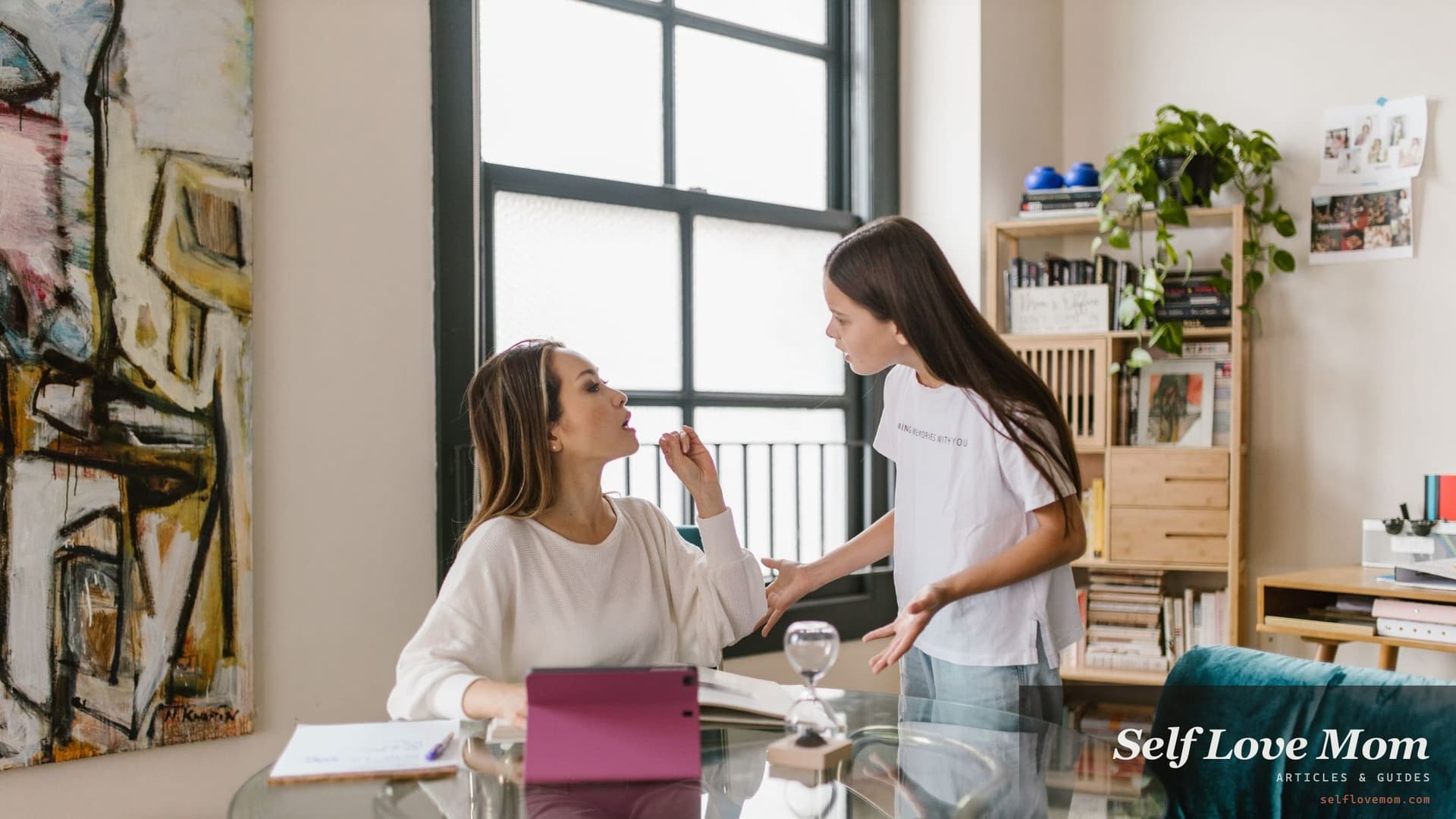
Every mother loses her temper. What separates a secure child from an anxious one is not whether the rupture happened, it is whether anyone repaired it. Repair teaches your child that love survives conflict, and it hands them the exact skill they will need in every relationship they ever have. It is also the one quality most lists of this kind leave out.
How to Do It:
- Name what you did without explaining it away: "I shouted, and that was not okay."
- Leave your child's behavior out of the apology. The repair is about yours.
- Say what you will try instead next time, then let it go.
- Repair the same day, while the moment still means something to them.
14. Taking Care of Yourself
Self-care is not a reward you earn once everyone else is handled. Pew found 41% of parents say being a parent is tiring all or most of the time, and 29% say it is stressful. A depleted mother has very little responsiveness left to give, and responsiveness is the trait this whole page keeps returning to. It is one of the sharpest challenges single mothers face. Protecting your own baseline is parenting work.
How to Do It:
- Book one thing a week that is yours alone, and keep it like an appointment.
- Sleep before laundry on the nights you have to choose between them.
- Tell one person the truth about a hard week instead of performing fine.
- Learn your own early burnout signs so you are not waiting for the crash.
15. Emotional Intelligence
Of all the qualities of a good mother, emotional intelligence is the one that makes the rest possible. It is noticing your own temper rising and naming it before it lands somewhere unhelpful. Children who grow up around adults who name feelings learn to do the same. Otherwise feelings only ever show up as behavior. That is a harder house.
How to Do It:
- Name emotions out loud during big or small moments.
- Practice solving pretend conflicts with kindness.
- Reflect on your own feelings to grow smarter.
- Encourage kind treatment in all home interactions.
16. Asking for Help
Asking for help is a skill, not an admission. Mothers who build a support network before they are desperate recover faster from the weeks that go wrong. It also shows your child that needing other people is ordinary. If you are doing it without a support network, building one is the first job, not the last.
How to Do It:
- Name the task when you ask. "Can you take pickup Thursday" beats "I am drowning."
- Build the network on a good week, not in the middle of the crisis.
- Accept help the first time it is offered, even if you could have managed.
- Trade favors with another parent so neither of you is keeping score.
17. Setting Boundaries
Boundaries are the structure half of warmth plus structure. Children test a limit to find out whether it is real, and a limit that moves under pressure teaches them that pressure works. With a difficult co-parent, parallel parenting is the boundary structure that holds. Pew found 45% of parents describe themselves as overprotective, 51% of mothers against 38% of fathers. For many mothers the harder boundary is the one that lets a child take a risk.
How to Do It:
- Say the rule once, calmly, then follow through without renegotiating it.
- Keep the list of rules short enough that you can enforce every one.
- Hold boundaries with other adults too, including family who overstep.
- Let natural consequences teach the lesson wherever it is safe to.
18. Encouragement
Praise the effort, not the result. A child praised for being clever avoids anything she might not be clever at. A child praised for working hard tries the harder thing. This is one of the qualities of a good mother that pays out years later, in a teenager willing to be bad at something first.
How to Do It:
- Give clear praise for specific things they do really well with effort.
- Help make goals they can reach with steady work and dedication.
- Gently urge them to try new things beyond their comfort zones with support.
- Cheer little wins with high fives or special treats for motivation.
19. Forgiveness
Forgiveness is mostly about what you stop carrying. Grudges inside a family are heavy and they are catching, and children work out very fast whether apologies here actually end things or only pause them. Letting a bad afternoon finish is a skill. Say it is over, then behave as though it is.
How to Do It:
- Apologize first when you make a mistake, honestly.
- Talk calmly to resolve issues and start fresh.
- Offer chances to try again after slip-ups.
- Create habits like hugs after saying sorry.
20. Playfulness

Playfulness is the cheapest thing on this list and the first to go. Fifteen minutes of something silly does more for a bond than an hour of well-run logistics. It also shows a child that adulthood is not one long sequence of tasks. Be ridiculous sometimes. They remember it.
How to Do It:
- Join silly games and impromptu dance breaks to keep everyday moments light and connected.
- Tell jokes and share laughs during meals and car rides daily.
- Create pretend play scenarios to spark imagination and creativity together.
- Plan surprise fun activities; keep things light and joyful.
Extending Motherhood: Qualities in Broader Roles
The same three pillars (warmth, structure, responsive caregiving) extend into the other roles a mother holds across her life, particularly as a mother-in-law and as a wife or partner. Pew found 48% of mothers say they are raising their children differently from how they were raised (Pew Research Center, 2023). The previous generation is less a script than a draft to revise. The qualities below carry that forward.

Broader roles covered: 2 · Qualities each: 4 · Pillars: warmth + structure + responsiveness · Source: Pew 2023, Parenting in America Today
Qualities of a Good Mother-in-Law
The mother-in-law role is where motherhood quietly graduates into mentorship. The strongest mothers-in-law treat their adult child's marriage as its own family system, not a continuation of the original household. In-law friction is common enough to measure: Pew found 41% of partnered parents feel judged by their partner's parents at least sometimes. A mother-in-law who stays out of that statistic is doing the work.
How to practice it:
- Wait to be asked before offering parenting or marriage advice, especially in the first three years.
- Treat your child's partner as a full member of the family, not a guest who married in.
- Hold confidences. If a grown child tells you something private about their marriage, do not pass it on, even to other family.
- Step in only when asked, and only with help that solves the problem, not commentary about it.
Qualities of a Good Mother and Wife
A good mother and wife protects the couple while still showing up for the kids. Pew found 52% of married or cohabiting parents feel judged by their spouse or partner at least sometimes. The couple relationship needs tending in its own right, not only as a backdrop to the parenting.
How to practice it:
- Keep one ritual that belongs only to the two of you: coffee before the kids wake, a Sunday walk, ten minutes after bedtime.
- Disagree in front of the kids respectfully. Repair in front of them too. Children learn conflict resolution by watching, not by being shielded.
- Split the invisible work (meal planning, school admin, doctor calls) explicitly. The labor gap is the most cited driver of resentment in long-term marriages.
- Schedule one date a month, even if it is at home after bedtime. Consistency matters more than venue.
Final Thoughts on Qualities of a Good Mother
These qualities focus on consistent care and small daily repairs, not perfect days. Show up, apologize when you slip, and keep practicing the traits you want your child to grow up modeling. The research is unusually consistent on this point, and so is the lived experience of the millions of mothers who came before you.
What quality do you work on now in your parenting journey? Share in comments, we grow as a group with support and ideas. If this helped, share it with another mom who needs encouragement today.
Frequently Asked Questions
What are the most important qualities of a good mother?
Decades of developmental research point to three: warmth, structure, and responsive caregiving. Harvard's Center on the Developing Child calls the responsive half "serve and return". Every other quality on the list above, from patience to encouragement, is a practical expression of one of those three.
What makes a great mom different from a good mom?
Not much, in research terms. A "great" mom is usually a good mom who has been at it long enough that repair, reflection and self-care have become habits. Pew found 62% of parents say parenting has been at least somewhat harder than expected. The difference is whether a rough day reads as information or as a verdict.
Can a working mom be a good mom?
Yes. Lucas-Thompson and colleagues in 2010, pooling 69 studies and 1,483 effect sizes, found no consistent negative effect of early maternal employment, and that it was most beneficial where families faced single parenthood or welfare status. What matters is the quality of the time, not the quantity. Presence matters more than hours.
How do I know if I am a good mother?
If you are asking, that is itself a signal. A practical self-check: does your child seek you out when hurt or scared? Do they apologize after doing something wrong, copying what you do? Do they take measured risks because they trust you have their back? Two yes answers out of three means you are doing the work.
What should a good mother not do?
The clearest research-backed "do not" list is short: do not use shame as discipline, do not compare siblings to each other, and do not ignore your own mental health. Harsh verbal discipline causes measurable harm, and the repair afterwards is a sincere apology, which most parents will need to make at some point.
Is being a good mother more about love or discipline?
Both, and the research is unusually clear. Diana Baumrind's foundational 1971 typology identifies authoritative parenting, high warmth plus high structure, as the consistent predictor of well-adjusted adult children. Love without structure produces permissive parenting. Structure without love produces authoritarian parenting. The combination is what works.
Sources
- Harvard Center on the Developing Child, Serve and Return: foundational research on responsive caregiving and brain development in the first five years.
- American Academy of Pediatrics, HealthyChildren: the AAP's parenting and child-health guidance hub.
- Lucas-Thompson, Goldberg and Prause, Psychological Bulletin 2010: meta-analysis of 69 studies and 1,483 effect sizes on maternal employment and later child outcomes.
- Pew Research Center, Parenting in America Today (2023): nationally representative survey on parenting experience.
- Kuppens and Ceulemans, Parenting Styles: A Closer Look at a Well-Known Concept: open-access review of Baumrind's authoritative, authoritarian and permissive typology and what fifty years of follow-up found.
- Zero to Three: early-childhood development research and parenting resources.
- NIH NICHD: federal child-health research clearinghouse.
- UC Davis Health, Positive Parenting: clinical guidance on communication and positive parenting practices.
- CDC, Essentials for Parenting: evidence-based parenting toolkit and child-development milestones.
✻ Share this article
✻ About the contributor · Folio N°.180

Written by Subha
Psychologist and writer covering the topics that matter most to single moms, money, mental health, and the small daily rituals that keep a family running. Every article is research-backed and edited four times before publish.
- Articles
- 180
- Desks
- 05
- Edited
- 4×
More from this writer
✻ Edited four times before publish