Self Care for Mothers: Easy Ways to Prioritize Your Well-Being
Self care for mothers is not a bubble bath, it is maintenance. 48% of parents feel overwhelmed. See the realistic, by-time-and-stage guide that actually fits.

 Click to zoom
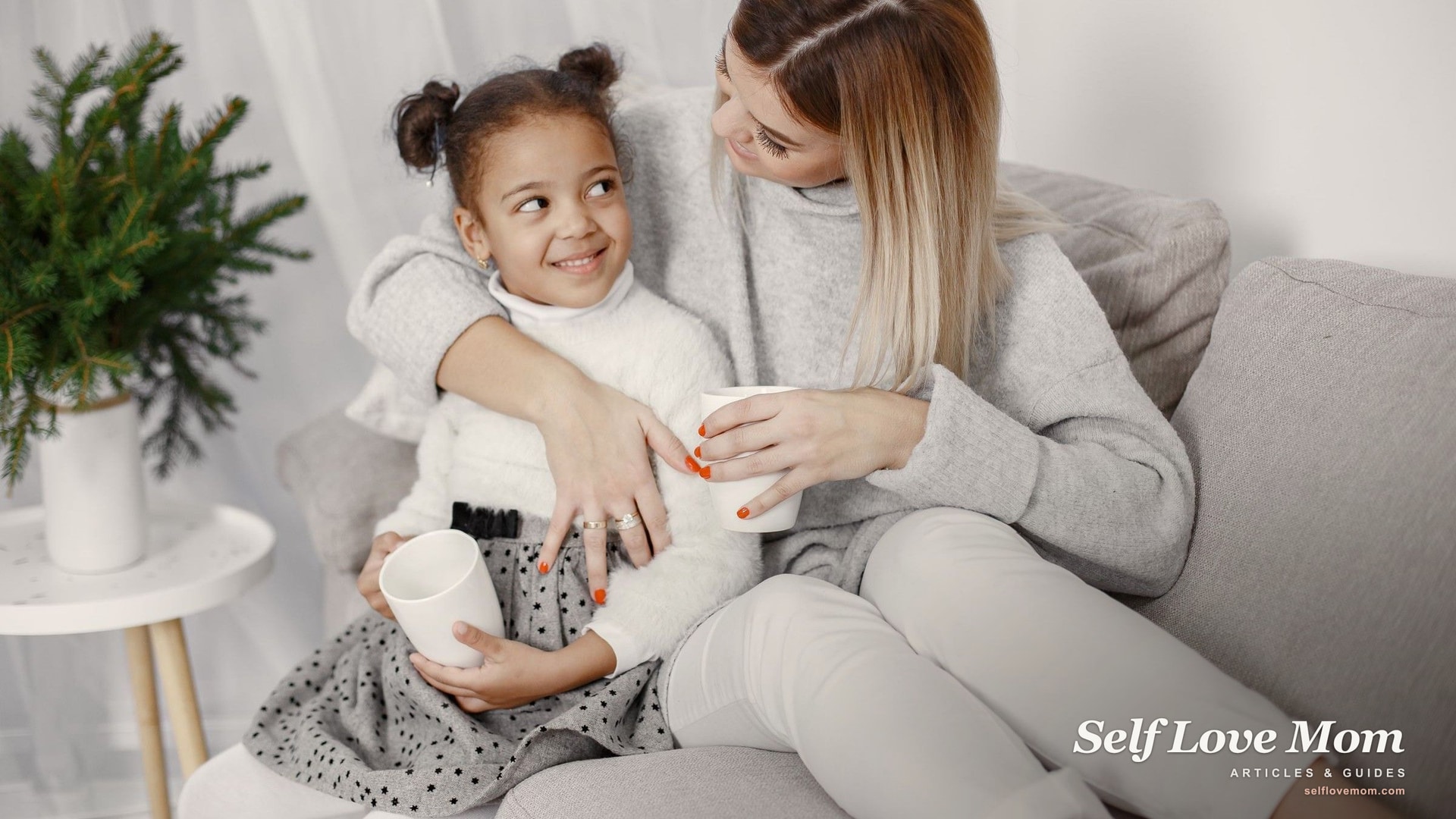
A mother and her young daughter share a calm moment over warm mugs on the couch, an everyday act of self care for mothers.
Most advice about self care for mothers stops at "take a bubble bath," which is exactly why it fails. Real self-care is not a treat you squeeze in when everything else is done. It is the maintenance that keeps you functioning, and for moms running on a heavier load than most, it is not optional.
The scale of the need is documented. In 2024 the U.S. Surgeon General reported that 48% of parents say most days their stress is completely overwhelming, compared with 26% of other adults ("Parents Under Pressure"). Self-care is how you protect yourself against that, and it works best in small, repeatable doses, not grand gestures.
This guide defines what self-care for mothers actually means, why it matters, the realistic version sorted by how much time you have, and how it changes at each stage of motherhood, with a clear signal for when it is time to reach for more than self-care.
| The pressure | The risk | The fix |
|---|---|---|
| 48% of parents say daily stress is completely overwhelming (Surgeon General) |
~9% of U.S. parents reach clinical burnout that self-care buffers (42-country study) |
10 min a day, done consistently, beats a rare spa day |
The short version
Self care for mothers is the deliberate practice of protecting your physical, emotional, mental, social, and financial health, and the World Health Organization treats it as a genuine health practice, not a luxury. It is not selfish; it is what keeps caregiving sustainable. You do not need hours: 10 to 15 consistent minutes a day moves the needle more than an occasional big reset. Match the care to the time you have and the stage you are in, and if low mood or exhaustion will not lift for weeks, that is the point to add therapy.
What is self-care for a mom?
Self-care for a mom is any deliberate action that protects her own health, and it is a recognized health practice, not indulgence. The World Health Organization defines self-care as the ability to promote health, prevent disease, and cope with illness, with or without a health worker's support (WHO). For mothers, it is the difference between running on empty and running on a full-enough tank.
Here is the reframe that helps most. Self-care is not the bubble bath, it is the system underneath: sleep, boundaries, connection, movement, money. It is also personal. For one mom it is ten quiet minutes with coffee before the house wakes; for another it is a hard workout or an honest talk with a friend. What counts is that it genuinely refills you, not that it looks like self-care on social media.
Why does self-care for mothers matter?
Because the load moms carry has measurable health costs, and self-care is the buffer. Beyond the Surgeon General's finding that 48% of parents call their daily stress completely overwhelming, roughly 1 in 8 new mothers develop postpartum depression (CDC), and nearly 9% of U.S. parents reach clinical burnout (42-country study). Self-care does not erase those risks, but it lowers the everyday stress that feeds them.
There is upside, too, not just risk reduction. Sleep, movement, and real social connection are among the best-studied protectors of mood and energy. A mom who guards even a little of each is steadier, more patient, and more present, which is better for the whole family, not just her.
What are the types of self-care every mother needs?
Self-care is not one thing; it spans several areas, and moms tend to over-invest in one and ignore the rest. The fullest model breaks into eight types: physical, emotional, mental, social, spiritual, practical, environmental, and financial. You balance them rather than rank them, because a rested body cannot outrun money panic and a full social life cannot fix no sleep.
The quickest way to use this is to notice which area is emptiest this week and feed that one first. Our full guide to the 8 types of self-care includes a self-care wheel you can use as a one-minute check-in to spot the dimension running low.
How do busy moms find time for self-care?
By shrinking it to fit the time you actually have, not the time you wish you had. Research on habit change is consistent that small, anchored actions stick where ambitious routines collapse. So stop waiting for a free hour and match the care to the pocket of time in front of you. Our guide to stress management for moms collects the techniques that work in five minutes or less.
- 5 minutes. Box breathing, step outside for daylight, stretch, drink a full glass of water, or write one line you are grateful for. Anchor it to something you already do, like the coffee brewing.
- 20 minutes. A real walk, a chapter of a book, a phone call with a friend, a shower without rushing, or a short guided meditation from a free self-care app.
- An hour or more. A workout, a hobby, a therapy session, coffee with a friend, or a genuine break while someone else covers the kids. Protect it on the calendar like any appointment.
- On a tight budget. Almost none of this costs money. Our guide to self-care on a budget covers free swaps for the pricey stuff.
What does self-care look like at each stage of motherhood?
The basics stay the same, but the barriers change, so the practical version does too. A new mom is fighting sleep deprivation; a working mom is fighting a double shift; a single mom is doing it without a built-in backup. Match the approach to your reality.
- New moms. Recovery first: bank sleep when the baby sleeps, hydrate, accept help, move gently. Our guide to self-care for new moms covers the fourth-trimester basics.
- Single moms. Build a support network on purpose and take guilt-free micro-breaks. See self-care for single moms for doing it without a partner.
- Working moms. Protect "me-time" like a meeting and guard the work-home boundary. Our self-care for working moms guide tackles the double shift.
- Stay-at-home moms. Use nap windows and independent-play time, and fight isolation with a mom group. See self-care for stay-at-home moms.
When is self-care not enough?
Self-care prevents and buffers, but it does not treat a clinical condition. When exhaustion, numbness, or low mood stays for more than two weeks no matter what you do, that points past self-care toward burnout, depression, or anxiety. About 1 in 8 new mothers experience postpartum depression (CDC), and studies have found that up to half of cases go undiagnosed.
That is a signal to add support, not more willpower. Our guides to therapy for overwhelmed moms and counseling cover the next step, including free and low-cost options, and the 988 Suicide and Crisis Lifeline is free, 24/7, by call or text if things feel like too much.
Frequently Asked Questions
What is self-care for a mom?
Self-care for a mom is any deliberate action that protects her physical, emotional, mental, social, or financial health. The World Health Organization treats it as a real health practice, not a luxury. In practice it ranges from sleep and boundaries to connection and movement, and it is what makes sustained caregiving possible.
How can a mom practice self-care with no time or money?
Shrink it to five honest minutes and anchor it to a habit you already have, like breathing deeply while the coffee brews or stepping outside for daylight. Most self-care is free, box breathing, a walk, a gratitude line, a glass of water. Consistency matters far more than length or cost.
How can I be a good mom when I am exhausted?
Lower the bar on non-essentials, protect one block of real sleep, ask for help without apologizing, and get ten minutes of daylight and movement. Exhaustion that never lifts, though, is a burnout or depression signal, not a willpower problem, and it deserves support rather than more pushing.
Is self-care for mothers selfish?
No. Tending your own health is not taking away from your family, it is protecting the person they rely on most. The WHO frames self-care as a legitimate health practice, and for caregivers it is what keeps the caregiving sustainable rather than a slow slide into burnout.
How much self-care does a mother actually need?
There is no fixed dose, but 10 to 15 consistent minutes a day does more than an occasional big reset. Aim for a little across the different types of self-care rather than a lot in one, and increase it when a season of life gets harder, such as a newborn or a stressful stretch at work.
Sources
- World Health Organization, "Self-Care Interventions for Health," who.int (definition of self-care, retrieved 2026-07-10).
- Office of the U.S. Surgeon General, "Parents Under Pressure: A Surgeon General's Advisory," hhs.gov (48% overwhelming and 33% high-stress figures, 2024, retrieved 2026-07-10).
- Centers for Disease Control and Prevention, "Depression During and After Pregnancy," cdc.gov (1 in 8 postpartum depression symptoms, retrieved 2026-07-10).
- BMC Public Health, "Exploring Predictors and Prevalence of Postpartum Depression," link.springer.com (up to half of postpartum depression cases undiagnosed, 2024, retrieved 2026-07-10).
- Roskam, I., Aguiar, J., Mikolajczak, M. et al., "Parental Burnout Around the Globe: a 42-Country Study," Affective Science (US parental-burnout prevalence 8.9%, 2021, retrieved 2026-07-10).
- National Institute of Mental Health, "Caring for Your Mental Health," nimh.nih.gov (self-care and mental health, retrieved 2026-07-10).
✻ Share this article

✻ About the contributor · Folio N°.180

Written by Subha
Psychologist and writer covering the topics that matter most to single moms, money, mental health, and the small daily rituals that keep a family running. Every article is research-backed and edited four times before publish.
- Articles
- 180
- Desks
- 05
- Edited
- 4×
More from this writer
✻ Edited four times before publish