Self Care for Mothers: What Works When Time Is Short
Self care for mothers sorted by the time you have and the life you lead: working, home all day, or raising kids with no backup. Free ideas, no spa needed.

 Click to zoom
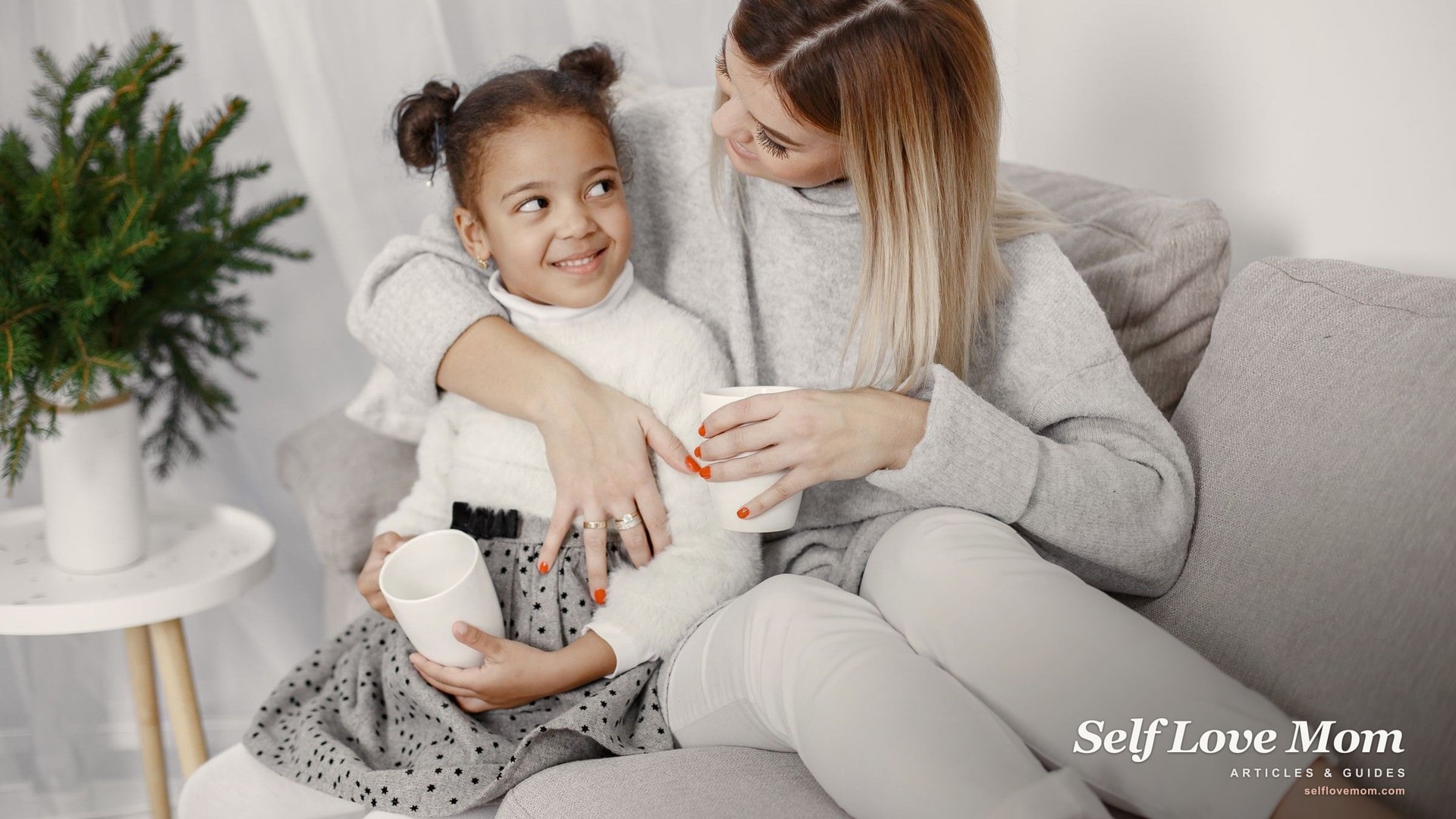
A mother and her young daughter share a calm moment over warm mugs on the couch, an everyday act of self care for mothers.
Most mothers do not need another list of bubble-bath ideas. They need self care that survives a real week: the 7 a.m. scramble, a shift at work or a long day home with a toddler, and the bedtime that runs late. This guide is written around a single mom raising two kids, because a plan that holds up for her holds up for almost anyone.
Self care for mothers comes down to three questions: which part of you is running lowest, how much time you actually have, and what your daily setup allows. Each gets its own section below, with ideas sorted into five minutes, thirty minutes, or a whole evening, plus a separate playbook for working moms, moms at home, and moms with no backup adult.
| Free time | Working moms | Parent stress |
|---|---|---|
| 3.9 hrs of daily leisure for adults 35 to 44, the least of any age group (BLS, 2025) |
67% of full-time working moms say they lack time to relax (Pew, 2026) |
48% of parents call their stress completely overwhelming most days (Surgeon General, 2024) |
The short version
Self care for mothers is the routine upkeep of your body, mind, relationships, and money, which the World Health Organization counts as genuine health practice. Find the dimension running lowest, then match one small act to the time you have. Working moms guard the edges of the workday, moms at home guard adult contact, and a single mom with no backup builds trades and a sick-day plan. If low mood lasts two weeks, add professional help.
What does self care for mothers actually include?
The World Health Organization describes self-care as the ability to promote and maintain your own health, prevent disease, and cope with illness, with or without a health worker's support. That is a much wider net than pampering. It covers sleep, food, movement, money, friendships, and even the state of the kitchen counter: the background systems that decide whether a hard day feels manageable.
A practical map comes from the federal mental health agency SAMHSA, which splits wellness into eight dimensions. Some schools use seven; Virginia Commonwealth University lists emotional, mental, physical, social, spiritual, professional, and financial. The exact count matters less than checking all of them. The table turns each dimension into a warning sign and a refill that fits a single mom's evening.
| Dimension | Sign it is running low | A 10-minute refill |
|---|---|---|
| Physical | You live on coffee and skip lunch | Eat one meal sitting down; turn the lights out 20 minutes earlier |
| Emotional | Small things make you snap or cry | Name the feeling in one sentence, out loud or on paper |
| Intellectual | Your brain only holds schedules | Read ten pages of a novel or play a podcast that has nothing to do with kids |
| Social | Whole days pass with no adult conversation | Send a voice note to a friend who knows the unedited you |
| Spiritual | Days feel like a checklist with no point | Sit outside without your phone, pray, or write one line of thanks |
| Occupational | Work, paid or unpaid, feels like a trap | Write down one skill you want to grow and one task you could drop |
| Financial | Money worry hums all day | Check one balance and set one bill to autopay |
| Environmental | Clutter and noise follow you room to room | Clear one surface and open a window |
Two rows running low at once is common, and they often feed each other: poor sleep makes money worry louder, and isolation makes every chore feel heavier. Good self care for mothers treats the lowest row first, because one refill there usually lifts a second row for free. Leave the full rows alone for now; they are not where your scarce minutes belong this week.
How much free time do mothers really get?
Less than almost anyone. The 2025 American Time Use Survey found adults ages 35 to 44, the core child-raising years, averaged 3.9 hours of leisure a day, the least of any age group. Employed adults with a child under 6 at home averaged 3.2 hours, against 4.5 hours for employed adults with no children under 18.
Those averages include TV, which fills about half of all leisure time. They also hide a gap inside couples. A Pew Research Center analysis found married, employed mothers of kids under 18 had about 22.8 hours of leisure a week, versus 25.7 for fathers. A single mom has no partner to trade evenings with at all.
That is why everything below starts from minutes, not hours. Self care for mothers that waits for a free Saturday tends to get postponed until it quietly disappears.
Self care for moms, sorted by the time you have
Match the idea to the window in front of you instead of waiting for a better one. The National Institute of Mental Health notes that even small acts of self-care in daily life can have a big impact, and that 30 minutes of walking a day can boost mood, even in shorter pieces.
If you have five minutes
- Look far away. Stand on the porch or at a window and rest your eyes on something distant while the kettle heats.
- Breathe longer out than in. Four counts in, six counts out, five rounds.
- Empty your head onto paper. Write tomorrow's top three tasks so your brain can stop rehearsing them.
- Send one honest text. Tell a friend how the day really went, not just "fine."
If you have thirty minutes
- Walk the block twice. Let the kids ride scooters beside you, or go alone if someone else has them.
- Cook something you like. One meal chosen for your taste, not the nuggets everyone shares by default.
- Stretch along with a video. Nap time or a cartoon is enough; a free self-care app can guide you.
- Lie down with no phone. Rest counts even when nothing gets crossed off.
If you have a whole evening
- Trade for it. Swap a night of childcare with another parent and spend yours at dinner with a friend.
- Take a class. Libraries and community centers often run free ones, from crafts to yoga.
- Plan the wind-down. Long shower, a face mask, and one movie start to finish; a self-care night plan helps you defend it.
- Go to bed with the kids. Once a week, lights out at 8:30 pays down real sleep debt.
Self care for working moms: guard the edges of the day
Most mothers work for pay. The Bureau of Labor Statistics put labor force participation at 73.9% for all mothers with kids under 18 in 2025, and at 78.1% for mothers who are not married, a group that includes most single moms. For them the squeeze is a double shift: the job, then a second job at home.
A 2026 Pew survey of working parents found 62% of full-time working moms call balancing work and family difficult, compared with 47% of dads. Moms were also more likely than dads to lack time to relax (67% vs 53%), and about eight in ten handle parenting tasks at work at least sometimes.

- Protect lunch. Block 30 minutes on the calendar and eat away from the screen.
- Use the commute as a buffer. Keep one playlist only for the drive home, or take three slow breaths in the car before going inside.
- Set a hard stop. Pick the hour work ends and mute notifications after it.
- Batch the kid admin. Book appointments and answer school emails in one 15-minute block instead of all day long.
For a single mom on one income, the hard stop matters most. Nobody else absorbs the evening, so a workday that bleeds into dinner eats the only hour that might have been hers.
Self care for stay-at-home moms: break the isolation
A day at home sounds restful from the outside. In practice it has no breaks, few adult voices, and no finish line. A Gallup analysis of more than 60,000 U.S. women found stay-at-home moms were more likely than employed moms to report sadness, anger, and a past depression diagnosis, and they fared worse at every income level.

- Leave the house daily. A loop around the park with the stroller counts.
- Get one adult conversation. Five minutes on the phone with a grown-up changes the tone of a long afternoon.
- Claim nap time. At least three days a week, it is yours, not laundry time.
- Find a room where adults talk. Library story hour or a playgroup gives you company while the kids play.
A single mom who stays home, often while job hunting or caring for a baby, faces that isolation with no partner walking in at six. A standing weekly meetup matters even more for her. If a heavy, flat feeling has lasted weeks, the guide to stay-at-home mom burnout covers recovery beyond these basics.
Self care when there is no backup adult
Every idea above assumes someone can take the kids for a while. Many single mothers have no such person, or not reliably. The answer is to build that backup on purpose instead of hoping it appears.
- Start a childcare swap. Two single moms trading one Saturday morning a month each get a free block at no cost.
- Write a sick-day plan now. Who can do pickup, which meals sit in the freezer, which work tasks can wait a day.
- Use free supervised time. Library programs, school clubs, and youth nights keep kids busy while you sit nearby with a book.
- Lower one standard. Cereal for dinner once a week buys back real minutes, and the kids will not mind.
For the full one-parent version, with daily habits sized for a household run by one adult, see the deep dive on self care for single moms. Finding other parents to trade with is easier through single mom support groups, both local and online.
How to balance motherhood and self care week to week
Balance does not mean equal hours. It means no dimension stays empty for long. A ten-minute Sunday check works: scan the eight rows in the table above, pick the one that drained most this week, and schedule two small refills for it in the days ahead.
Take a hypothetical single mom of two who works days. Social ran dry, so she books a Tuesday lunch call with her sister and a Saturday park meetup with another mom. Physical is low too, so she moves her own bedtime 20 minutes earlier on Monday and Thursday. Four small changes, no new routine, and none cost a dollar.
The rows that need attention also shift with the season of motherhood. With a newborn, physical recovery and sleep crowd out almost everything else, and self-care for new moms covers that stretch. With school-age kids, the social and financial rows tend to empty first. Self care for mothers of teenagers often swings back toward the emotional row, as the worry gets quieter but heavier.
The best self care for tired moms is usually the plain kind: sleep, food, daylight, and one honest conversation. Pricier fixes help less when those basics are missing. If money is tight, self care on a budget lists free swaps for the paid versions.
When is self care for mothers not enough?
Self care lowers everyday stress, but it does not treat depression, anxiety, or burnout. The U.S. Surgeon General's advisory on parents found 48% say most days their stress is completely overwhelming, versus 26% of other adults, and 33% reported high stress in the past month, versus 20%.
Watch for exhaustion, numbness, or low mood that lasts two weeks or more no matter what you try. That is a reason to see a doctor or therapist, not a reason to push harder, and the guide to therapy for moms covers costs and low-fee options. If you ever feel unsafe, call or text 988, any hour.
Frequently Asked Questions
What is the simplest way to start self care as a mom?
Pick the dimension that feels emptiest and one action that takes under five minutes, then attach it to something you already do, such as drinking water while the coffee brews. Repeat it for two weeks before adding anything else. One small habit that sticks beats an ambitious plan that falls apart by Wednesday.
How do I balance motherhood and self care with no free time?
Stop hunting for free time and borrow from transitions instead: the commute, nap time, the ten minutes after the kids fall asleep. Federal time-use data shows parents of young children get the least leisure of any group, so short pockets are the realistic unit. Across a week, they add up to more than one hour.
Do stay-at-home moms need self care as much as working moms?
Yes, though what runs out differs. Working mothers usually run short on time, while mothers at home more often run short on adult company and time out of the house. Gallup found stay-at-home moms reported more sadness and depression than employed moms, so connection and fresh air deserve top priority at home.
What self care can a single mom do without a babysitter?
Quite a lot, if it happens alongside the kids or after bedtime: a family walk, reading while they play at the library, stretching during a cartoon, or an early night. A regular childcare swap with another parent adds longer breaks for free. Set these up ahead of time so they never depend on luck.
How do I know if I need more than self care?
If exhaustion, numbness, irritability, or sadness lasts two weeks or longer despite rest, talk to a doctor or counselor. Trouble sleeping even when you get the chance, losing interest in things you used to enjoy, or thoughts of self-harm are clear signals. In a crisis, call or text 988 for free, any time.
Sources
Every figure in this guide was checked against the original government or research source on November 3, 2026. Survey figures describe U.S. parents as a group, not any one family.
- World Health Organization. Self-care for health and well-being, fact sheet (definition of self-care, updated 3 June 2026). who.int (retrieved 2026-11-03)
- Substance Abuse and Mental Health Services Administration. Learn the Eight Dimensions of Wellness (SMA-16-4953). library.samhsa.gov (retrieved 2026-11-03)
- Mallahan, S. et al. A qualitative exploration of the eight dimensions of wellness in opioid use disorder recovery during the postpartum period, Drug and Alcohol Dependence Reports, 2023 (lists SAMHSA's eight dimensions). pmc.ncbi.nlm.nih.gov (retrieved 2026-11-03)
- Virginia Commonwealth University. 7 Types of Self-Care and Why You Should Practice Them. onlinesocialwork.vcu.edu (retrieved 2026-11-03)
- U.S. Bureau of Labor Statistics. American Time Use Survey, 2025 results (released June 25, 2026). bls.gov (retrieved 2026-11-03)
- Pew Research Center. Working husbands in U.S. have more leisure time than working wives do, especially among those with children (2023). pewresearch.org (retrieved 2026-11-03)
- National Institute of Mental Health. Caring for Your Mental Health. nimh.nih.gov (retrieved 2026-11-03)
- U.S. Bureau of Labor Statistics. Employment Characteristics of Families, 2025 (released April 23, 2026). bls.gov (retrieved 2026-11-03)
- Pew Research Center. For Working Parents, the Boundary Between Work and Family Is Often Blurred (survey of 2,242 working parents, March 2026). pewresearch.org (retrieved 2026-11-03)
- Gallup. Stay-at-Home Moms Report More Depression, Sadness, Anger (2012, sample of 60,799 U.S. women). news.gallup.com (retrieved 2026-11-03)
- Office of the U.S. Surgeon General. Parents Under Pressure: Parental Mental Health and Well-Being advisory (2024). hhs.gov (retrieved 2026-11-03)
✻ Share this article
✻ About the contributor · Folio N°.238

Written by Subha
Writer and researcher covering the topics that matter most to single moms, money, mental health, and the small daily rituals that keep a family running. Every article is research-backed and checked against official sources.
- Articles
- 238
- Desks
- 05
- Edited
- 4×
More from this writer
✻ Checked against official sources