8 Types of Self Care for Moms & Simple Ways to Practice
Confused by 5, 6, or 7 types? There are 8 types of self-care, and 48% of parents feel overwhelmed. Use our self-care wheel to find your emptiest one.

 Click to zoom
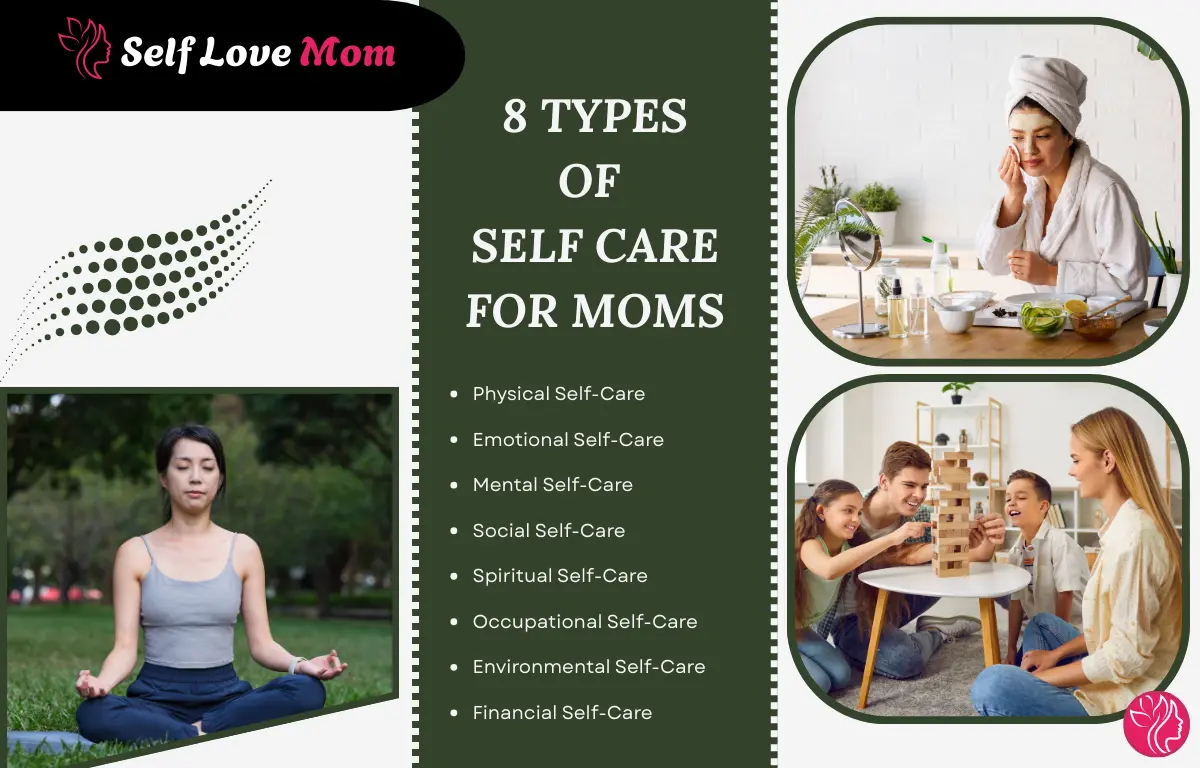
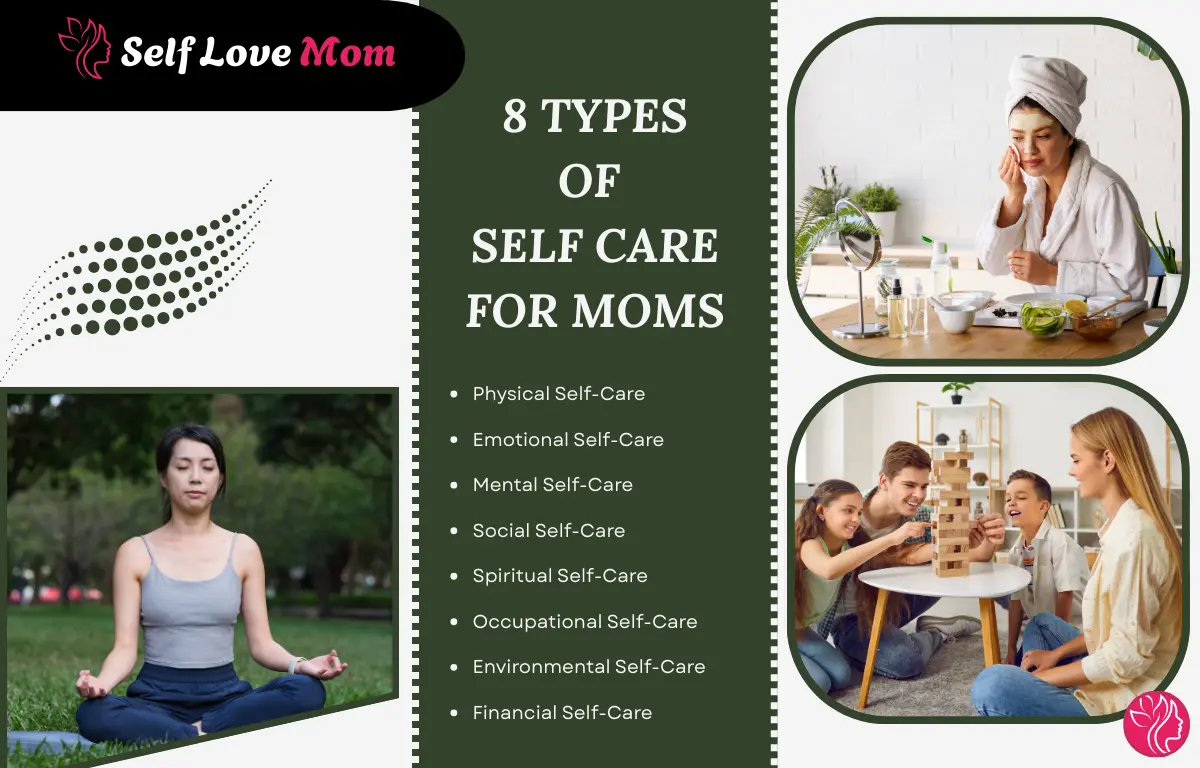
8 types of self care for moms: Physical, emotional, mental, and more
Search "types of self-care" and you get a different number every time: five here, seven there, eight somewhere else. The confusion is real, but the fix is simple. Self-care is not a spa day, it is a whole-person maintenance system, and the fullest version breaks into 8 types of self care: physical, emotional, mental, social, spiritual, practical, environmental, and financial.
Why it matters for moms specifically: the load is heavier and the tank runs lower. In 2024 the U.S. Surgeon General reported that 48% of parents say most days their stress is completely overwhelming, versus 26% of other adults ("Parents Under Pressure"). You do not need all eight every day. You need a way to see which one is empty.
This guide defines what self-care actually is, settles the 5-vs-7-vs-8 question, walks the 8 types with real mom-sized actions, and gives you a self-care wheel to spot your emptiest dimension in about a minute.
| The framework | Why moms need it | The risk it prevents |
|---|---|---|
| 8 types of self-care, from physical to financial |
48% of parents: daily stress is completely overwhelming (Surgeon General) |
~8% of U.S. parents reach clinical burnout that self-care helps buffer (42-country study) |
The short version
Self-care is any deliberate act that protects your physical, mental, or emotional health, and the World Health Organization treats it as a real health practice, not a luxury. The complete model has 8 types: physical, emotional, mental, social, spiritual, practical, environmental, and financial. Smaller lists (5, 6, or 7 types) just group these differently. You are not meant to do all eight daily. Use the self-care wheel below to find the dimension running on empty, then feed that one first.
What is self-care, really?
Self-care is the deliberate practice of protecting your own health, and it is a recognized health concept, not a trend. The World Health Organization defines self-care as the ability to promote health, prevent disease, and cope with illness, with or without a health worker's support (WHO). It is proactive maintenance, not selfishness, and for moms it is what keeps the caregiving sustainable.
Here is the reframe that helps most. Self-care is not the bubble bath, it is the system underneath: sleep, boundaries, connection, money, meaning. The bath is a nice output. The system is the point. When people say self-care "did not work," they usually tried a one-off treat instead of tending the dimension that was actually depleted.
How many types of self-care are there: 5, 6, 7, or 8?
All of the above, depending on how finely you slice it. The most-cited frameworks range from 5 types (Verywell Mind) to 7 (Virginia Commonwealth University) to 8 (most health centers), and they describe the same territory at different resolutions. The 8-type model is the most complete because it separates practical, environmental, and financial care that shorter lists fold into one.
So which number is "right"? The one you will actually use. We teach 8 because the extra categories, especially financial and environmental, are exactly the ones overwhelmed moms tend to ignore until they become a crisis. Think of the shorter lists as the same wheel with fewer spokes.
The 8 types of self-care for moms
Each type answers a different kind of empty. You do not rank them, you balance them: a rested body cannot outrun money panic, and a full social life cannot fix no sleep. Here is what each of these eight looks like in a real mom's week, not in theory.
- Physical. Your body's baseline: sleep, food, movement, care. Mom-sized: protect one 7-hour sleep block, drink water before coffee, a 15-minute walk with the stroller.
- Emotional. Feeling and processing what comes up instead of stuffing it. Mom-sized: name the feeling out loud, text a friend the honest version, let yourself cry without narrating guilt over it.
- Mental. Keeping your mind engaged and rested, not just busy. Mom-sized: 15 minutes of a real book, a podcast that is not about parenting, a hard screen cutoff at night.
- Social. Connection that refills rather than drains. Mom-sized: one honest adult conversation a week, a mom group (online counts), saying yes to help without apologizing.
- Spiritual. A sense of meaning beyond the to-do list, religious or not. Mom-sized: five quiet minutes, time outside, a nightly gratitude line, remembering you are more than mom-duties.
- Practical. The admin that steals peace when ignored. Mom-sized: one nagging task off the list, a shared family calendar, handing off a chore instead of re-explaining it.
- Environmental. The spaces you live in. Mom-sized: clear one surface, make one calm corner yours, open a window, lower the noise for ten minutes.
- Financial. Money care that lowers background dread. Mom-sized: a simple budget app, a tiny automatic emergency-fund transfer, one money task you have been avoiding.
Your self-care wheel: which dimension is empty?
A self-care wheel turns those 8 types into a one-minute self-check. You rate each dimension from 0 (running on empty) to 5 (full), and the shape shows you where to aim. It beats generic "do more self-care" advice because it points you at the one or two dimensions actually depleted, so a scarce 20 minutes goes where it counts.
Do this weekly, not daily. A quick Sunday scan of the wheel shows what the week drained, and you pick the one lowest spoke to feed on purpose. Balance beats intensity: eight dimensions at a steady 3 will carry you further than two at a 5 and the rest at zero.
How do busy moms actually keep this up?
Consistency comes from shrinking the habit, not gritting your teeth. Research on behavior change is clear that tiny, anchored actions stick where ambitious routines collapse. So the goal is not an hour of self-care, it is five honest minutes attached to something you already do, most days.
A few things that hold up in real life: anchor one small act to an existing cue (stretch while the coffee brews), keep the bar embarrassingly low on hard days, and fold family in where you can, a walk together still counts. Our guides to self care for single moms and self care on a budget give you no-cost, low-time starting points for each dimension.
When is self-care not enough?
Self-care prevents and buffers, but it does not treat a clinical problem. When exhaustion, numbness, or dread stay for weeks no matter what you do, that points past self-care toward burnout or depression. About 8% of U.S. parents meet the threshold for clinical parental burnout, which self-care can cushion but not cure (42-country study).
If the wheel stays flat across every dimension for a couple of weeks, or the low mood is not lifting, that is a signal to reach for support, not more willpower. Our guides to therapy for overwhelmed moms and stress management for moms cover the next step, and the 988 Suicide and Crisis Lifeline is free, 24/7, by call or text if things feel like too much.
Frequently Asked Questions
What are the 8 types of self-care?
The eight types of self-care are physical, emotional, mental, social, spiritual, practical, environmental, and financial. Each protects a different part of your well-being, from sleep and movement (physical) to lowering money dread (financial). You balance them rather than rank them, using a self-care wheel to spot the emptiest one.
What are the 7 types of self-care?
The common 7-type model (used by Virginia Commonwealth University) lists emotional, mental, physical, social, spiritual, professional, and financial self-care. It is the same territory as the 8-type model, just folding environmental care into the others. We teach 8 because the environmental piece matters more than it gets credit for.
What is a self-care wheel?
A self-care wheel is a simple self-assessment that plots the types of self-care as spokes, each rated from 0 (empty) to 5 (full). The resulting shape shows which dimensions are depleted, so you can aim limited time and energy at the one or two that need it most instead of guessing.
What is the most important type of self-care?
There is no single most important type, because they support each other: good sleep cannot offset money panic, and connection cannot fix chronic exhaustion. The most important type at any moment is whichever one is emptiest, which is exactly what the self-care wheel is designed to reveal.
Is self-care selfish?
No. The World Health Organization treats self-care as a legitimate health practice, and for caregivers it is what makes sustained caregiving possible. Tending your own physical, emotional, and financial health is not taking away from your family, it is protecting the person they rely on most.
Sources
- World Health Organization, "Self-Care Interventions for Health," who.int (definition of self-care, retrieved 2026-07-10).
- Office of the U.S. Surgeon General, "Parents Under Pressure: A Surgeon General's Advisory," hhs.gov (48% of parents report overwhelming daily stress, 2024, retrieved 2026-07-10).
- Virginia Commonwealth University, "7 Types of Self-Care and Why You Should Practice Them," onlinesocialwork.vcu.edu (7-type framework, retrieved 2026-07-10).
- Roskam, I., Mikolajczak, M. et al., "Parental Burnout Around the Globe: a 42-Country Study," Affective Science via PubMed (US parental-burnout prevalence, 2021, retrieved 2026-07-10).
- National Institute of Mental Health, "Caring for Your Mental Health," nimh.nih.gov (self-care and mental health, retrieved 2026-07-10).
✻ Share this article
✻ About the contributor · Folio N°.180

Written by Subha
Psychologist and writer covering the topics that matter most to single moms, money, mental health, and the small daily rituals that keep a family running. Every article is research-backed and edited four times before publish.
- Articles
- 180
- Desks
- 05
- Edited
- 4×
More from this writer
✻ Edited four times before publish