Depleted Mother Syndrome: Is It Real and What Helps?
Depleted mother syndrome is not a real diagnosis, but the burnout underneath it is measured. US parents hit 8.9% in a 42-country study. Here is what helps.

 Click to zoom
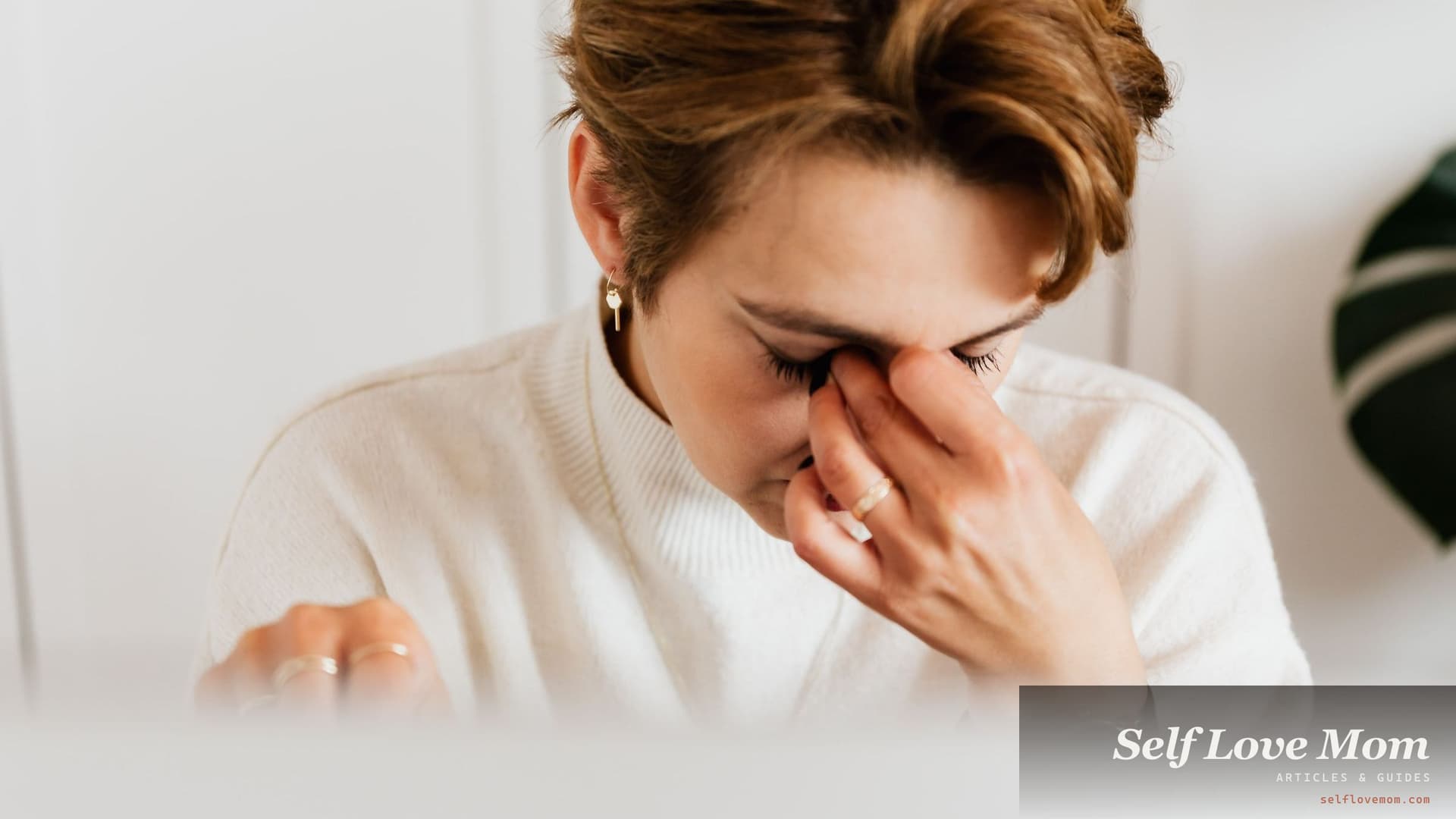
A mother closes her eyes and pinches the bridge of her nose while sitting at a table in a bright room.
You searched the phrase because something in it matched. Not tired. Not stressed. Emptied out, like the part of you that used to enjoy your kids got quietly switched off and nobody told you when.
Here is the honest answer nobody on the first page of results gives you. Depleted mother syndrome is not a medical diagnosis and never has been. The exhaustion it describes, though, has been measured in 42 countries with a validated questionnaire, and American parents score among the worst in the world.
| What was measured | Figure | Why it matters |
|---|---|---|
| US parents meeting the burnout threshold | 8.9% | Among the highest of all 42 countries |
| Thai parents meeting the same threshold | 0.2% | Same questionnaire, 44 times rarer |
| Link between individualism and burnout | r = 0.53 | Culture predicted it better than income did |
| Single mothers in moderate or severe distress | 32% | Against 19% of married mothers |
The short version
Depleted mother syndrome is a popular name, not a clinical one. The condition underneath it is parental burnout, which has a 23-item validated scale and four measured symptoms. In the United States 8.9% of parents meet the threshold. In Thailand it is 0.2%.
The strongest predictor across all 42 countries was not money, and not how many children you had. It was individualism, the cultural expectation that you should be handling this by yourself.
What is depleted mother syndrome, and is it real?
Depleted mother syndrome is a popular label for a real condition that carries a different name in the research: parental burnout. You will not find the phrase in any diagnostic manual, which is why so many mothers get told they are just tired and sent home.
The distinction matters more than it sounds. A label with no clinical standing gets dismissed. A measured construct does not. Parental burnout has both a definition and an instrument, and that is the difference between a feeling you cannot prove and a condition a clinician can assess.
So when you ask whether it is real, the accurate answer is two-part. The name is informal. The exhaustion, the emotional distance, the sense of being a worse parent than you used to be, all of that is documented, measured, and has been studied across tens of thousands of parents.
The practical test is not intensity but recovery. Ordinary tiredness lifts after a good night, a quiet weekend, a week where nothing goes wrong. Burnout does not. It survives the good weekend, which is the part that frightens mothers into searching for a name for it at 11pm.
It is also role-specific, and that catches people out. You can be burned out as a parent while still functioning at work, holding a conversation, being funny with friends. The depletion is attached to the parenting role rather than to you as a whole person.
| Parental burnout | Depression | |
|---|---|---|
| Where it shows up | Tied to the parenting role. A parent can score high and still function at work | Pervades most areas of life at once |
| How it is measured | The 23-item Parental Burnout Assessment, scored on four subscales | Clinical assessment against diagnostic criteria |
| Diagnostic status | Not in the DSM-5-TR or the ICD-11 | Recognized in both |
What does the research actually measure?
Researchers measure parental burnout with the Parental Burnout Assessment, a 23-item questionnaire built by Roskam, Brianda and Mikolajczak in 2018. It scores four separate symptoms, and reading them is often the moment the whole thing clicks for people.
- Emotional exhaustion. Nine items. The sample statement is "I feel completely run down by my role as a parent." Not tired at the end of a hard day. Run down by the role itself.
- Contrast with your previous parenting self. Six items, including "I tell myself that I'm no longer the parent I used to be." This is the one mothers describe as grief.
- Feeling fed up with the parental role. Five items, the mildest being "I don't enjoy being with my child(ren)" and the bluntest "I can't stand my role as father/mother any more." Almost nobody says either out loud.
- Emotional distancing from your children. Three items, the heaviest being "I'm no longer able to show my child(ren) how much I love them." This is the symptom that separates burnout from ordinary tiredness.
Each item is rated on a seven-point frequency scale, from never through to every day. That structure is deliberate. Burnout is not about whether you have ever felt these things. Everyone has. It is about how often.
If the exhaustion is showing up as anger rather than numbness, that has its own research base, and our guide to mom rage and why it happens covers what that pattern usually means.
Why is it so much worse in the United States?
Because of culture, and the finding is more specific than that sounds. In a 2021 study, Roskam and colleagues surveyed 17,409 parents across 42 countries, 71% of them mothers, and found prevalence ranging from near zero to nearly ten percent.
The team then tested which cultural values predicted the pattern. Individualism correlated with prevalence at r = 0.53, and it was the only one of six cultural values still tied to burnout once parental workload and national wealth were controlled for.
Read that finding as a single mother and it lands differently. The thing driving burnout is not a shortage of effort on your part. It is the expectation that a parent should manage alone, and that expectation is strongest in exactly the countries where mothers are most burned out.
What are the signs, and when do they become serious?
The signs of depleted mother syndrome track the four measured symptoms above, but the ones that matter clinically are the two people find hardest to admit. Feeling you cannot stand the role any more, and losing the ability to show your children affection.
A 2025 narrative review in Healthcare describes what happens when burnout is left to run. Emotional distancing widens. In parent profiles with significant burnout, the reviewers report that neglect and most forms of violence occurred more frequently.
The review also names the outcome it calls among the worst: thoughts of escape. That ranges from wanting to leave the family through, in the most severe cases, contemplating suicide. If you have reached that point, this is not something to manage with better routines.
Worth being careful with that finding. It is a narrative review rather than a single controlled study, and it reports associations, not a guarantee of what happens next. Plenty of exhausted parents never come close to any of it. The point is the direction of travel, not a prophecy.
What the direction tells you is that this is progressive. It does not sit still and wait politely for a convenient moment. The symptoms that people find hardest to say out loud are also the ones furthest along the scale, which is exactly the wrong incentive structure for getting help early.
If you are in crisis
In the United States, call or text 988 for the Suicide and Crisis Lifeline. It is free, confidential, and available every hour of every day. Thinking about escaping is a recognized symptom of burnout, not evidence that you are a bad mother.
What actually helps when you are the only parent?
Almost every article on this topic assumes there is a second adult to hand things to. Split the night feeds. Ask your partner to own bedtime. That advice is not wrong, it was just written for a household you may not have.

The 42-country finding points somewhere more useful for solo parents. If isolation is the mechanism, then the lever is not working harder alone. It is deliberately reducing how alone you are, even in small and unglamorous ways.
Structured groups do this without requiring you to have a partner or spare money. Free single mom support groups exist in most areas and online, and they run on the exact resource the research says is missing.
Beyond that, three things are worth more than another productivity system. One recurring adult contact that is not about logistics. One task permanently handed to somebody else, even a cheap or traded one. One block of time each week that exists whether or not you earned it.
None of that is a cure and it would be dishonest to sell it that way. What it does is move the variable the research actually identified, which is more than a tidier routine or an earlier bedtime will do.
If the exhaustion has hardened into something that does not lift on a good week, it may have moved past burnout. Our piece on how long burnout takes to lift sets out the realistic timeline.
How do you get help without a diagnosis?
You describe symptoms, not the label. A clinician who has never heard the phrase depleted mother syndrome will still recognize emotional exhaustion, feeling fed up with the role, and emotional distance from your children, because those are assessable.
Bring specifics. How often, using the same frequency language the scale uses. "I have not enjoyed being with my kids in about three months" is clinical information. "I am exhausted" is not, and it is the sentence that gets you sent home.
It also helps to say what has already failed. Sleep did not fix it. The weekend away did not fix it. That rules out the first things a busy provider will otherwise suggest, and it moves the conversation to what is actually going on rather than back to the start.
Cost is the usual barrier, and it is a real one rather than an excuse. There are low-cost and free therapy routes for single mothers that do not depend on employer insurance.
If you want a structured read on where you currently sit before booking anything, our mom burnout quiz uses adapted burnout scoring and takes about five minutes.
Frequently asked questions
Is depleted mother syndrome a medical diagnosis?
No. It appears in no diagnostic manual and has no billing code. The underlying condition, parental burnout, is a validated research construct with a 23-item assessment and prevalence data from 42 countries. The experience is documented even though the popular name is not clinical.
How do you know if you have depleted mother syndrome?
Researchers look at four symptoms: emotional exhaustion in the parenting role, feeling you are no longer the parent you used to be, feeling fed up with the role itself, and emotional distancing from your children. Frequency is what separates burnout from a hard week.
Is there a test or quiz for it?
The research instrument is the Parental Burnout Assessment, 23 items scored on a seven-point frequency scale. It is designed for clinical and research use rather than self-diagnosis, so an online quiz can point you toward a conversation but cannot replace one.
How long does it take to recover?
There is no established recovery timeline in the literature, which is an honest gap rather than a reassuring one. What the research does show is direction: burnout worsens when the conditions producing it stay unchanged, so recovery tracks whether the load and the isolation actually shift.
Is it the same as depression?
No. Parental burnout is specific to the parenting role, which is why a parent can score high on burnout while functioning at work. Depression is broader and pervades every domain. The two can occur together, and only a clinician can separate them properly.
What medication treats it?
None, because it is not a diagnosis and no drug is approved for it. Where burnout occurs alongside depression or anxiety, a prescriber may treat those conditions directly. Whether medication fits your situation is a conversation for someone who can assess the whole picture.
The bottom line
The label is informal, the condition is measured, and the strongest driver is the one nobody can fix alone. Being told to try harder by yourself is the exact prescription the research says makes it worse.
That is worth sitting with if you have spent months assuming the problem is your own weakness. Across 42 countries, the thing that best predicted which parents broke down was not effort, income or family size. It was how much a culture expects parents to cope unaided.
So the useful question is not what is wrong with you. It is which part of the load can be shared this month, with whom, and starting when.
Sources
- Roskam, I., Aguiar, J., Akgun, E. et al., "Parental Burnout Around the Globe: a 42-Country Study," Affective Science, 2021, retrieved 2026-08-04, pmc.ncbi.nlm.nih.gov
- Roskam, I., Brianda, M. E. and Mikolajczak, M., "A Step Forward in the Conceptualization and Measurement of Parental Burnout: The Parental Burnout Assessment," Frontiers in Psychology, 2018, retrieved 2026-08-04, pmc.ncbi.nlm.nih.gov
- Bogdan, P. M., Varga, K., Toth, L., Grof, K. and Pakai, A., "Parental Burnout: A Progressive Condition Potentially Compromising Family Well-Being, A Narrative Review," Healthcare, 2025, retrieved 2026-08-04, pmc.ncbi.nlm.nih.gov
- Brookings, "Single Mothers Experience High Rates of Psychological Distress. The Safety Net Can Help," retrieved 2026-08-04, brookings.edu
- Cleveland Clinic, "Depleted Mother Syndrome: How To Manage It," retrieved 2026-08-04, health.clevelandclinic.org
- 988 Suicide and Crisis Lifeline, "Home," retrieved 2026-08-04, 988lifeline.org
✻ Share this article
✻ About the contributor · Folio N°.176

Written by Subha
Psychologist and writer covering the topics that matter most to single moms, money, mental health, and the small daily rituals that keep a family running. Every article is research-backed and edited four times before publish.
- Articles
- 176
- Desks
- 05
- Edited
- 4×
More from this writer
✻ Edited four times before publish