
📋 Quick Summary
Yes, you can get food stamps on unemployment. Unemployment income qualifies as SNAP, and in most instances, the income is low enough to qualify. This guide discusses food stamps eligibility on unemployment, work requirements for food stamps, exemption status, and a walk-through on how to apply for SNAP while you’re on unemployment.
Losing a job is tough, especially with little ones depending on you. After filing for unemployment, many of us wonder, “Can I get food stamps on unemployment?” The answer is yes in most cases, you can. Unemployment benefits count as income for SNAP, and since they’re often lower than your previous earnings, you’re likely to qualify.
But it can be hard to comprehend income limits, family regulations, and labour necessities. This guide will assist you in finding out who is eligible for food stamps on unemployment, the amount of money you may get, the work requirements, and how to apply.
Can You Get Food Stamps on Unemployment? The Short Answer
Yes. And here’s why it’s more straightforward than people think.
SNAP (Supplemental Nutrition Assistance Program), commonly referred to by many as food stamps, considers your present household income to determine whether you qualify or not. Your income is reduced when you are on unemployment. Often significantly. That drop is exactly what makes food stamps on unemployment a real option for millions of families every year.
Unemployment benefits are counted as income by SNAP. But here’s the thing: the average unemployment check in the US is somewhere around $300–$400 per week. For a household of two (you and one child), the gross income limit for SNAP in 2026 is around $2,096 per month. Do the math; most unemployment checks fall well under that threshold.
So, can I get food stamps while on unemployment? If your unemployment income plus any other household income falls below your state’s SNAP limit, which it very likely does, then yes, you qualify.
Eligibility for Food Stamps on Unemployment: What SNAP Actually Looks At
Understanding eligibility for food stamps on unemployment comes down to a few key factors. SNAP doesn’t just look at whether you have a job or not. They look at the whole picture:
1. Your Gross Monthly Income
This covers unemployment benefits, any part-time work, child support you receive and any other income. For most states in 2026, the gross income limit is 130% of the federal poverty level. For a family of three, that’s roughly $2,311 per month. If your unemployment check is $1,400/month and that’s all you’ve got? You’re well within the limit.
2. Your Net Monthly Income
After deductions, items such as housing expenses, child care expenses, and a standard deduction, your net income must be less than 100% of the poverty line. This is where single moms can easily be even more qualified, since the budget is consumed by childcare and rent.
3. Your Household Size
The more individuals you have in your family, the higher the income limit. The threshold of a single person is far more constrained than that of a mom with two or three children. SNAP includes all the households that live together and purchase/prepare food together.
4. Your Assets
Most states have significantly relaxed asset tests. In many states, they don’t even look at your savings or car value anymore when determining eligibility for food stamps on unemployment. Having a modest savings account won’t disqualify you in most places.
💡 Quick Tip
Don’t assume you won’t qualify just because you’re getting unemployment checks. The whole point of SNAP benefits is to help people in exactly this situation. Run your numbers through your state’s SNAP calculator before you rule yourself out.
SNAP Income Limits for 2026 (Quick Reference)
Here’s a rough breakdown of gross monthly income limits for SNAP in 2026. Keep in mind these can vary slightly by state:
| Household Size | Gross Monthly Income Limit | Max Monthly SNAP Benefit |
|---|---|---|
| 1 | $1,696 | $298 |
| 2 | $2,292 | $546 |
| 3 | $2,888 | $785 |
| 4 | $3,483 | $994 |
| 5 | $4,079 | $1,183 |
If you’re receiving food stamps on unemployment and your unemployment check is your only income, compare it against the limits above. A mom with two kids getting $1,600/month in unemployment? That’s below the $2,888 threshold for a household of three. You’d likely qualify for a decent monthly SNAP amount.
Do SNAP Work Requirements Apply to You While on Unemployment?
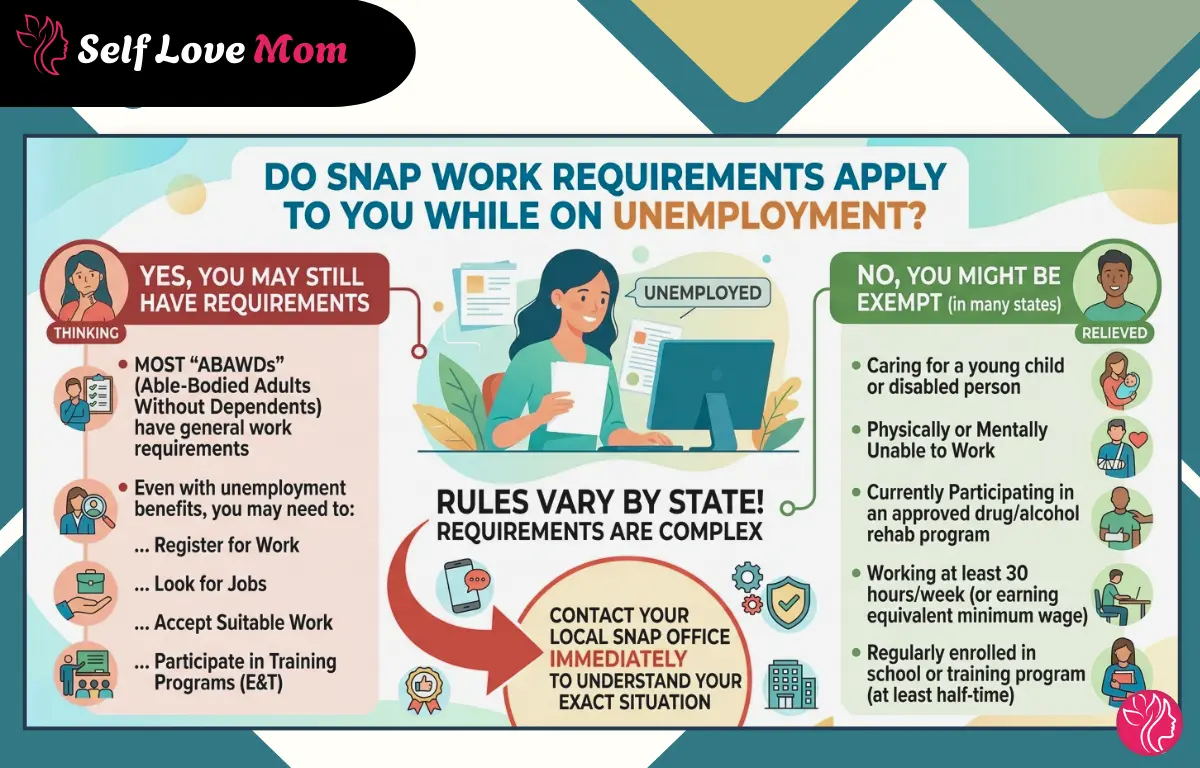
Work requirements for food stamps can be confusing. Generally, receiving unemployment benefits does not exempt you from SNAP work requirements, but the details vary by age, state, and circumstances.
1. The Basic SNAP Work Requirements
Most of the able-bodied adults between 16 and 59 are expected to enroll in work, take jobs that suit them, and should not leave a job voluntarily without any significant reason. Being on unemployment does not make them inapplicable to you, but as you are already actively seeking work (which is a requirement of receiving unemployment you are generally in compliance.
2. The ABAWD Rule (The Stricter One)
The Able-Bodied Adults Without Dependents (ABAWD), who are typically aged 18-54, have now expanded to ages 18–64 and have no children or disabled dependents, are subject to one more rule: they have to work or enroll in a work program at least 80 hours per month, or they can only receive 3 months of SNAP benefits within 36 months.
Collecting food stamps on unemployment does NOT automatically satisfy the ABAWD work requirement, because unemployment means you are not currently working. However, actively searching for work and complying with your state’s unemployment office job-search requirements may help satisfy SNAP’s work registration requirements in some states.
You’re exempt from SNAP work requirements if you:
Have a child under 18 living with you (this alone exempts most single moms)
Are pregnant
Have a physical or mental health condition that limits your ability to work
Are already receiving unemployment benefits (in many states, this counts as meeting the requirement)
Are in a job training or education program
Are you caring for an incapacitated household member
Live in an area with a waiver due to high unemployment rates
How to Apply for SNAP While You’re on Unemployment
Applying for food stamps while you’re on unemployment is actually pretty straightforward once you know the steps. Here’s exactly what to do:
- Find your state’s SNAP application. Every state handles SNAP differently. Google “[your state] SNAP application” or go to benefits.gov. Most states now let you apply for food stamps on unemployment entirely online
- Check your eligibility first. Unemployment income is counted toward SNAP’s gross income limit (130% of the federal poverty level). A single person can earn roughly ~$1,580/month and still qualify.
- Gather your documents. You’ll need:
- Proof of identity (ID or passport)
- Proof of unemployment benefits (your award letter or bank statements showing deposits)
- Proof of residence (utility bill, lease agreement)
- Social Security numbers for everyone in your household
- Submit your application. You’ve got options here:
- Online: Visit your state’s SNAP portal or find your link through benefits.gov
- In person: Walk into your local Department of Social Services office
- By phone or mail: Most states offer both of these, too
- Submit and wait for your interview. Most states require a phone or in-person interview within 30 days of your application. It’s not an interrogation; it’s mostly just confirming what you wrote on the form.
- Get your EBT card. As soon as it is approved, you will receive an Electronic Benefits Transfer card (it acts as a debit card) with your monthly SNAP amount loaded. Benefits normally take 30 days after application, and in a real emergency, request expedited processing, which makes the benefits available within 7 days.
✅ Pro Tip
Apply for SNAP the same day you file for unemployment if you can. There’s no rule saying you have to wait. The sooner you submit, the sooner you get help with groceries. Many families receiving food stamps on unemployment wish they’d applied earlier instead of trying to stretch things on their own.
What Happens to Your Food Stamps When You Get a New Job?
Getting a new job is great news, but it will likely affect your SNAP (Supplemental Nutrition Assistance Program) benefits. Here’s what to expect:
You Must Report the Change
In most states, you are required to notify a new employment and any change in the income to your local SNAP office within 10 days of employment commencement. If you do not report, you may end up paying back overpayments or face punishment for fraud.
Your SNAP Benefits May Be Reduced; Not Necessarily Eliminated
SNAP uses an income-based benefit calculation formula. Your benefits are usually cut off by approximately 30 cents (not a dollar) per extra dollar that you earn. Therefore, getting a new job does not necessarily render you ineligible; it is just that you will have a reduced monthly payment.
You May Still Qualify, Depending On…
- Household size, bigger families have more income thresholds.
- Your gross income typically should be up to 130% of the federal poverty level.
- Deductions like rent, childcare, and medical costs can reduce your countable income
- State regulations: The amount of state variations is within slight thresholds.
You Could Lose Benefits Entirely If…
Your new income pushes your household above the eligibility threshold. At that point, your case will be closed, though you can reapply if your situation changes again.
What to Do
- Immediately report your new job to your state SNAP office: over the phone, online, or in person.
- Include simple documentation, such as an offer letter or an initial pay stub.
- Request a benefit recalculation: A caseworker could inform you of your new benefit amount.
- Have current contact information so that you do not miss any notifications regarding your case.
A Silver Lining: Work Incentives
Many states have transitional benefits or work support programs that allow you to continue to receive some SNAP temporarily when you start to work, to facilitate the transition. You should ask your caseworker whether these programs are available in your state.
The bottom line: when you start a job, your benefits do not disappear overnight; the system is meant to reduce progressively as your earnings increase.
Other Programs You Should Apply for at the Same Time
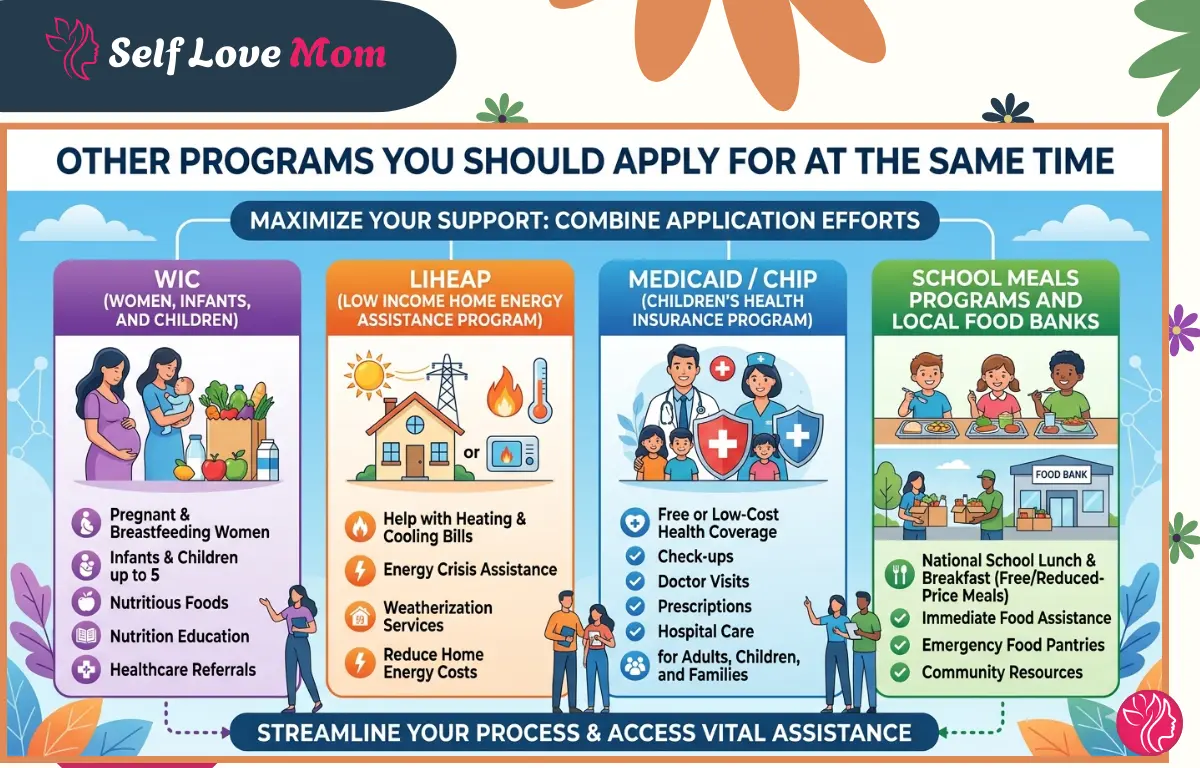
If you’re already going through the process to apply for food stamps on unemployment, you might as well apply for these, too. Many use the same application or a very similar one:
- WIC: Pregnant women and those with children younger than 5 receive free nutrition and formula and nutrition assistance independent of SNAP.
- TANF (Temporary Assistance for Needy Families): Direct cash assistance to aid in rent, child care and basic needs. If you are eligible for SNAP, there is a high chance you will receive TANF as well.
- Medicaid / CHIP: Health coverage for families with low income. Being laid off usually amounts to losing health coverage from the employer. Don’t skip this.
- LIHEAP: Assists in heating and cooling aid. LIHEAP can help you reduce some of that when you are concerned with utilities on top of groceries.
- School Meals Programs: If you have school-aged children, they are eligible for free or reduced-price breakfast and lunch at school. Most schools automatically enrol SNAP families.
- Local Food Banks: No application was required. Just show up. Food banks are designed precisely for this moment, and there is no need to check on income.
Stacking programs isn’t gaming the system; it’s using the safety net the way it was designed. A family receiving food stamps on unemployment, WIC plus LIHEAP is doing exactly what these programs exist for.
Don’t Wait, Mama. Apply Today. 💛
If you’re currently on unemployment and wondering whether you should apply for food stamps, the best step is to apply. The worst that can happen is that your application may be denied. However, many people receiving unemployment benefits still qualify for SNAP. These food stamps on unemployment benefits can make a real difference, helping you cover grocery costs and easing the stress of feeding your family during a difficult time.
Don’t hesitate to use the support available to you. Use it. Bookmark this page, share it with another mom who’s going through it, and go fill out that application.
Frequently Asked Questions
Can I get food stamps on unemployment?
Yes. Unemployment income counts toward SNAP eligibility, and since most unemployment checks are significantly lower than regular wages, many people on unemployment fall within SNAP benefits income limits. You can absolutely receive food stamps on unemployment.
Will getting a new job cancel my food stamps?
Not automatically. You report the income change, and SNAP recalculates your benefit. If your new income still falls under the limit, you’ll keep receiving benefits at a lower amount. The transition is gradual; they won’t cut you off overnight.
Who is exempt from SNAP work requirements?
Parents with children under 18, pregnant women, people with disabilities, those in job training programs, and individuals already receiving unemployment benefits are all typically exempt. If you’re a single mom, you’re almost certainly exempt from SNAP work requirements.
What disqualifies you from getting SNAP benefits?
You can be disqualified from food stamps on unemployment if you exceed the income or asset limits, are an undocumented immigrant, or are an able-bodied adult without dependents who refuses to meet work requirements. Prior drug-related felony convictions, voluntarily quitting a job, or being a student enrolled more than half-time without qualifying exceptions can also disqualify you.
What is the highest income to qualify for food stamps on unemployment?
For 2026, the gross monthly income limit is 130% of the federal poverty level. That works out to roughly $1,696/month for one person and $3,483/month for a family of four. After deductions, your net income needs to be at or below 100% of the poverty line.