
📋 Quick Summary
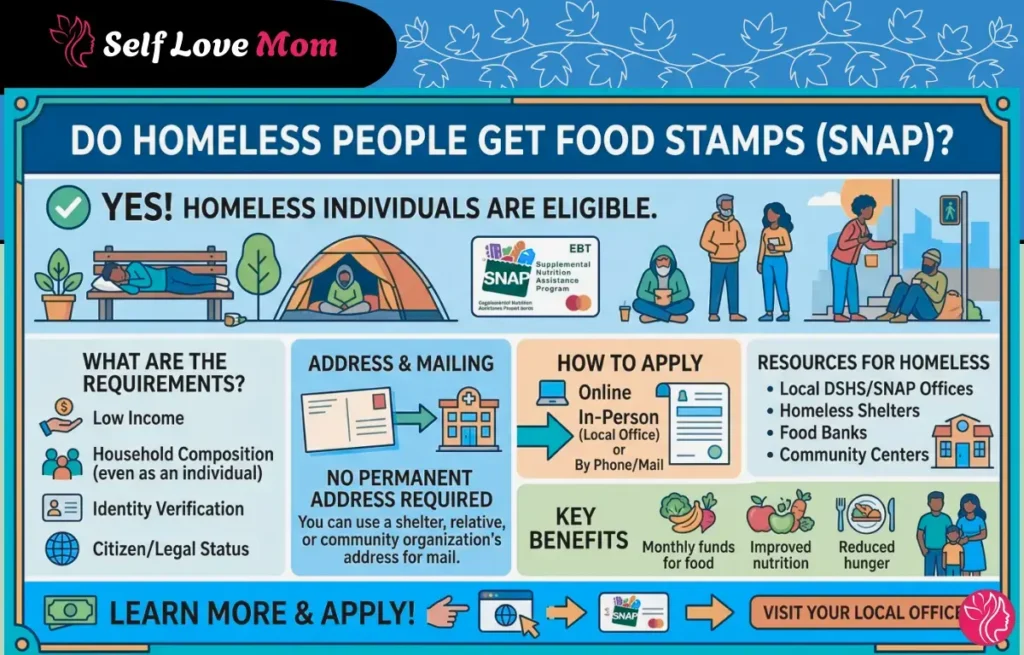
Yes, individuals experiencing homelessness are fully eligible for food stamps (SNAP) in 2026. A permanent address is not required, nor is a kitchen or even a state-issued ID in many cases. This guide explains do homeless get food stamps, benefit amounts, emergency food stamps for homeless individuals, and the complete application process, even without stable housing.
Do Homeless Get Food Stamps? — The Short Answer
A question often asked: do homeless get food stamps? Yes, and here’s why. The Supplemental Nutrition Assistance Program (SNAP) is a USDA program that provides funds to states to assist homeless individuals. Most states don’t require a home, a lease, or even a mailing address to apply.
The fact, which most people do not know, is that SNAP has an eligibility category that caters to homeless individuals. The federal program officially acknowledges that street residents, shelter residents, vehicle residents, and those in temporary situations with friends and family need food aid.
Across the country, thousands of homeless individuals walk into SNAP offices with nothing more than a shelter intake letter and receive approval within the same week. So, if you’ve wondered Do homeless get food stamps?” keep reading. This guide provides all the details you need to act now.
Food Stamps Eligibility for Homeless Individuals: Key Criteria
Food stamp eligibility for homeless applicants actually works a little differently than that of those with housing. And it favors the applicant in most cases. The main reason? The “homeless shelter deduction.”
When people ask do homeless get food stamps, one of the first things to understand is this deduction. In practical terms, the program assumes that living expenses are higher and less predictable, so a larger deduction is applied to the income calculation. For the 2026 fiscal year, the homeless shelter deduction stands at $198.99 per month.
Basic Eligibility Checklist
- US citizenship or qualified non-citizen status
- A Social Security number (or documentation showing an application has been submitted)
- Household income below the SNAP threshold for the applicable household size
- Meeting the homeless food stamps requirements, which primarily involves demonstrating the absence of fixed, regular housing
Important: Food stamps for homeless allow beneficiaries to use their EBT cards at participating restaurants through the Restaurant Meals Program. This service, available in several states, ensures that cooked food can be purchased when a kitchen is not available.
How Much Food Stamps Do You Get If You’re Homeless?
The amount of food stamps a homeless person receives depends on income, household size, and state of residence. While the maximum benefit amounts for SNAP in 2026 are the same for all, the shelter deduction for homelessness typically allows homeless people to qualify for the maximum benefits, regardless of their income.
Below is a breakdown of maximum monthly SNAP benefits for 2026 based on household size:
| Household Size | Max Monthly SNAP Benefit (2026) |
|---|---|
| 1 person | $298 |
| 2 people | $546 |
| 3 people | $785 |
| 4 people | $994 |
| 5 people | $1,183 |
For individuals reporting zero income, which applies to a significant number of homeless applicants, the maximum benefit amount is typically what gets approved. For example, a single parent with two children and no income, for example, would likely receive the full $785 per month. That’s enough to maintain consistent meals while working toward stability in other areas.
Homeless Applying for Food Stamps: A Step-by-Step Guide
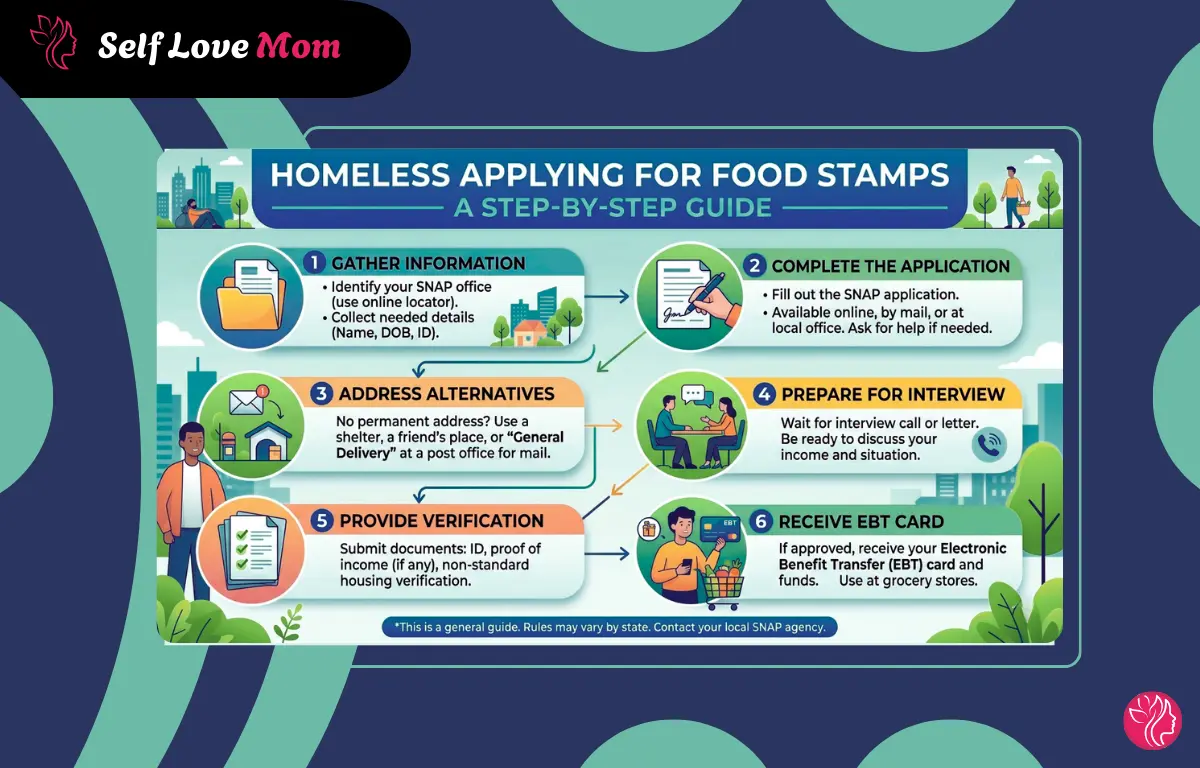
Many families and individuals want to know: do homeless get food stamps even without a stable address, a printer, or consistent phone service? Yes, SNAP offices are specifically equipped to assist applicants in exactly this situation.
Step 1: Know Your Rights as a Homeless Applicant
- You do not need a fixed address to qualify
- All you need is an address where the office can send your benefits and correspondence. This could be a shelter, a friend’s address, or even the office of a social worker.
- If you are experiencing homelessness, you are counted as a household of one.
- Homeless households receive a standard shelter deduction of $198.99, which can increase your benefit amount
Step 2: Find a Mailing Address
You must have a place where you withdraw your EBT card. Options include:
- A homeless shelter in which you live.
- A local charity, nonprofit, or food bank.
- Address by a social worker/case manager.
- The address of a friend or a relative who is trusted.
Step 3: Gather What You Can
You don’t need much. Bring whatever you have:
- Any ID (state ID, driver’s license, or even a library card in some states).
- Social security card/number (where applicable)
- Evidence of any revenue (even zero)
- Mailing address (shelter address is okay)
Step 4: Apply
Depending on your state, you may be able to submit a SNAP application online, in person, by mail, or by fax. The easiest options for homeless individuals are:
- In person at your local SNAP or social services office
- Through your shelter — many shelters have staff who can help you apply
- Online at benefits.gov or your state’s SNAP website
Step 5: Complete Your Interview
You may need to take part in an interview before being approved for SNAP benefits. This can often be done by phone; you do not have to appear in person.
Step 6: Receive and Use Your EBT Card
- If you have no fixed address, the SNAP office can arrange to have your EBT card mailed to an authorized representative such as a case manager or shelter worker.
- Residents of public or private nonprofit shelters are eligible to participate in SNAP.
- You can use your EBT card at any approved vendor; you are not restricted to only using it at your shelter
Emergency Food Stamps for Homeless: Expedited Processing Explained
When asking, ” Do the homeless get food stamps faster than other applicants, the answer is often yes. Emergency food stamps for homeless applicants can be processed in as few as 7 calendar days, rather than the standard 30-day timeline.
Expedited SNAP processing is available when any of the following conditions apply:
- Monthly gross income is below $150, AND liquid assets total less than $100
- Combined rent, mortgage, and utility costs exceed monthly income
- The applicant is a migrant or seasonal farmworker with assets below $100
- The applicant is currently experiencing homelessness this alone frequently meets the expedited criteria
Simply request expedited processing when applying, and if you’re eligible, your benefits will be issued quickly.
Do Homeless get Food Stamps Automatically?
No, but homelessness increases the likelihood of approval. While an application is still required, the absence of fixed housing and the shelter deduction often makes approval more probable, particularly for those with little or no income.
If you’re employed, your income is considered, but it won’t automatically disqualify you. Many people experiencing homelessness can qualify for SNAP even with a job if their income falls below the threshold. So if you’re asking, do homeless get food stamps while employed, the answer is still very likely yes.
Income Limit for Food Stamps for Homeless Applicants
Understanding how income limits apply helps answer the question: do homeless get food stamps even while working? The income limit for food stamps for homeless applicants is the same as the federal poverty threshold used for all SNAP program beneficiaries.
Here is a reference table for 2026:
| Household Size | Gross Monthly Income Limit | Net Monthly Income Limit |
|---|---|---|
| 1 | $1,696 | $1,305 |
| 2 | $2,292 | $1,763 |
| 3 | $2,888 | $2,221 |
| 4 | $3,483 | $2,680 |
In many states, there is Broad-Based Categorical Eligibility (e.g., California, New York, Michigan), which can increase the gross limit to 200% of the poverty level, to allow homeless families that are working to be eligible.
Important 2026 Update: Work Requirements
Due to federal changes in the 2025 One Big Beautiful Bill Act, a common concern is: do homeless get food stamps under the new work rules? The automatic exemption on most of the ABAWD work rules has been removed. ABAWDs, who have no dependents and are typically between the ages of 18 and 64 years, are now expected to work or train 80 hours per month in order to receive food stamps within 3 months of a 36-month period.
However, there are still important exemptions:
Several homeless people can still remain exempt. A chronic homelessness situation may often be a physical or mental incapacity, and other exemptions are made to persons who are expecting, disabled, or who have a child under 18.
Most adults are still subject to the general work registration requirement.
Action Step: Inform your caseworker of the entire situation. They can assist in finding out whether you are eligible for an exemption or refer you to work programs. It is important to note that rules can differ slightly based on state, so always check locally.
Homeless Food Stamps Requirements: Documentation Guide
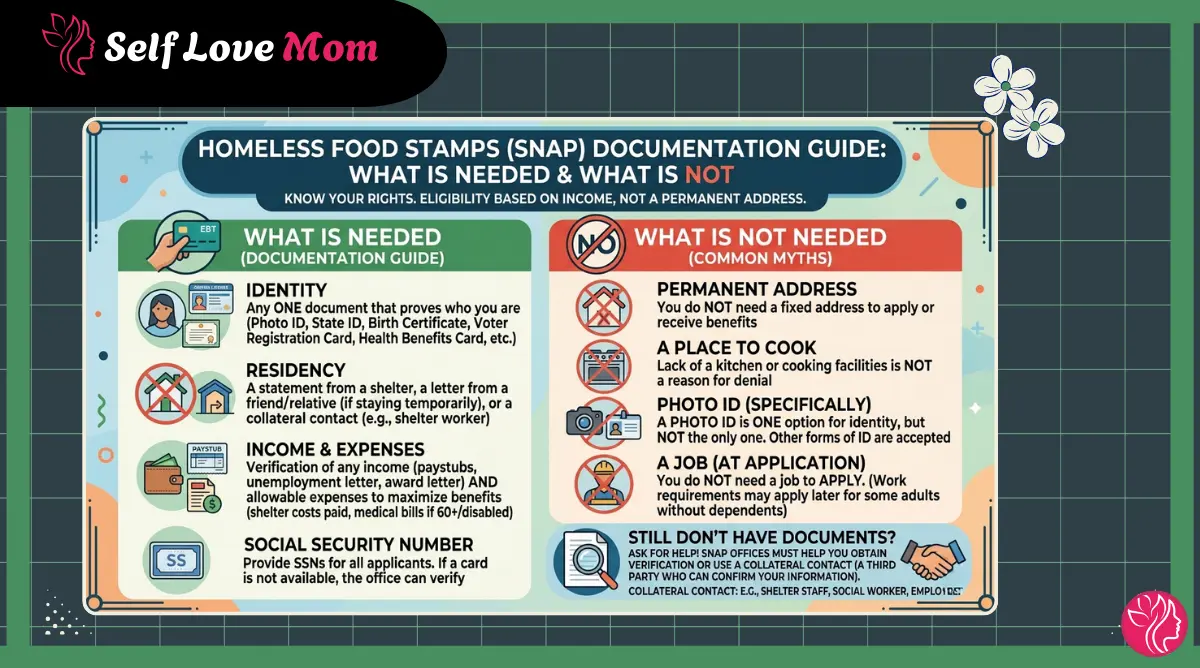
The homeless food stamps requirements are less demanding than most applicants expect. Below is a clear breakdown of what is and isn’t required:
What Is Needed
- Some form of identity verification, such as a state ID, birth certificate, or even a letter from a shelter director
- A Social Security number, or documentation showing an application has been submitted
- Proof of any income currently being received
- A statement regarding the current living situation, a verbal statement, is accepted in most jurisdictions
What Is NOT Needed
- A permanent mailing address, shelter addresses, P.O. boxes, or “general delivery” at any post office are all acceptable alternatives
- Many states accept alternative identity documents for a photo ID.
- Proof of rent or mortgage payments. This requirement is waived for homeless applicants
- A bank account of any kind
- A personal phone number, though, having one does facilitate the interview process
SNAP caseworkers across the country routinely approve homeless applicants with nothing more than a shelter letter and a verbal declaration of income. The federal framework is deliberately designed to be flexible for individuals in crisis situations. Paperwork anxiety should never prevent anyone from applying; anyone asking do homeless get food stamps should know the system is built to accommodate exactly these circumstances.
What to Do If the Application Is Denied
Denials happen, though they’re uncommon for homeless applicants. Those who are denied and still need to know do homeless get food stamps have strong appeal options:
- Review the denial letter closely; it will state the specific reason. In most cases, they are missing a document or have made an error calculating income. Fix what was flagged and resubmit immediately. There is no waiting period between applications.
- Request a “fair hearing” within 90 days. This is your legal right under federal law. Many denials of SNAP benefits are reversed on appeal, sometimes because the caseworker made a calculation error or failed to apply the homeless shelter deduction properly.
- Call 211 or a local legal aid office: Agencies such as the Legal Aid Society take on SNAP appeals for free. They know the process inside and out.
A denial is not a final answer; it’s a temporary setback that can almost always be resolved.
Access the Help That’s Available
So, Do homeless get food stamps? Yes. Can applications be submitted without a permanent address? Yes. Is the process designed to accommodate individuals in unstable housing situations? Absolutely. And if any caseworker’s approach feels dismissive, applicants have every right to request a different one.
Save this page and share it with anyone who might search do homeless get food stamps. Knowing that food stamps for homeless people are available, and the exact process to get them is valid, is a valid, actionable piece of information that can help you now in one of life’s hardest moments.
Need Help Right Now?
211 is free, confidential, and available 24/7. They will link callers to local SNAP offices, food banks, and emergency shelters. Anyone asking do homeless get food stamps can call 211 right now and get connected to the right resources immediately. Nobody has to go through this alone.
FAQs on Do Homeless get Food Stamps?
Do you automatically get food stamps if you’re homeless?
No, an application is still required. However, homelessness makes approval significantly more likely because income is typically low or zero. Expedited processing is available and can get benefits issued within 7 days.
How much food stamps do homeless get?
The amount of food stamps given to the homeless depends on the number in the household and the income bracket. An individual with zero income (on average) is expected to receive the maximum, about $ 298 per month, in 2026. A three-person family can get up to $768 a month.
If you’re homeless do you automatically get food stamps with a job?
Employment does not disqualify anyone from SNAP. The program compares total income to the set limit based on household size. Most working people living homeless are eligible, as their salaries do not exceed the income threshold, with the homeless shelter deduction taken into consideration.
How much food stamps does a homeless person get?
Food stamps for a homeless person depend on the state and personal conditions. In 2026, the maximum monthly benefit of a single person will be approximately $298. Applicants who record zero income with the homeless shelter deduction are usually granted at or slightly below the maximum.
Do you get more food stamps if you’re homeless?
Yes, those who ask do homeless get food stamps are often surprised to find that homeless applicants receive higher benefits because the homeless shelter deduction significantly lowers their countable income. This pushes their calculated benefit much closer to the maximum monthly amount allowed under SNAP in 2026.