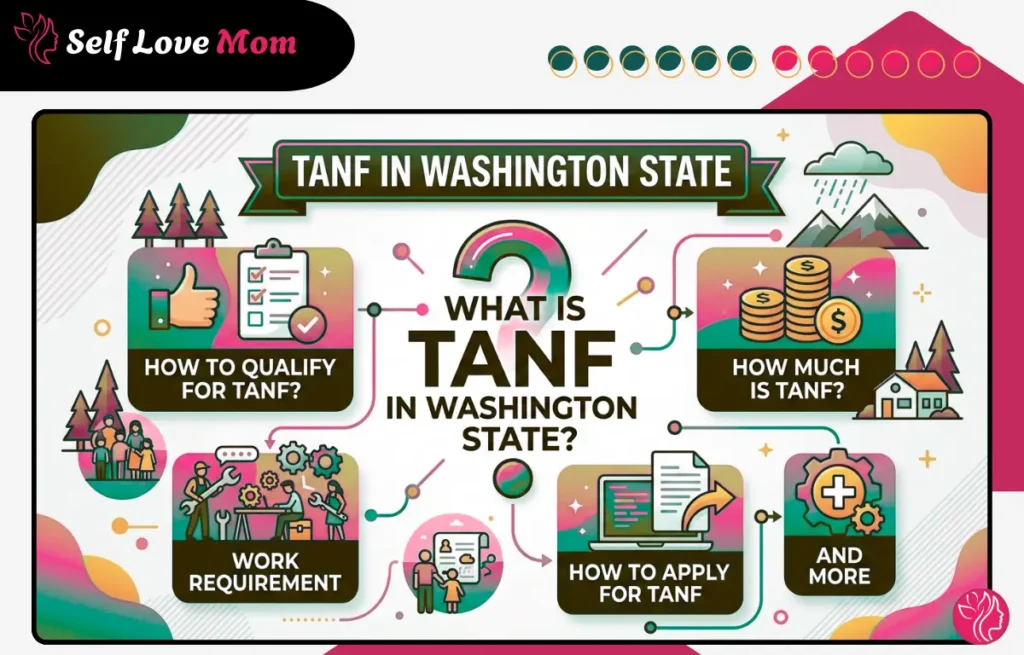

If you’re a mom in Washington State and things are really tough right now, TANF might be exactly what your family needs. It’s monthly cash in your pocket, plus real support like childcare help, job training, and emergency funds. This guide covers everything you need to know about TANF eligibility, benefit amounts, and how to apply in 2026.
Key Facts: TANF in Washington State at a Glance
| Topic | Details |
|---|---|
| Program Name | Temporary Assistance for Needy Families (TANF) |
| Administered By | Washington State DSHS |
| Phone Number | 877-501-2233 |
| Apply Online | washingtonconnection.org |
| Income Limit (3-person HH) | ~$1,912/month |
| Max Benefit (3-person HH) | ~$706/month |
| Lifetime Limit | 60 months (adults only) |
| Work Requirement | 30–40 hrs/week (WorkFirst) |
| Non-Needy TANF | Available for relative caregivers |
What Is TANF in Washington State?
TANF stands for Temporary Assistance for Needy Families. It’s a federal program that Washington runs through DSHS, and it gives families with kids monthly cash while helping them work toward a more stable future.
DSHS TANF and WorkFirst work together: TANF provides economic sustainability, and WorkFirst provides the means to become independent of it. Along with the monthly check, the program connects families to emergency assistance, child care subsidies, job coaching, and other services designed to reduce long-term dependence and promote self-sufficiency.
Whether you’re a single mom, a grandparent raising grandkids, or an expecting parent with nothing coming in right now, this program was built with you in mind.
How to Qualify for TANF in Washington State: Eligibility Criteria
Five key factors for TANF eligibility Washington State: residency, citizenship, family size, income, and assets.
1. Basic Eligibility Criteria
- Residency: You must live in the State of Washington.
- Citizenship: You must be a U.S. citizen, a lawful permanent resident, or another qualifying legal alien. Some individuals may be eligible for the State Family Assistance (SFA) Program.
- Household Situation: You have a pregnant woman or a child under 18 living in your home. Children under 19 who are still attending high school or working toward a GED also qualify.
- Caregiver Status: You need to be a biological parent, adoptive parent, legal guardian, or relative caregiver serving as a parent.
2. Washington State TANF Income Limits (2026)
The income limits for TANF in Washington State depend on your gross countable monthly income and household size. The Washington State TANF income limits in 2026 are roughly:
| Household Size | Income Limit |
|---|---|
| 1 | $1,400/month |
| 2 | $1,640/month |
| 3 | $1,912/month |
| 4 | $2,166/month |
| 5 | $2,418/month |
| 6 | $2,680/month |
| 7 | $3,016/month |
| 8 | $3,284/month |
How income is counted:
If you’re working, your wages are only counted at 50% of their value, plus a $500 earned income disregard. That means getting a job won’t immediately cut off your benefits — the program is designed to support you as you transition back to work, not punish you for trying. Unearned income, like Social Security or unemployment, is counted dollar for dollar.
3. Resource Limits
Your household’s countable resources must not exceed $6,000. This includes checking/savings accounts, stocks, bonds, and vehicle equity over $10,000. One vehicle used for daily transportation is generally excluded, which is a relief for most moms who need a car to get to work or take the kids to school.
4. Who Is Excluded?
SSI recipients cannot receive a TANF grant for themselves, though children in the home may still receive child-only benefits. Adults who don’t meet immigration requirements are excluded from federal TANF WA but may qualify for SFA or Non Needy TANF Washington State (covered below).
How Much Is TANF in Washington State?
The TANF benefit amount washington state is determined by household size and countable income. Here’s what that looks like by household size:
| Household Size | Payment |
|---|---|
| 1 | $450 |
| 2 | $570 |
| 3 | $706 |
| 4 | $833 |
| 5 | $959 |
| 6 | $1,090 |
| 7 | $1,258 |
| 8 | $1,392 |
The amounts shown are the highest monthly cash benefits that families without countable income can receive. Real payments can differ depending on the income of a family and other eligibility criteria.
Want to know your exact amount?
Not sure what you’d receive TANF benefits Washington State? Check with the TANF benefits calculator. Go to washingtonconnection.org, log in or create an account, and enter your household details to get a personalised estimate — no paperwork needed.
Additional Financial Support
TANF in Washington State comes with more than just a monthly check. As a recipient, you may also have access to:
- Child Support Pass-Through: If DSHS collects child support from a non-custodial parent, you receive up to $50 a month (one child) or $100 a month (two or more children) of that.
- Additional Requirements for Emergent Needs (AREN): Emergent financial assistance for emergency rent or utility situations. Call the TANF Washington State phone number at 877-501-2233 or visit your local Community Services Office to request AREN assistance.
- Diversion Cash Assistance (DCA): A one-time lump sum of $1,250 for families who need emergency help but don’t want to enter the long-term TANF program. This counts against your lifetime limit in a different way, so ask a caseworker if DCA is the right choice for you.
- WorkFirst Supports: Gas reimbursements, educational supply stipends, and clothing vouchers for participants actively working toward employment goals.
Connected Programs You May Also Qualify For
Washington State DSHS TANF recipients often automatically qualify for:
- SNAP (food stamps) without a separate income test
- Medicaid / Apple Health for full medical coverage
- Working Connections Child Care (WCCC) for subsidised daycare and preschool
WorkFirst: Washington State’s TANF Work Requirement
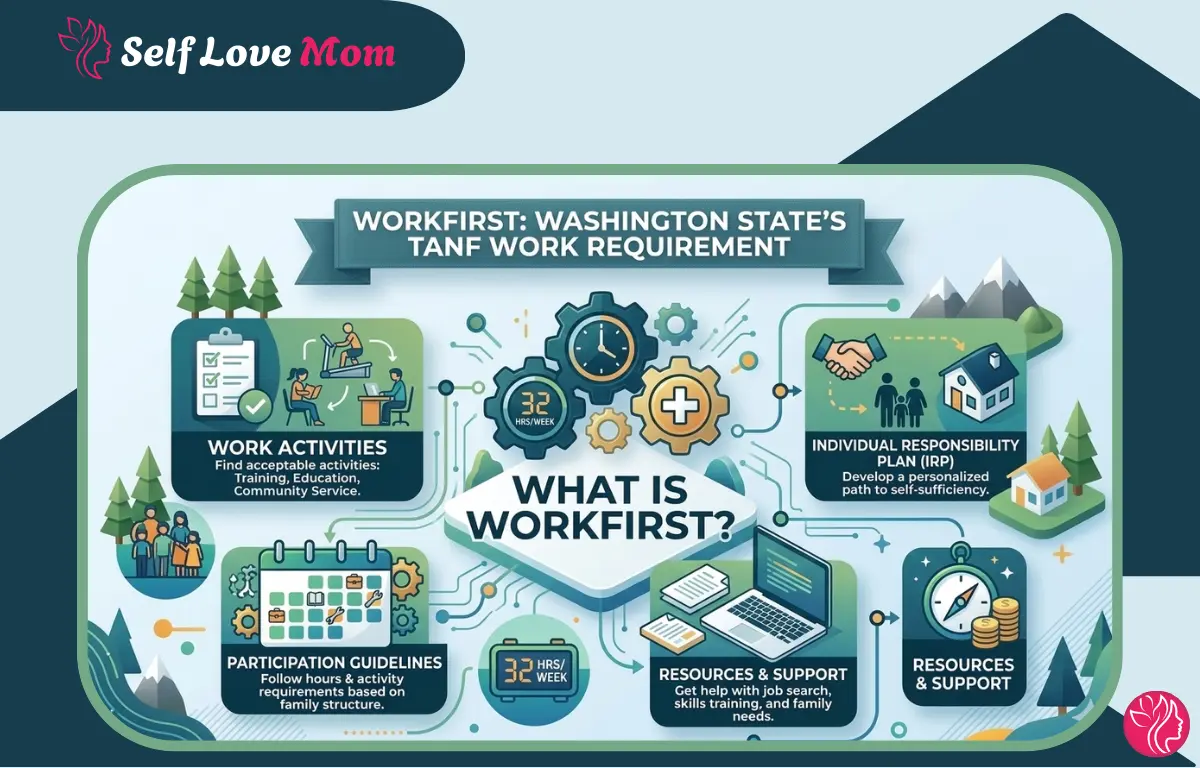
In TANF WA, most adults receiving TANF must be enrolled in WorkFirst, which is the employment readiness program in Washington. WorkFirst is not a uniform requirement at all; it is designed to meet the needs of each individual via an Individual Responsibility Plan (IRP) created with a case manager.
Common activities of WorkFirst include:
- Actively searching for employment
- Attending job skills training or vocational programs
- Completing community service
- Enrolling in adult education or GED programs
Participants are usually supposed to take around 30-40 hours per week of approved WorkFirst activities. Once approved, new applicants will undergo a WorkFirst orientation, and the IRP will be developed.
WorkFirst Exemptions
You may be exempt from WorkFirst participation if you:
- Are you the sole caregiver for a child under 2 years old
- Have a physical or mental health condition verified by a medical professional
- Are you caring for a family member with a disability
- Qualify under the “good cause” exemption for other significant caregiving burdens
Single moms — read this
If you have a child under 2 at home and you’re the only caregiver, you are likely exempt from WorkFirst. Mention this at your first appointment. Don’t let the work requirement stop you from applying.
How Long Can You Receive TANF in Washington State?
In Washington State, adults can receive TANF for a lifetime maximum of 60 months (5 years). Each month, you get a TANF grant, which includes your own adult benefits, and this counts towards this limit.
Child-Only TANF Does Not Count Toward the Limit
If you are a grandparent, relative, or non-parent caregiver applying for a child-only grant, meaning you are not requesting benefits for yourself, those months do not count toward the 60-month clock.
Can the Time Limit Be Extended?
Yes. TANF in Washington State may extend beyond 60 months if:
- The family received benefits during a month when the statewide unemployment rate was 7% or higher
- A household member has a documented physical or mental disability
- Other extenuating circumstances recognised by DSHS
✅ If you’re approaching your time limit: Don’t wait until your benefits run out. Call 877-501-2233 or contact your case manager right away to discuss your extension options before the clock runs out.
How to Apply for TANF in Washington State?
The TANF Washington State application can be submitted in several ways:
Apply Online
Apply TANF Washington State application through the Washington Connection. Run the TANF Washington State calculator before you submit; no paperwork required.
Portal: washingtonconnection.org
By Phone
Call to apply with a live representative who will walk you through every step of the application.
TANF Helpline: 1-877-501-2233
TTY: 1-800-521-0597
In Person
Go to any DSHS Community Services Office (CSO). Recommended for complicated cases or for families who require faster processing.
Find your office: dshs.wa.gov/esa/community-services-offices
Mail or Fax
Download a form. Fill it out, then send it by mail or fax to the Community Services Office of your local DSHS.
Download form: dshs.wa.gov
Fax/mail address: Please contact your local CSO for the appropriate number and mailing address.
What Documents Are Needed to Apply for TANF in Washington State?
To apply for TANF Washington State, you must have the right paperwork. Here’s what to have ready:
After submission, DSHS will arrange a verification interview, either by phone or in person. Once your application is approved, your monthly benefit will be deposited into your EBT card or bank account, and you will receive WorkFirst orientation information, if applicable.
💡 Homeless or in a crisis situation?
Make sure to clearly note this on your application. It can help flag your case for expedited processing so you get help faster.
How Long Does TANF Approval Take?
DSHS is required to process your application within 30 days. After you file, anticipate having a verification interview by phone or in person within 1–2 weeks. Once you are approved, benefits are generally loaded to your EBT card within a couple of business days.
The most common reason for TANF in Washington State delay is the lack of documents. Have everything ready before you apply to keep things moving. If you have not received a response after two weeks, call 877-501-2233 to inquire about your status.
What Happens If Your TANF Application Is Denied?
If your application for TANF in Washington State is denied, DSHS will mail a written notice stating the reason for the denial. Common reasons include:
- Income exceeding the limit for your household size
- Missing or incomplete documents
- Missed verification interview
- Failure to meet eligibility criteria (e.g., residency, immigration status, or no qualifying child)
Before you take action, you should generally call your caseworker. Many denials can be reversed with a phone call.
If you still disagree with the decision, you have the right to:
- Request a fair hearing within 90 days by calling 877-501-2233 or visiting your local CSO.
- Keep your existing benefits at their prior level if you appeal within 10 days of receiving a notice of cut or termination.
- Get free legal assistance through the Northwest Justice Project at nwjustice.org.
This gives you the option to address the denial promptly and ensure that you’re receiving the benefits you’re entitled to.
Non Needy TANF Washington State: A Special Program
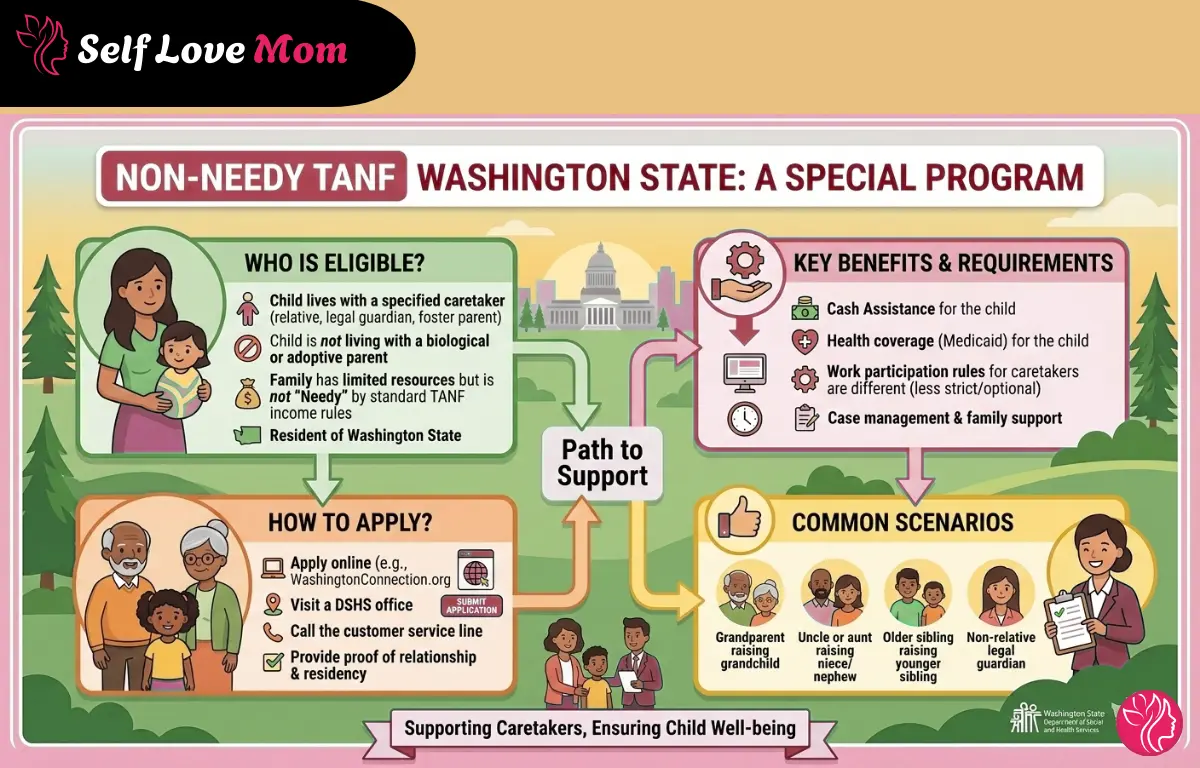
In Washington state, there is a special program called Non Needy TANF that allows a child to receive TANF cash benefits even when the caretaker (the adult in the household) is not eligible, such as an undocumented immigrant or has reached their federal lifetime TANF limit.
How It Works
In a non-needy TANF case, the grant is calculated based only on the child’s needs, resulting in a lower benefit amount. The caretaker’s income is still counted when determining the child’s eligibility and benefit amount, but the adult is excluded from the grant itself.
This is an important option for mixed-status families in Washington State, where children are U.S. citizens, but parents are not.
TANF Washington State Phone Number & Key Contacts
Need help with your TANF in Washington State case, or want to start your application over the phone? Here are the key contacts for Washington State DSHS TANF:
Ready to Apply? You Don’t Have to Figure This Out Alone 💛
TANF in Washington State is a comprehensive bridge, not just a check. If you think your family might qualify, just apply. It takes 20 minutes online and costs nothing to try. You deserve this support, mama.
📞 Call: 877-501-2233
🏢 Or walk into your local DSHS Community Services Office
FAQs on TANF in Washington State
What happens if my TANF application is denied?
DSHS will send a written notice stating the reason for the most common causes being lack of documentation or income above the limit. You can call your caseworker to straighten it out, or ask for a fair hearing within 90 days.
Can I receive TANF in Washington State if I’m working?
Yes. Wages are calculated at only 50% of their value, plus a $500 earned income disregard, so benefits phase out as you earn more; they don’t stop as soon as you get a job.
How long does it take to get approved for TANF in Washington State?
DSHS must process your application within 30 days. Expect a verification interview within 1–2 weeks, and benefits will be loaded to your EBT card shortly after approval.
Can undocumented immigrants or mixed-status families get TANF?
Undocumented adults are not eligible for federal TANF, but US-citizen children in the home can still receive child-only benefits through Non-Needy TANF. Some adults may also qualify for the State Family Assistance program
Do I have to participate in WorkFirst to receive TANF?
Most adults are required to participate in 30-40 hours a week of WorkFirst activities, such as looking for work or attending skills training. You might be exempt if you care for a child under 2 years old, have a medical condition, or meet the criteria for a “good cause” exemption.
How Long Can You Receive TANF in Washington State?
Adults in Washington State can receive TANF for a lifetime maximum of 60 months (5 years). Extensions may be available in cases of documented disability, economic hardship, or if the statewide unemployment rate was 7% or higher.