
Quick Summary
2026 SNAP Update: New benefit amounts took effect October 1, 2025 and run through September 30, 2026. The minimum benefit is $24/month, maximums increased across all household sizes, and work requirements expanded for some adults, but pregnant women are completely exempt, no matter what trimester they’re in. So, if you’ve been asking, “can I receive food stamps while pregnant?” Yes, you absolutely can.
Growing a baby is already one of the hardest things your body will do. Worrying about whether you can afford groceries on top of that is a stress no pregnant woman should have to carry alone. So here’s the straight answer to “can I receive food stamps while pregnant”: yes, absolutely — and applying is worth every minute it takes. This guide gives you the accurate 2026 SNAP rules, the real benefit numbers, and a clear picture of what to expect so you can apply with confidence.
Max Benefit
Single Person
Max Benefit
Family of 4
Average Benefit
Per Person
Minimum Benefit
(Up from $23)
What Are Food Stamps (SNAP) in 2026?
Most people still call it food stamps, but the official name is SNAP — Supplemental Nutrition Assistance Program. It’s a federal program run by the USDA that loads monthly grocery money onto an EBT card, just like a debit card at most supermarkets and farmers’ markets. If you’ve been asking, “can I get food stamps if I’m pregnant?” — yes, and this program was honestly built for exactly your situation. Every October, the USDA updates benefit amounts, and the FY 2026 increase is real money that matters when you’re eating for two on a tight budget.
Can I Receive Food Stamps While Pregnant — At Any Stage?
When you asked, can I receive food stamps while pregnant at any stage? The answer is Yes, and there’s no reason to wait. You can receive food stamps while pregnant at any stage, whether you just found out or you’re heading into your third trimester. Applying early matters because your benefits are retroactive to your application date. The sooner you file, the sooner that money starts working for you.
Being pregnant doesn’t slow down your approval or affect your work exemption status. Your pregnancy is a completely valid reason to apply, and a simple doctor’s letter or prenatal record is all you need to document it. Can I receive food stamps while pregnant in any trimester? Yes, first, second, or third — it makes no difference.
“Your unborn baby counts toward your household size, so you automatically get higher benefits during pregnancy.”
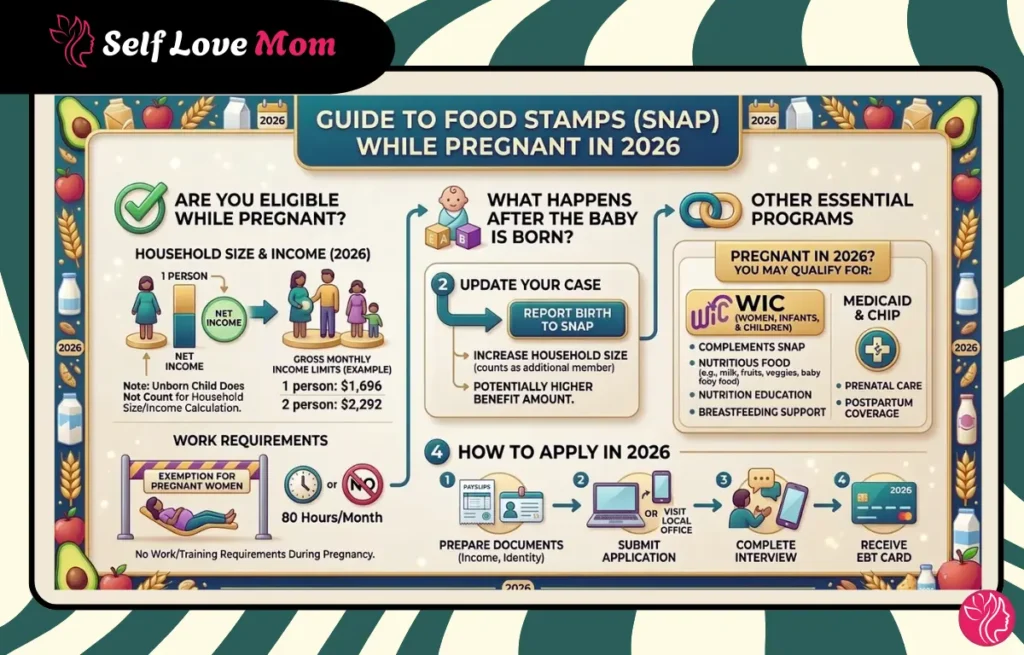
Under federal SNAP rules, a household is defined as people who live together AND purchase and prepare meals together. An unborn child is not counted in your household size until after birth. Pregnancy alone does not raise your household count, income limit, or maximum benefit.
A single pregnant woman with little or no income is counted as a 1-person household and qualifies for up to $298/month. Once the baby is born and you report it, your household becomes 2 people, and the maximum rises to $546/month.
This is honestly one of the most misunderstood things about whether you can receive food stamps while pregnant — so don’t let it catch you off guard.
$298/month is still real, meaningful grocery money. And pairing SNAP with WIC (which does count your unborn baby) gives you much broader coverage during pregnancy. More on that below.
Can I Receive Food Stamps While Pregnant? — 2026 Eligibility Explained
Pregnant food stamps eligibility comes down to three things: household size, income, and assets. Most states use Broad-Based Categorical Eligibility (BBCE), which can waive asset limits entirely — so don’t count yourself out before checking your state’s rules. If you’re asking, can I receive food stamps while pregnant on a low income, the income thresholds below are more forgiving than most people expect.
1. Official FY 2026 Income Limits and Maximum Benefits
Your gross monthly income (before taxes) must be at or below 130% of the Federal Poverty Level. Your net income (after deductions) must be at or below 100% of the FPL. These are the official USDA numbers for the 48 contiguous states and D.C., effective October 1, 2025:
| Household Size | Max Monthly Benefit | Gross Limit (130% FPL) | Net Limit (100% FPL) |
|---|---|---|---|
| 1 person (single pregnant woman) | $298 | $1,696 | $1,305 |
| 2 people (after baby is born) | $546 | $2,292 | $1,763 |
| 3 people | $785 | $2,888 | $2,221 |
| 4 people | $994 | $3,483 | $2,680 |
| 5 people | $1,183 | $4,079 | $3,138 |
During pregnancy, your SNAP household size is based only on people already living with you. If you live alone, you’re a 1-person household (max $298/month). If you live with a partner, that’s 2 people (max $546/month). After your baby is born, call your SNAP office right away — that’s when your household size officially increases, and your benefit goes up.
2. Asset Limits (2026)
Most households need $3,000 or less in countable assets. If someone in your home is 60+ or has a disability, the limit is $4,500. Your home doesn’t count as an asset at all. And since most states use BBCE rules, a lot of applicants face no asset limit whatsoever. So if asset limits were the thing holding you back from asking can I receive food stamps while pregnant — you likely have nothing to worry about. Most pregnant SNAP applicants pass this check without any issues.
3. Other Things You’ll Need
- U.S. citizenship or legal residency — qualified non-citizens with 5+ years of lawful residence generally qualify.
- State residency — apply in the state where you’re living right now.
- Proof of pregnancy (optional but smart) — a doctor’s letter or prenatal record isn’t required to apply, but it’s what gets you exempted from work requirements. Bring it.
Work Requirements in 2026 — And Why They Don’t Apply to You
Work requirement rules got stricter in 2026 for a lot of adults. The One Big Beautiful Bill Act expanded the 80-hour/month work or training rule to more able-bodied adults ages 18-64, with the child exemption narrowed to children under 14 in most states.
But if you’re asking whether I can receive food stamps while pregnant without working, yes, completely. Pregnant women are fully exempt in every trimester and in every state, with no exceptions.
✅ Pregnant Women Are Fully Exempt
Pregnant women are fully exempt from SNAP work requirements — in every trimester, every state, every situation. This has been federal SNAP policy for years, and nothing changed in 2026. You don’t need to be working, registered for work, or enrolled in any training program. Your doctor’s letter confirming the pregnancy is all your caseworker needs to note the exemption in your file.
Can You Get Food Stamps While Pregnant and Working?
Yes — having a job doesn’t disqualify you at all. SNAP is income-based, not employment-based. As long as your household income falls within the 2026 limits, you can qualify whether you’re working full-time, part-time, or not working at all.
Something that surprises a lot of working applicants: earned income can actually help your benefit calculation because SNAP builds in deductions that lower your countable income:
- 20% earned income deduction — a fifth of your wages is automatically excluded from your countable income.
- Standard deduction — $209/month is knocked off automatically for households of 1-3 people, regardless of income.
- Dependent care deduction — if you’re paying for childcare to keep working, that full cost is deducted.
- Excess shelter deduction — if your rent and utilities together exceed 50% of your net income, the excess is deducted, which can significantly raise your benefit.
Run the numbers before assuming you won’t qualify. Many working moms are surprised by how much they get. Some common concerns are:
- Can I receive food stamps while pregnant and still hold a job? Yes — your income just changes the amount, not your eligibility.
- Can I receive food stamps while pregnant part-time? Absolutely — even $800/month income still qualifies most single-person households.
How Much Do You Get If You Can Receive Food Stamps While Pregnant?
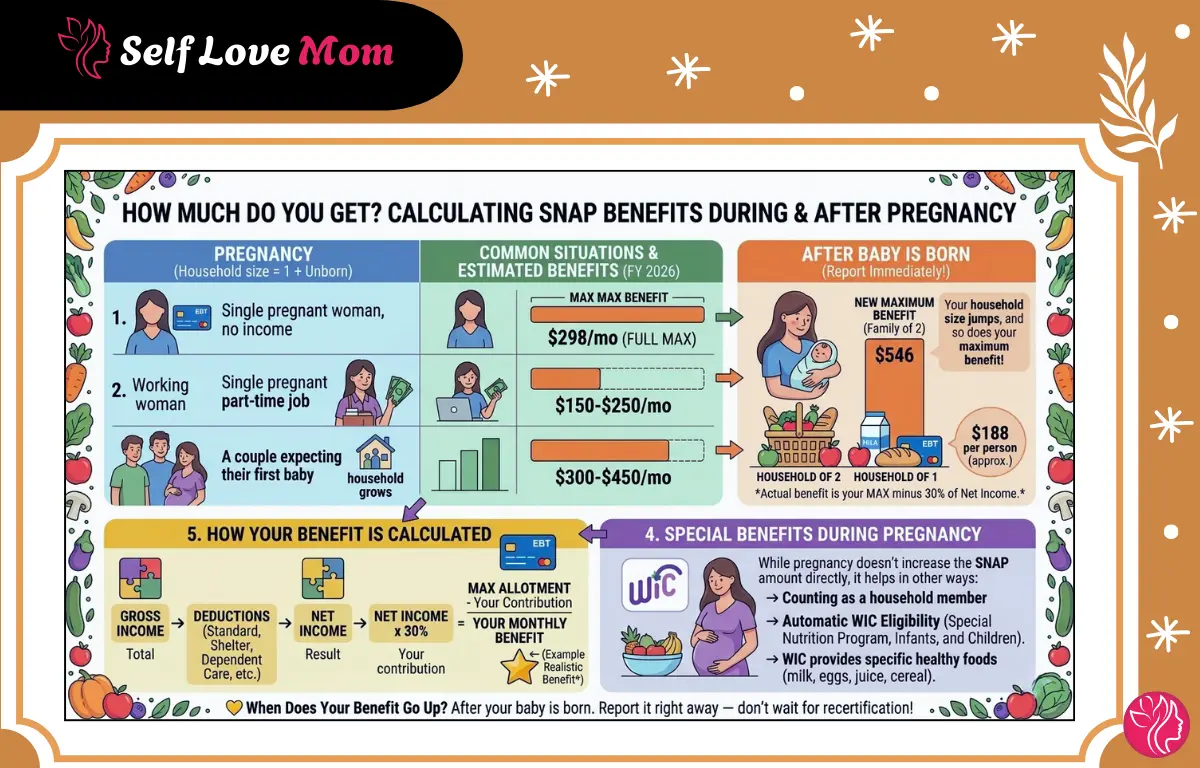
A question almost every expectant mom types at some point: how much does a pregnant woman get on food stamps? Your actual benefit is calculated using this formula: Maximum benefit for your household size minus 30% of your net income. Here’s what that looks like in practice for common situations a pregnant woman might be in:
| Situation (During Pregnancy) | SNAP Household Size | Max Benefit | Example Realistic Benefit* |
|---|---|---|---|
| Single pregnant woman, no income | 1 person | $298/mo | ~$298/mo (full max) |
| Single pregnant woman, part-time job | 1 person | $298/mo | ~$150-$250/mo |
| A couple expecting their first baby | 2 people | $546/mo | ~$300-$450/mo |
| Family of 2 kids + pregnant mom | 3 people | $785/mo | ~$450-$650/mo |
| After the baby is born (single mom, newborn) | 2 people | $546/mo | ~$400-$546/mo |
After your baby is born. That’s when you report the birth to your SNAP office, your household size officially increases from 1 to 2, and your maximum benefit jumps from $298 to $546/month. Report it right away — don’t wait for your recertification date.
What Can You Buy With SNAP While Pregnant?
Once you confirm you can receive food stamps while pregnant, you’ll want to know exactly what that EBT card covers. It works like a grocery debit card at most major supermarkets, corner stores, and many farmers’ markets. You can buy everything your body and your baby need:
- Fresh, frozen, and canned fruits and vegetables
- Meat, poultry, and seafood
- Dairy — milk, cheese, yoghurt, and eggs
- Bread, rice, pasta, cereals, and grains
- Snacks and non-alcoholic drinks
- Seeds and plants that produce food at home
A growing number of states now have USDA-approved waivers banning SNAP purchases of soda, candy, and energy drinks. Indiana, Iowa, Nebraska, Utah, and West Virginia already have active restrictions. Florida, Texas, and several others are rolling these out in 2026. Check your state’s rules so you’re not caught off guard at checkout.
How to Apply — Step-by-Step Guide to Receiving Food Stamps While Pregnant
The process is easier than most people expect. If you’ve confirmed you can receive food stamps while pregnant, here’s exactly how to apply for food stamps while pregnant, step by step.
Check Your Eligibility First
Head to your state’s SNAP website or use the free pre-screener at fns.usda.gov. Enter your actual household size — just the people currently living with you, not your unborn baby — and your gross income for a quick estimate.
Gather Your Documents
You’ll need a photo ID, proof of address (a utility bill or lease works), recent pay stubs as proof of income, and a doctor’s letter or prenatal records confirming your pregnancy. That last one is specifically what gets you the work exemption — don’t skip it.
Submit Your Application
You can apply online through your state portal, mail in a paper form, or walk into your local SNAP office. Most states have a fully digital process that takes 20-30 minutes. Your benefits are retroactive to your application date, so don’t delay filing.
Complete Your Eligibility Interview
Almost every state requires a short phone interview. They’ll ask about your income, household, and pregnancy status. Have your prenatal paperwork ready, so your caseworker can note the work exemption right away. Pregnant women often get priority scheduling.
Receive Your EBT Card
If approved, your EBT card will arrive within 30 days. If you’re in a real pinch — less than $150/month gross income and under $100 in resources — you may qualify for expedited emergency benefits within 7 days of applying.
Other Programs to Stack With SNAP While Pregnant
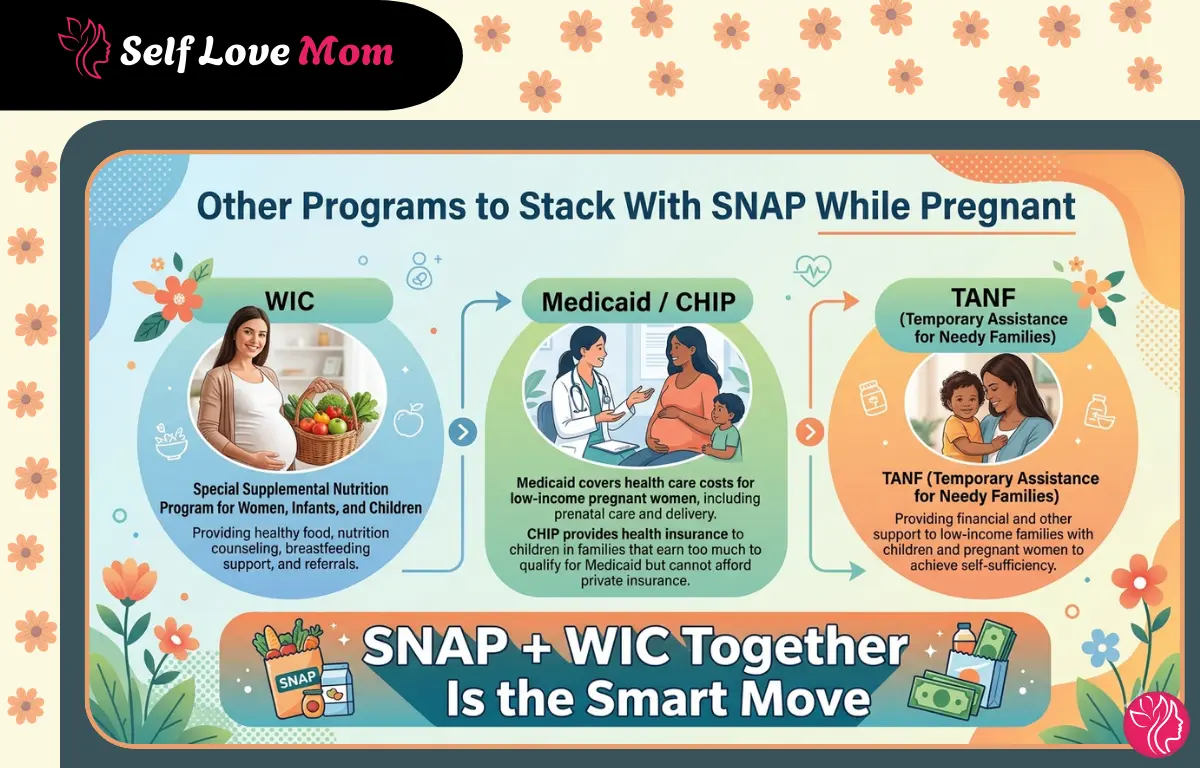
Knowing you can receive food stamps while pregnant is just the beginning. SNAP benefits for pregnant women work best when stacked with these other programs, and you can hold all of them at the same time:
WIC (Women, Infants, and Children)Here’s the key difference: WIC does count your unborn baby. That’s why applying for WIC while pregnant is so valuable — it covers specific food packages (eggs, dairy, whole grains, produce, baby formula), prenatal vitamins, and nutrition counselling. It’s a separate application from SNAP, but you can hold both at the same time.
Medicaid / CHIPCovers prenatal appointments, lab work, ultrasounds, and delivery if you meet income thresholds. Many states now share data between SNAP and Medicaid systems, so one application can sometimes trigger enrollment in both.
TANF (Temporary Assistance for Needy Families)Monthly cash assistance for low-income families. In many states, receiving TANF automatically qualifies your household for SNAP without a separate income review.
SNAP gives you grocery flexibility. WIC covers specific nutritional needs during pregnancy that SNAP doesn’t target. They work together, not against each other. When you apply for SNAP, ask your caseworker about a WIC referral at the same appointment.
You’ve Earned This Support — Apply Today
So, when you asked, can I receive food stamps while pregnant in 2026? Yes — and you should apply today. Your benefit during pregnancy is based on your current household size, not your unborn baby, so a single pregnant woman can get up to $298/month right now, jumping to $546/month after delivery once you report the birth.
You’re fully exempt from work requirements, the application is mostly digital, and benefits go back to your application date, no matter when you’re approved. File today. Your baby is worth it, and so are you.
FAQs on Can I Receive Food Stamps While Pregnant
Can I receive food stamps while pregnant, even in my first trimester?
Yes, absolutely. Pregnancy qualifies you from day one — there is no waiting period or trimester requirement. As soon as you find out you’re pregnant, you can apply, and your unborn baby counts toward your household size.
Do you get more food stamps if you’re pregnant with twins?
Yes! Each baby counts as a separate household member, so twins mean two extra people added to your household size. More household members means a higher monthly benefit — it’s that straightforward.
What happens to my SNAP benefits after my baby is born?
Once your baby is born, report the birth to your SNAP office right away. Your household size increases from 1 to 2, and your monthly benefit jumps from $298 to $546 automatically.
Do the new 2026 SNAP work rules affect me as a pregnant woman?
No, pregnant women are fully exempt from the new 80-hour monthly work requirement, at any stage of pregnancy. Just make sure you mention your pregnancy clearly during your eligibility interview so the exemption is properly documented.
Is WIC the same as SNAP? Do I need both?
They are completely separate programs — SNAP is for groceries broadly, while WIC covers specific foods like milk, eggs, and formula designed for pregnancy and early childhood. Applying for both is absolutely worth it because they work together and don’t affect each other’s benefits.