Mom Rage: A Psychologist's Guide to Breaking the Cycle
Mom rage is not a character flaw. In one study, 91% of mothers named ordinary child behavior as the trigger. A psychologist on the causes and the fix.

 Click to zoom
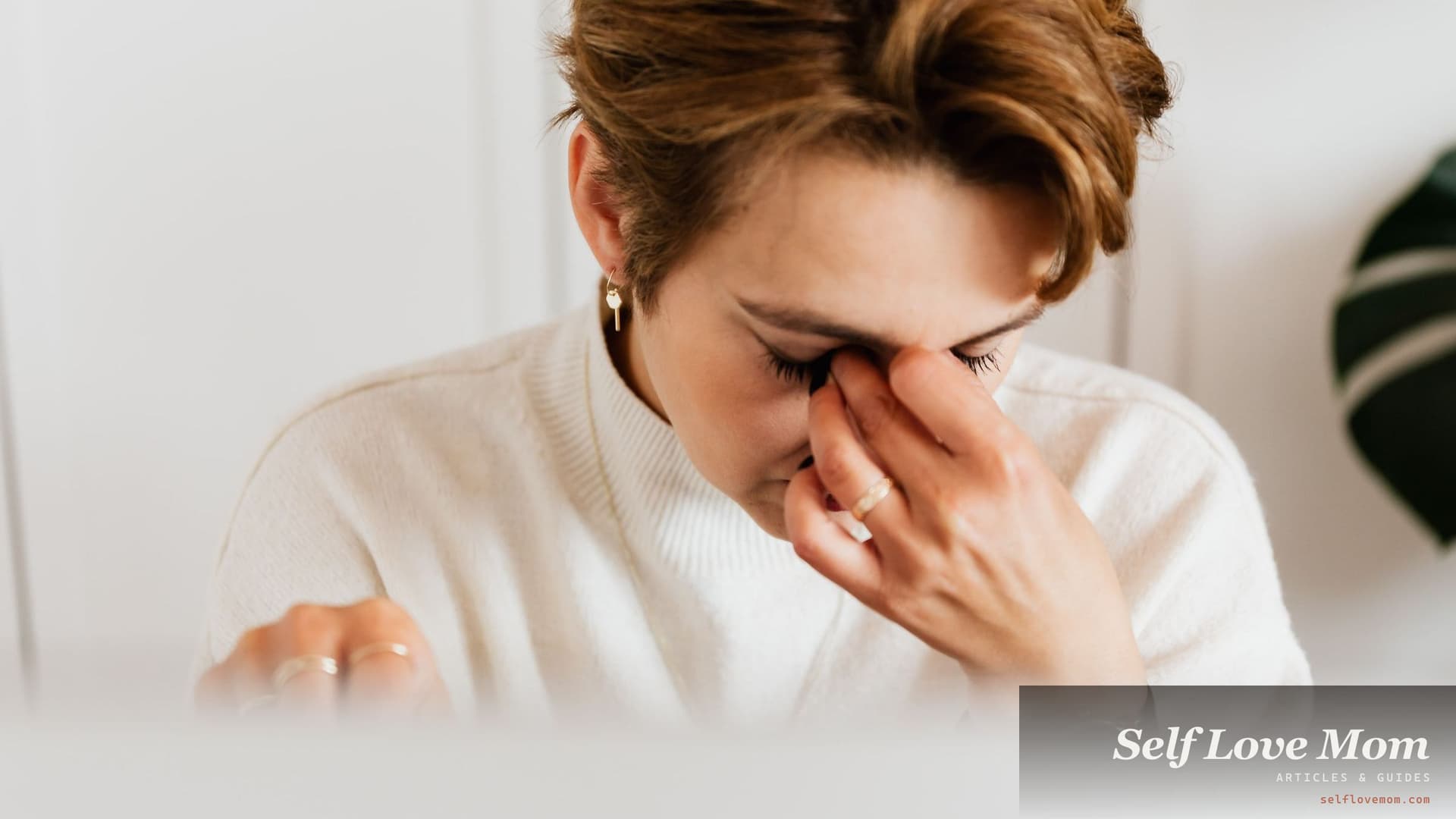
A mother closes her eyes and presses a hand to her forehead at her limit while her young son sits close beside her.
You did not turn into a different person when you had kids. But if you have screamed at a four-year-old over a spilled cup, then sat on the bathroom floor afterward wondering what is wrong with you, you have met mom rage. It has a name because it is common, and it has causes that are not moral failings.
Here is the part most articles skip. Nearly every coping guide assumes a second adult is home. Hand the baby to your partner. Agree on a code word. That advice is useless when you are the only adult in the house, and solo parents carry the most isolation of anyone: 77% of single parents report loneliness, against 55% of non-parents.
| What was measured | Figure | Why it matters |
|---|---|---|
| Mothers whose anger was set off by child behavior | 91% | The trigger is ordinary, not extreme |
| Mothers who felt the anger in their body | 86% | It shows up physically, not only in words |
| Single parents reporting loneliness | 77% | Isolation is a structural driver |
| Parents too stressed to function most days | 41% | Against 20% of other adults |
The short version
Mom rage is intense, poorly controlled anger tied to mothering, and researchers connect it to powerlessness and unmet needs rather than character. Among 65 mothers studied in 2023, 91% named child behavior as the trigger and 86% felt it in the body. The answer is not more patience. It is protecting sleep, cutting load where you can, using an exit that needs no second adult, and repairing afterward.
What is mom rage, and is it normal?
It is a recognized pattern, not a diagnosis. In 2023, researchers in the journal Sex Roles defined it as "uncontrollable episodes of intense anger associated with mothering that are not goal directed and may derive from feelings of powerlessness, injustice, and stress" (Billotte Verhoff and Sanford, Sex Roles, 2023). You will not find mom rage in a diagnostic manual. You will find it in the research literature.
That distinction matters more than it sounds. Because it is not a diagnosis, nobody screens you for it, and most mothers never say it out loud. The same study found 89% of participants had expressed the anger emotionally, through screaming or shouting, and 45% had expressed it physically. Those are not rare outliers. That is most of the room.
Postpartum Support International describes the pattern as a cycle with three parts: a buildup of stress and overstimulation, an explosion, then the aftermath of guilt and shame. If the guilt half of that cycle is the part that follows you around all day, our guide to why mom guilt feels so heavy deals with it directly.
What actually causes mom rage?
Ordinary friction, stacked on an empty tank. When those 65 mothers were asked what set off their most recent episode, 91% pointed to child behavior, and the examples were mundane: siblings bickering, a toddler refusing shoes. Only 15% named physiological factors such as hormones. The trigger is rarely the cause. The depletion underneath it is.
Look at what sits in second and third place. Unmet personal needs at 62%, and time pressure at 58%. Both describe a person running a deficit, not a person with an anger problem. One participant put it plainly: "I was tired and hungry and hadn't slept enough."
Sleep is the input with the hardest evidence behind it. In a 2019 experiment published in the Journal of Experimental Psychology: General, 142 adults were randomly assigned to either keep their usual sleep or cut it by two to four hours for two nights. Restricted sleep intensified anger across the board and reversed the normal pattern of adapting to an irritating noise.
Why does mom rage hit harder when you parent alone?
Because every standard coping tool assumes someone else is in the building. The 2024 US Surgeon General advisory on parents found 41% of parents say most days they are so stressed they cannot function, against 20% of other adults, and 48% say the stress is completely overwhelming. For single parents the isolation figure is starker still, at 77% reporting loneliness.

There is a quieter problem with the evidence itself, and it is worth naming. In that 65-mother study, 73.8% of participants were married and 74% held a four-year degree or higher. The foundational research on mom rage was largely conducted on partnered, well-resourced mothers. The advice built on top of it inherits those assumptions.
So when the standard guidance says to tap out and let your partner take over, or to agree on a code word with your spouse, it is not bad advice. It is advice written for a household you do not have. If your isolation is the load-bearing problem, free single mom support groups are a more honest starting point than a breathing exercise.
The other structural piece is that you cannot outsource the recovery. A partnered mother who loses her temper can hand over bedtime and go decompress. You finish bedtime. That is why the strategies below are built for one adult, and why repair matters more here than prevention.
How long does mom rage last?
The episode is short. The pattern is not, unless something changes. A single surge of anger typically peaks and drops within minutes, which is why the thirty seconds after you notice it are the ones that count. What persists is the cycle, because the conditions that produced it are still there tomorrow morning.
Timing looks different if you are in the first year after birth. Cleveland Clinic describes postpartum rage as most common "within the first six weeks to one year after you give birth," driven partly by steep drops in estrogen and progesterone. Outside that window, hormones are a much smaller part of the picture, which fits the 15% who named physiological factors in the chart above.
If the anger has been constant for months and arrives alongside exhaustion, numbness, and dread about the day ahead, you may be looking at burnout rather than isolated episodes. Our piece on how long burnout actually takes to lift covers that timeline honestly.
How do you stop mom rage in the moment?
You interrupt it at the body signal, before the words start. In that study, 86% of mothers felt it physically, as a clenched jaw, a racing heart, or muscle tension. The research did not test whether that sensation comes first, but it is the cue you can practice catching. The steps below need no second adult.
- Name the body signal out loud, even just "my jaw is tight." Naming an emotion reliably takes some heat out of it.
- Put your child somewhere safe first. A crib, a playpen, a car seat, or a room with the gate up. Safety before space, always.
- Step out of eye line for sixty seconds. The bathroom counts. A hallway counts. You are not abandoning anyone.
- Breathe out longer than you breathe in. Four counts in, seven or eight counts out, three times.
- Drink water and eat something if you have not in hours. Two of the top three triggers are unmet physical needs.
- Come back and say one sentence about what happened. Not an essay. One sentence.
None of that lowers your actual load, and it would be dishonest to pretend it does. Over weeks, the things that move the needle are sleep you defend like a bill that must be paid, one recurring block of childcare, and lowering the standard on something visible. Our guide to self-care that fits a single mom's budget and schedule is built around exactly those constraints.
If the episodes are frequent, or you are frightened by what goes through your mind during them, that is the point to bring in a professional rather than a checklist. There are low-cost and free therapy routes for single mothers that do not require good insurance.
How do you repair with your child after you snap?
Repair is the part that protects the relationship, and it is the part most guides rush past. Children are not damaged by a parent who loses her temper and comes back. They are affected by anger that goes unacknowledged, becomes frightening, or never gets followed by reconnection. The rupture is not the injury. The silence after it is.

A repair does not need to be long or tearful. Get to their eye level, name what you did without excusing it, name the feeling, and then be warm. "I yelled and that was not okay. I was very frustrated, and it was not your fault. I love you." Then move on and let it be over.
Two things to avoid. Do not make your child comfort you, because that quietly hands them a job that is not theirs. And do not promise it will never happen again, because you will break that promise and they will learn your apologies are unreliable. Promise you will keep working on it instead.
The guilt afterward is often heavier than the incident. That guilt is worth managing on its own terms, and simple stress techniques that work in short bursts are more useful than a long apology loop.
Frequently asked questions
What are the symptoms of mom rage?
Cleveland Clinic lists lashing out when you normally would not, an urge to scream, punching objects or slamming doors, losing your temper, swearing or yelling more than usual, extreme irritability, dwelling on an incident, and feeling unable to cope. Most mothers also report a physical component, such as a tight jaw or racing heart.
Is mom rage the same as postpartum rage?
No, though they overlap. Postpartum rage is tied to the period after birth, and our guide to how long postpartum rage lasts covers that window in detail. Mom rage describes the same anger at any stage of motherhood, including in mothers of school-age and teenage children.
What is depleted mother syndrome?
It is a popular term, not a clinical diagnosis, and you will not find it in any diagnostic manual. It describes the exhaustion, resentment, and short fuse that build when a mother's own needs go unmet for a long stretch. The underlying experience is real and overlaps heavily with parental burnout and maternal anger.
What medication is used for mom rage?
There is no medication for the pattern itself, because it is not a diagnosis. Where the anger is a symptom of postpartum depression or anxiety, Cleveland Clinic notes that SSRIs or SNRIs may be prescribed alongside psychotherapy and support groups. That is a conversation for a doctor who can assess what is actually driving it.
Does an angry parent damage a child?
Occasional anger followed by genuine repair is not what harms children. Sustained hostility, frightening outbursts, and anger that is never acknowledged do carry risk. The protective factor is reconnection: naming what happened, taking responsibility without making your child manage your feelings, and returning to warmth reasonably quickly.
When should you get professional help for mom rage?
Seek help if the anger is frequent, if you have frightening thoughts about harming yourself or your child, if you have acted on it physically, or if it comes with low mood and hopelessness. Cleveland Clinic advises contacting a provider for intense anger or a sense of having no control over your temper.
The bottom line
Mom rage is a signal about your conditions, not a verdict on your character, and the research points at depletion and isolation rather than temperament. You cannot always lower the load, especially alone. You can catch the body signal, take sixty seconds, repair properly afterward, and defend your sleep like it matters. Start with the one thing you can change this week.
Sources
- Billotte Verhoff, C. and Sanford, A., "A Fire in my Belly: Conceptualizing U.S. Women's Experiences of 'Mom Rage'," Sex Roles, 2023, retrieved 2026-08-01, pmc.ncbi.nlm.nih.gov
- Office of the U.S. Surgeon General, "Parents Under Pressure: The U.S. Surgeon General's Advisory on the Mental Health and Well-Being of Parents," 2024, retrieved 2026-08-01, ncbi.nlm.nih.gov
- Cleveland Clinic, "Postpartum Rage: Symptoms, Diagnosis and Treatment," retrieved 2026-08-01, my.clevelandclinic.org
- Krizan, Z. and Hisler, G., "Sleepy Anger: Restricted Sleep Amplifies Angry Feelings," Journal of Experimental Psychology: General, 2019, retrieved 2026-08-01, psycnet.apa.org
- Postpartum Support International, "Mom Rage: Causes, Ways to Cope, and Reasons for Hope," retrieved 2026-08-01, postpartum.net
✻ Share this article

✻ About the contributor · Folio N°.177

Written by Subha
Psychologist and writer covering the topics that matter most to single moms, money, mental health, and the small daily rituals that keep a family running. Every article is research-backed and edited four times before publish.
- Articles
- 177
- Desks
- 05
- Edited
- 4×
More from this writer
✻ Edited four times before publish