
- Alaska’s ATAP (TANF) pays up to $923/month for a qualifying family of three, cash on a Direct Payment card
- The Alaska Permanent Fund Dividend gave every eligible resident $1,000 in 2025, kids included
- SNAP expanded in July 2025, covering up to $1,015/month in groceries for a family of three
- Heating assistance (LIHEAP) can cover up to $6,125 per season, paid straight to your heating vendor
- The Pell Grant gives up to $7,395/year for college and never has to be repaid
- Most state programs apply through one portal: my.alaska.gov or call 1-800-478-7778
Alaska is expensive. Childcare in Anchorage can run over $1,500 a month. Winter heating bills hit $400 to $600. Single moms here carry all of that on one income, in one of the priciest states in the country. But the grants for single mothers in Alaska are genuinely substantial, and most women aren’t using everything they qualify for.
This guide covers all active grants for single mothers in Alaska in 2026. Cash, food, healthcare, housing, childcare, and college funding. All verified from state and federal sources as of April 2026.
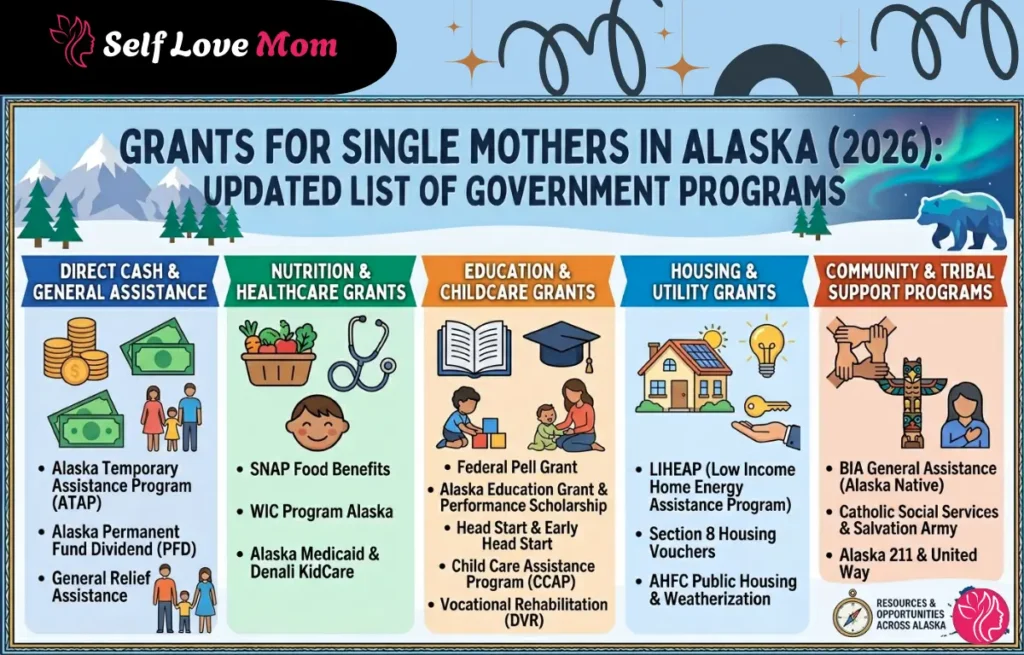
Direct Cash & General Assistance for Single Mothers in Alaska
The largest monthly cash grants for single mothers in Alaska come from ATAP and the PFD. Both are state-run, and most single moms qualify for at least one.
Alaska Temporary Assistance Program (ATAP)
ATAP is Alaska’s Temporary Assistance Program (TANF). It pays up to $821/month for a family of two, or $923/month for a family of three. No restrictions on what you spend it on. You have to do work activities, and there’s a 60-month lifetime limit for adults. ATAP recipients automatically qualify for reduced childcare costs through CCAP.
Alaska Permanent Fund Dividend (PFD)
The Alaska Permanent Fund Dividend is unlike anything in the lower 48. Every qualifying resident, including your children, gets an annual check just for living here. The 2025 PFD was $1,000 per person. A single mom with two kids got $3,000 in October 2025. No income requirement. Applications open from January 1 through March 31 each year.
General Relief Assistance
This is Alaska’s last-resort emergency program. It covers specific urgent needs: eviction notices, utility shutoffs, food and clothing. Net income must be under $500/month for one person, or $600 for two. You have to have tried other programs first. It won’t cover ongoing bills, just the immediate emergency in front of you.
Nutrition & Healthcare Grants for Single Mothers in Alaska
For grants for single mothers in Alaska that cover food and healthcare, these three programs are the most used. They’re federally funded, statewide, and most qualifying families are approved within 30 days.
SNAP Food Benefits
SNAP Alaska expanded in July 2025, raising the income limit to 200% of the Federal Poverty Level and removing the old asset cap entirely. A family of three now qualifies for up to $1,015/month in grocery benefits on an Alaska Quest card. Rural Alaska households often qualify for more. It’s one of the fastest grants for single mothers in Alaska to get approved for.
WIC Program Alaska
Alaska WIC covers pregnant women, postpartum moms up to six months, breastfeeding mothers through the baby’s first birthday, and children under 5. Income must be at or below 185% FPL. If you’re already on SNAP or Medicaid, you’re automatically income-eligible. Benefits include a monthly food package plus a produce voucher worth up to $52/month for breastfeeding moms.
Alaska Medicaid & Denali KidCare
Alaska Medicaid covers adults earning up to about $26,950/year (138% FPL): full coverage for doctor visits, prescriptions, mental health, dental, and vision. Denali KidCare extends that same coverage to children at up to 208% FPL, so your kids may qualify even if your income puts you just above the adult cutoff. Pregnant women are covered up to 230% FPL through 12 months postpartum.
Education & Childcare Grants for Single Mothers in Alaska
Education grants for single mothers in Alaska often go unused because women don’t realize they can stack them. Pell, the Alaska Education Grant, and the Performance Scholarship can all apply to the same student in the same year.
Federal Pell Grant
The Pell Grant is the foundation of college funding. The maximum award for 2025-2026 is $7,395/year and stays the same for 2026-2027. It’s not a loan. As a single parent, your FAFSA financial need score is typically high, which usually means the largest possible award. No separate application needed: file at studentaid.gov, and the award comes automatically once enrolled at least half-time.
Alaska Education Grant & Performance Scholarship
The Alaska Education Grant adds $500 to $4,000/year on top of Pell for Alaska residents with financial need at one of 11 qualifying state colleges. The Alaska Performance Scholarship adds $3,500 to $7,000/year for high school graduates from an Alaska school who have a qualifying GPA. Both require FAFSA. File early through acpe.alaska.gov because AEG funding runs out.
Head Start & Early Head Start
Head Start is a free, federally funded preschool for children ages 3-5. Early Head Start is for ages 0 to 3. If your family is a participant in the Alaska Temporary Assistance Program, SNAP or SSI, your child is in foster care, or you are homeless, you will qualify, no matter your family’s income. There are 17 programs serving over 100 communities in Alaska. There are often waiting lists, so apply as soon as possible at akheadstart.org.
Child Care Assistance Program (CCAP)
Alaska childcare assistance, known as CCAP or PASS, limits your monthly childcare co-pay to 9% of your family income and covers the rest with your licensed provider. You must be employed, enrolled in school or in an approved training program. Your family must make 85% or less of the Alaska State Median Income.
Vocational Rehabilitation (DVR)
If a physical or mental health condition creates barriers to work, Alaska DVR can fund training, education, job placement, and assistive technology. SSI and SSDI recipients qualify automatically. It’s one of the least-known grants for single mothers in Alaska, but a real resource for women with qualifying disabilities.
Housing & Utility Grants for Single Mothers in Alaska
Grants for single mothers in Alaska include real housing and heating support. Some have waitlists, so it’s worth knowing about them before you’re in crisis mode.
LIHEAP Heating Assistance Program
LIHEAP Alaska is one of the most generous heating programs in the country, which tracks with how brutal winters here can be. It runs from October 1 through April 30 and pays your heating vendor directly, one payment per season. In 2025, the range was $350 to $6,125 depending on household size, income, fuel type, and location. Rural families often receive the maximum. Income must be at or below 150% FPL.
Section 8 Housing Choice Voucher
Section 8 covers the difference between 30% of your income and the local rental market. Alaska’s housing voucher program is administered by the Alaska Housing Finance Corporation (AHFC) in 12 communities. The waitlist for Anchorage opened for a short period in April 2025, the first time since 2023, and closed almost immediately. The wait time is around 45 months. That’s a long wait, but families who applied during that period are now being prioritised.
AHFC Public Housing & Weatherization
The Alaska Housing Finance Corporation (AHFC) oversees more than 1,600 rental units across the state for families with incomes at or below 80% of Area Median Income (AMI). Applications are accepted year-round. Also, the Weatherization Assistance Program provides free home energy upgrades to eligible households: insulation, window sealing and furnace repair. It’s for both renters and owners. The income limit is around $39,100/year for 1 person.
Community & Tribal Support Programs
Beyond state and federal programs, Alaska has nonprofit and tribal resources that fill the gaps. These are especially useful while waiting on a state application or when you need help right now.
BIA General Assistance (Alaska Native)
Bureau of Indian Affairs Alaska Native assistance is for enrolled tribal members and provides cash for food, housing, utilities and clothing. It’s for people who don’t qualify for or have exhausted TANF. You must have applied for other programs first. Ask your tribal social services or call the BIA Alaska Regional Office (907) 271-4111.
Catholic Social Services & Salvation Army
Both organizations run emergency help programs across Alaska and don’t require religious membership. Catholic Social Services (cssalaska.org) assists with emergency rent, utilities, and housing case management in Anchorage and beyond. The Salvation Army runs a 16-room emergency family shelter in Anchorage (McKinnell House) and food assistance in 18 Alaska communities. No referral is typically needed.
Alaska 211 & United Way
If you’re unsure which grants for single mothers in Alaska apply to your situation, Alaska 211 is the best first call. Dial 2-1-1 or visit alaska211.org. It’s a free statewide referral service connecting you to every local program: food, housing, childcare, utilities, mental health, job referrals, and more. Available Monday through Friday, with multilingual support.
How to Apply for Grants for Single Mothers in Alaska
Nobody has time to figure out ten different applications while raising kids alone. Here is exactly what to do in order to apply for grants for single mothers in Alaska:
Pull together your ID, proof of Alaska residency, Social Security numbers for you and your kids, recent pay stubs, and any current bills or lease papers before you open a single application.
This is your best first stop. SNAP, Medicaid, ATAP, and childcare assistance all live here, and you can apply for more than one in the same session. Prefer the phone? Call 1-800-478-7778.
File at studentaid.gov as early as possible. It automatically unlocks the Pell Grant and opens the door to the Alaska Education Grant and Performance Scholarship on top of that.
LIHEAP runs only from October 1 through April 30. Do not wait until winter hits. Visit your nearest DPA office or call 1-800-478-7778 before the season opens to get your application in early.
The Alaska Permanent Fund Dividend application opens January 1 and closes March 31. Apply for every member of your household at mypfd.alaska.gov. Miss the window, and you wait a full year.
If you do not know where to start or which Alaska assistance programs fit your situation, dial 2-1-1. It is free, available in multiple languages, and connects you to every active local program. Let them do the sorting for you.
Start With the Most Urgent Need
You don’t have to apply for everything at once. Pick the most pressing thing first. SNAP and Medicaid both run through the Alaska Connect Portal and can be done in the same session. ATAP and CCAP can be added from there, too.
If you’re still not sure which grants for single mothers in Alaska you qualify for, call 2-1-1 and let them help you sort through them. That’s exactly what they’re there for.
FAQs on Grants for Single Mothers in Alaska
1
What are the easiest grants for single mothers in Alaska?
SNAP and Medicaid are the fastest to access. Most qualifying families are approved within 30 days and can apply for both at once through my.alaska.gov. The PFD is also straightforward, with no income verification, just residency.
2
Can I get housing assistance as a single mom in Alaska?
Yes. Section 8 vouchers, AHFC public housing, and the Weatherization Assistance Program are all available statewide. Section 8 waitlists open periodically at ahfc.us. AHFC-owned housing accepts rolling applications year-round with no waitlist to join first.
3
Where do I apply for grants for single mothers in Alaska?
To apply for grants for single mothers in Alaska, start by using my.alaska.gov, where you can apply online for programs like cash aid, SNAP, and more. You can also apply through the Alaska Department of Health Division of Public Assistance or visit a local office for in-person help.
4
Are there education grants for single mothers going back to school in Alaska?
Yes, and they stack. The Pell Grant (up to $7,395/year), the Alaska Education Grant ($500–$4,000/year), and the Alaska Performance Scholarship ($3,500–$7,000/year) can all apply to the same student. File FAFSA early at studentaid.gov.
Sources
- Alaska Temporary Assistance Program (ATAP), State of Alaska
- Alaska Permanent Fund Dividend, Department of Revenue
- General Relief Assistance, State of Alaska
- SNAP Nutrition Assistance, State of Alaska
- WIC Program, State of Alaska Department of Health
- Alaska Medicaid, State of Alaska
- Heating Assistance Program (LIHEAP), State of Alaska
- Alaska Housing Finance Corporation Programs
- ACPE Funding Solutions, Alaska Commission on Postsecondary Education
- Federal Pell Grant, U.S. Department of Education